
Kurdistan Oil Exports and India–Iraq Energy Relations: Macroeconomic Evidence and Strategic Implications
Dr. Mamta Singh’s op-ed analyzes India-Iraq energy ties, finding weak short-term but strong long-term links between oil prices and macroeconomic variables. It argues Kurdistan could become a key strategic energy partner for India through diversified, long-term cooperation.
By Dr. Mamta Singh
India and Iraq have maintained a long-standing and strategically important energy relationship shaped by crude oil trade, geopolitical continuity, and mutual economic dependence. Iraq has consistently remained one of India’s top oil suppliers, accounting for approximately 20% of India’s total crude oil imports in recent years, with a portion of this supply originating from the Kurdistan Region through regional export channels and intermediated trade routes. This relationship has deepened over time as India has sought to diversify its energy sources away from a narrow set of Gulf suppliers while ensuring stable access to medium-sour crude grades that are compatible with Indian refinery configurations. Indian refiners, many of which are specifically designed or adapted to process Iraqi crude, have further reinforced this structural dependency, making Iraq—notably including Kurdistan—a critical node in India’s energy security architecture.
Against this backdrop of strong bilateral energy dependence, India’s macroeconomic response to global oil price movements provides important insights into the resilience and limitations of its growth model.
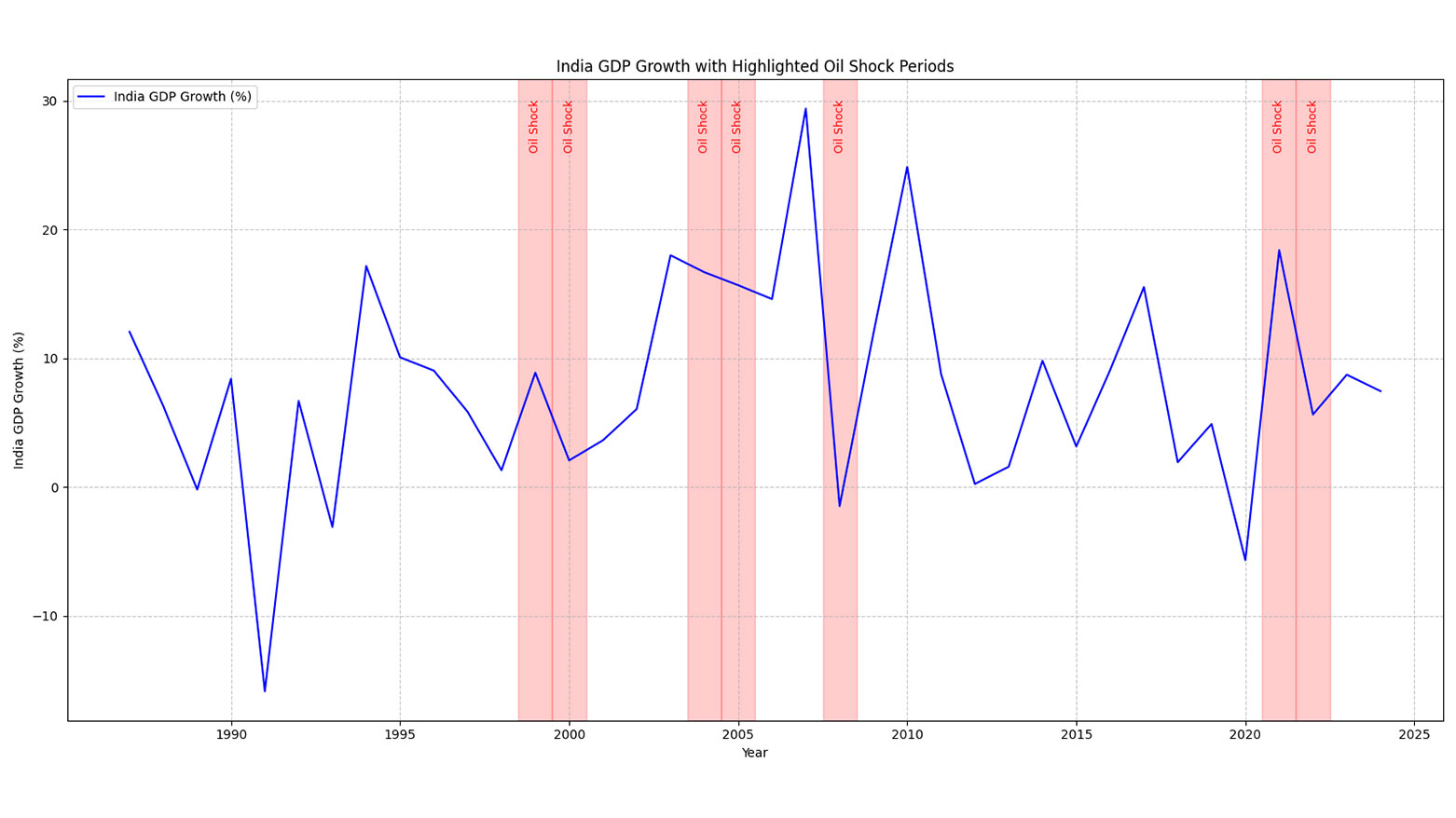
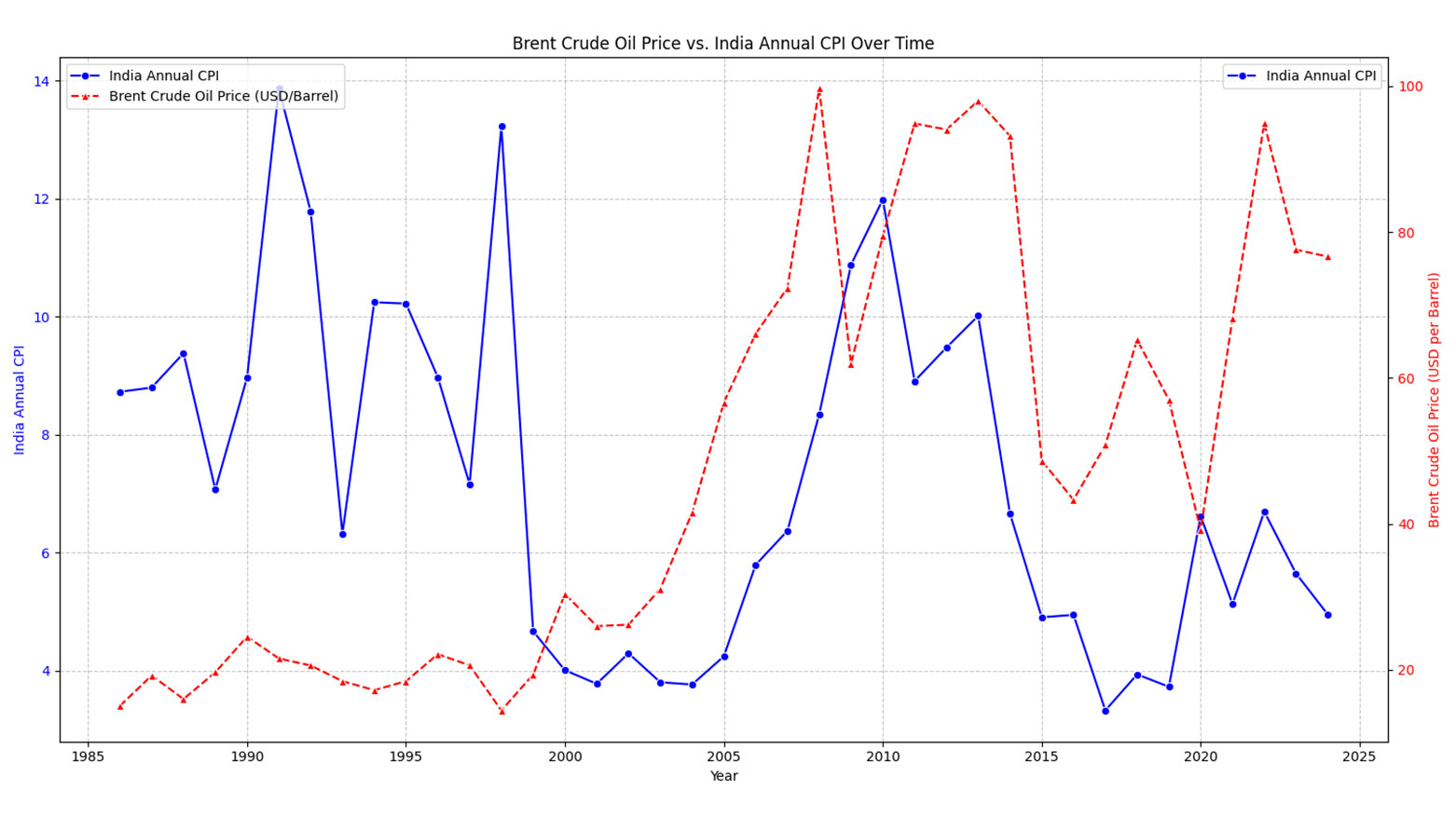
To further examine dynamic interactions of brent oil prices and macroeconomic variables relation, a Vector Autoregression (VAR) model was estimated including CPI (Consumer Price Index), lagged Brent prices, and GDP growth. The results show weak short-run interdependencies, with no statistically significant coefficients across equations and relatively weak model fit (AIC = 12.30, BIC = 12.43). However, unit root testing using the Augmented Dickey-Fuller (ADF) approach revealed mixed integration properties: CPI (ADF = –3.37, p = 0.012) and GDP growth (ADF = –5.87, p = 0.000) are stationary, while Brent oil prices (ADF = –1.59, p = 0.488) are non-stationary. Despite this, Johansen cointegration testing confirmed one long-run equilibrium relationship among the variables.
The Vector Error Correction Model (VECM), grounded in the econometric framework developed by Clive Granger and Soren Johansen, provides deeper insight into long-run adjustments. The results show that the error correction term is statistically significant for Brent oil prices (–0.1843, p = 0.039) and GDP growth (0.3151, p < 0.001), but not for CPI (–0.0144, p = 0.386). This indicates that while short-run effects of oil prices on macroeconomic indicators are weak, long-run equilibrium relationships remain economically meaningful, particularly for output and energy prices.
These findings collectively suggest that India has developed a structurally resilient macroeconomic framework in relation to oil price volatility. Policy buffers, diversified import sources, monetary stabilization mechanisms, and refinery adaptability have reduced the immediate transmission of oil shocks into GDP growth and inflation. However, the presence of cointegration indicates that energy prices continue to exert influence over long-run macroeconomic adjustments, implying that oil remains a structurally important input in India’s growth trajectory.
Within this macroeconomic and structural context, Kurdistan’s potential role as a long-term energy partner becomes strategically significant. As India’s energy demand continues to rise due to industrial expansion, urbanization, and transport sector growth, securing stable and diversified crude oil sources will remain a policy priority. Kurdistan, with its geographically proximate location, relatively low-cost production structure, and exportable crude grades compatible with Indian refinery systems, is well positioned to become a reliable supplier in India’s evolving energy portfolio.
Moreover, expanding India–Kurdistan energy cooperation could move beyond transactional crude trade toward a more integrated long-term partnership model. This may include long-term supply contracts, upstream investment collaboration, and infrastructure development in storage and transport logistics. For Kurdistan, India represents a structurally growing and stable demand center, offering a counterbalance to the volatility of global oil markets and geopolitical disruptions in traditional export routes. For India, enhanced engagement with Kurdistan strengthens energy security through geographic diversification and supply redundancy.
In conclusion, the empirical results demonstrate that while oil shocks do not exert strong short-run effects on India’s GDP growth or inflation, long-run equilibrium relationships between oil prices and macroeconomic variables persist. This dual structure of short-run resilience and long-run dependence reinforces the strategic importance of crude oil in India’s development trajectory. In this context, Kurdistan is uniquely positioned to emerge as a long-term strategic energy partner for India, leveraging geographic proximity, refinery compatibility, and rising Indian demand to build a mutually beneficial and durable energy trade relationship.
About the author:
Dr. Mamta Singh is serving as associate professor at British International University a regional center of University of London in Kurdistan region of Iraq. She has extensive experience of serving higher education institutions in India, Africa, Kazakhstan and Kurdistan.
References
Granger, C. W. J. (1981). Some properties of time series data and their use in econometric model specification. Journal of Econometrics, 16(1), 121–130.
International Energy Agency. (2024). World energy outlook 2024. https://www.iea.org
Johansen, S. (1988). Statistical analysis of cointegration vectors. Journal of Economic Dynamics and Control, 12(2–3), 231–254.
U.S. Energy Information Administration. (2025). Petroleum and other liquids data. https://www.eia.gov
Energy Institute. (2024). Statistical review of world energy. https://www.energyinst.org/statistical-review
The views expressed in this article are those of the author and do not necessarily reflect the views of Kurdistan24.