Ten Dead in Sydney Shooting as Israel Condemns Antisemitism Amid Bondi Beach Massacre
Ten died in a Bondi Beach shooting that Israel's President condemned as an "attack on Jews," while Australian police investigate the massacre.
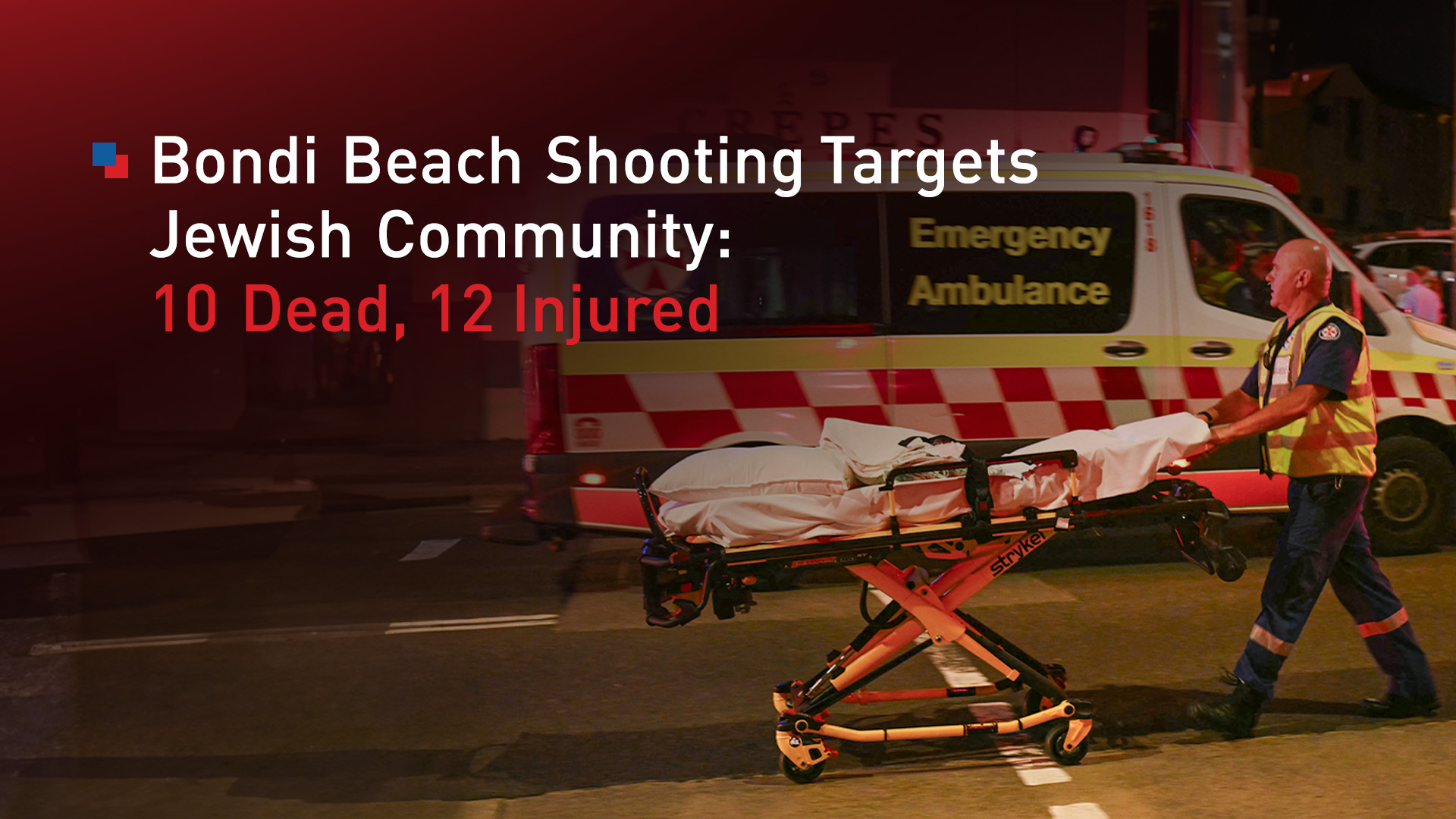
ERBIL (Kurdistan24) – The iconic sands of Bondi Beach were transformed into a scene of mass slaughter on Sunday as a shooting rampage in Sydney’s eastern suburbs left ten people dead and a dozen more wounded, a catastrophe that Israeli President Isaac Herzog has explicitly characterized as a targeted antisemitic assault.
The violence, which erupted just as the weekend was drawing to a close, triggered a massive security response that saw swarms of terrified beachgoers fleeing for their lives while tactical units engaged the assailants.
Agence France-Presse (AFP) reported that police confirmed the staggering death toll of ten, with Australia’s national broadcaster ABC indicating that one of the shooters is among the deceased, bringing a grim conclusion to one of the darkest days in the nation's recent history.
While Australian authorities have yet to officially confirm a motive or specific target for the massacre, the narrative surrounding the tragedy has immediately taken on a profound geopolitical dimension. Speaking from Jerusalem, Israeli President Isaac Herzog unequivocally condemned the violence as a "cruel attack on Jews."
In a speech delivered shortly after the news broke, Herzog described the victims as "our sisters and brothers in Sydney," alleging they had been "attacked by vile terrorists."
He utilized the moment to issue a stern call to Canberra, urging Australian authorities to "step up the fight against the enormous wave of antisemitism which is plaguing Australian society."
This high-level intervention places immense pressure on Australian investigators to determine whether the bloodshed was indeed a hate crime directed at the Jewish community, a sentiment echoed by the CEO of the Australian Jewish Association, who described the shooting to AFP as a "tragedy but entirely foreseeable."
Back on the ground in Sydney, the immediate reality was one of "pandemonium" and carnage. Detailed reporting by the Australian Broadcasting Corporation (ABC) described a frantic and horrific ordeal as emergency services struggled to triage victims amidst the chaos.
Vision obtained from the grassy knolls surrounding the beach depicted the aftermath, with multiple people lying injured on the ground while paramedics worked desperately to stabilize them. The ABC reported that in addition to the ten dead, 12 additional people were wounded, many with severe injuries.
Casualties were rushed to major medical centers across the city, including St Vincent’s Hospital, Royal Prince Alfred Hospital, and St George Hospital, as more than 25 emergency resources, including helicopters and special operations units, swarmed the area.
New South Wales Police moved quickly to secure the perimeter, treating the situation as a "developing incident" well into the evening. They issued urgent directives via social media for the public to avoid the area entirely, stating, "Anyone at the scene should take shelter."
The warning emphasized the fluidity of the threat, instructing citizens to obey all police instructions and strictly avoid crossing established police lines.
AFP, referencing earlier reports, indicated that two people had been taken into custody, with one suspect shot by police—a detail that aligns with the ABC's report of a shooter being among the fatalities.
Witness accounts provided to the ABC paint a picture of sudden confusion rapidly descending into sheer terror. Elizabeth Mealey, a resident of Randwick and a former journalist, was dining at the prominent Icebergs restaurant overlooking the ocean when the incident began.
"We thought it was fireworks, but it wasn't. It was something much worse," Mealey told the national broadcaster. She described the chilling moment realization set in, watching as people began running up the beach in a desperate bid to escape.
"It was panic and the panic spread to Icebergs and people are standing around still not knowing what's going on, so it's scary," she recounted.
Mealey noted that while she could not visually locate the shooter from her vantage point, the acoustic evidence suggested the gunfire was emanating from an area near the Bondi Pavilion, a central landmark on the beachfront.
"It felt like it took a long time to hear a siren, we've got a helicopter coming in now and ambulance is arriving... and we really don't know what's happening," she said.
Witnesses also described hearing a secondary burst of gunfire later in the evening, likely the exchange that ended with the suspect's death. "We did hear what sounded like another type of gunfire, eventually which we were hoping and assuming it was police shooting back," Mealey added. "It's terrifying."
The political reaction within Australia has been one of shock and grief. Prime Minister Anthony Albanese issued a statement describing the events at Bondi Beach as "shocking and distressing."
In comments shared by his office and cited by AFP, Albanese focused on the humanitarian response, stating, "Police and emergency responders are on the ground working to save lives. My thoughts are with every person affected."
He urged the public to strictly follow the information provided by New South Wales Police, refraining from speculating on the motives that President Herzog had so forcefully articulated abroad.
The incident has cast a long shadow over one of Australia's most beloved cultural institutions. Bondi Beach is not merely a local hang-out but a magnet for tourists, swimmers, and surfers from around the world.
The violence disrupts the image of safety and relaxation associated with the site, replacing the sunset with the flashing lights of emergency vehicles and crime scene tape.
Despite the assertions from Israeli leadership and local Jewish community representatives regarding an antisemitic motive, AFP noted that there has been no official confirmation in Australia that the attack specifically targeted the Jewish community.
However, the proximity of the attack to areas with significant Jewish populations in Sydney’s east will undoubtedly be a central line of inquiry for detectives.
As night fell over Sydney, the investigation transitioned from a tactical response to a forensic one.
Investigators are now tasked with piecing together the movements of the shooters, identifying the victims, and determining how such a heavily armed assault could be launched in a crowded public space.
For the witnesses like Elizabeth Mealey and the survivors fighting for their lives in hospitals, the psychological scars of the evening will likely linger long after the physical wounds have healed.
With ten dead and a nation in mourning, the tragedy at Bondi Beach has become a flashpoint for fears regarding domestic security and the potential reach of global hatreds into the peaceful suburbs of Sydney.
This article was updated on Dec. 14, 2025, at 01:11 PM.