Iran’s Pezeshkian says country is now in strongest position for deal with US
Iranian president cites unity and what he calls victory in the war as Tehran and Muscat near a maritime arrangement for the Strait of Hormuz
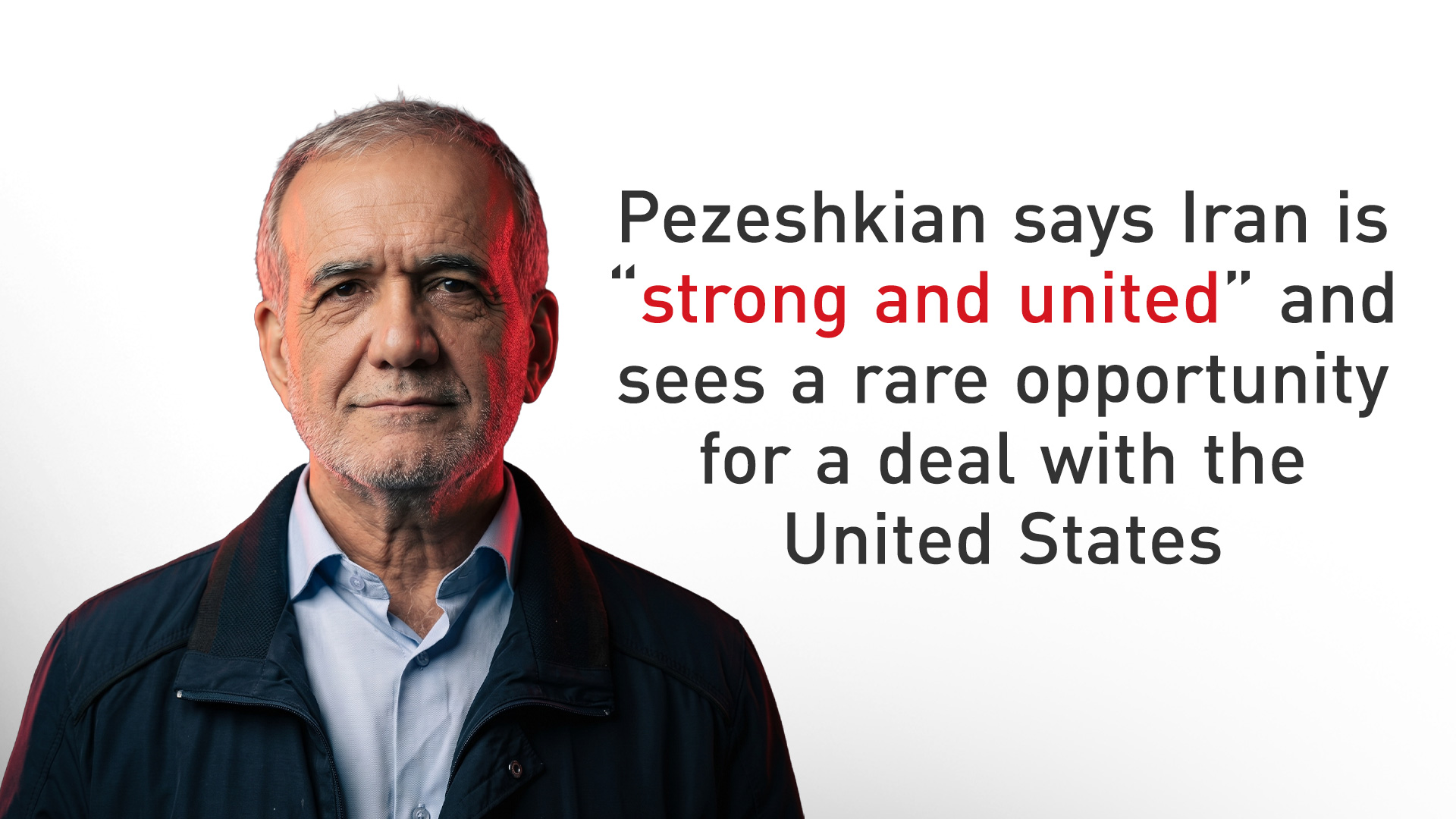
ERBIL (Kurdistan24) — Iranian President Masoud Pezeshkian said Saturday that Iran is in its strongest position to reach an agreement with the United States, citing the country’s unity and what he described as its success in the “war of pressures.”
Speaking in a televised interview, Pezeshkian said Iran’s adversaries had expected the government to collapse under intense pressure and severe sanctions.
“The enemies were waiting for the government to collapse because of the intense pressure and severe sanctions imposed on us,” Pezeshkian said.
He said external pressure had consistently been a feature of Iran’s political environment and that successive Iranian governments had faced similar challenges.
Pezeshkian also said plans associated with the recent conflict had included attempts to generate unrest in parts of northwestern and southeastern Iran by exploiting border areas.
He claimed that neighboring countries had prevented individuals from easily crossing into Iran to create instability.
The Iranian president said the circumstances now offered an opportunity for an agreement with Washington, arguing that Iran had emerged from the conflict “strong and united” and was considered a winner of the war.
Iran, Oman near Hormuz maritime arrangement
Separately, Iranian Foreign Minister Abbas Araghchi said Saturday that Tehran and Muscat were “very close” to reaching an agreement on a new maritime navigation arrangement through the Strait of Hormuz.
Araghchi said the arrangement would be subject to conditions, including compensation over what Tehran describes as US violations related to an Islamabad memorandum of understanding.
He said Iran and Oman were also discussing a temporary arrangement for maritime traffic through Hormuz while technical and legal issues surrounding a permanent navigation framework are resolved.
The comments came amid conflicting signals from Iranian officials over whether the reopening of the strategic waterway is directly linked to Tehran’s negotiations with Oman.
Tasnim News Agency quoted Hossein Mohebi, a spokesperson for Iran’s Islamic Revolutionary Guard Corps, as saying that reopening the Strait of Hormuz was not connected to negotiations between Iran and Oman.
Mohebi reiterated that the waterway would be reopened only if the United States accepted conditions set by Tehran.
The apparent divergence in the statements reflects the complex negotiations surrounding Hormuz, with Oman seeking to facilitate arrangements for maritime navigation while Iranian officials continue to emphasize conditions they want Washington to meet.
Hormuz deal seen as potential step toward broader agreement
An agreement between Iran and Oman on managing navigation through the Strait of Hormuz is being viewed as a potentially significant step toward a broader peace arrangement.
The strait has remained a major flashpoint amid the confrontation between Iran and the United States, with Tehran using its control over the strategic waterway as leverage in negotiations.
Over recent weeks, the administration of US President Donald Trump repeatedly indicated that an agreement to reopen the strait was close. Iran, however, subsequently rejected the prospect of holding negotiations under the terms proposed by Washington.
The Strait of Hormuz is a critical global maritime chokepoint connecting the Persian Gulf with the Gulf of Oman and the Arabian Sea. Prolonged restrictions on shipping through the waterway have raised concerns over international trade and global energy supplies.
Pezeshkian’s remarks suggest that Tehran now sees its strengthened position following the conflict as an opportunity to pursue an agreement with Washington, even as Iranian officials continue to insist that any deal must address Tehran’s demands.