Kurdish Farmer Turns Garmian Land Into a Date Palm Success
A Sulaimani farmer's gamble on Barhi and Medjool dates has grown from a small plantation into a 70-dunum operation, highlighting the agricultural potential of the Kurdistan Region.
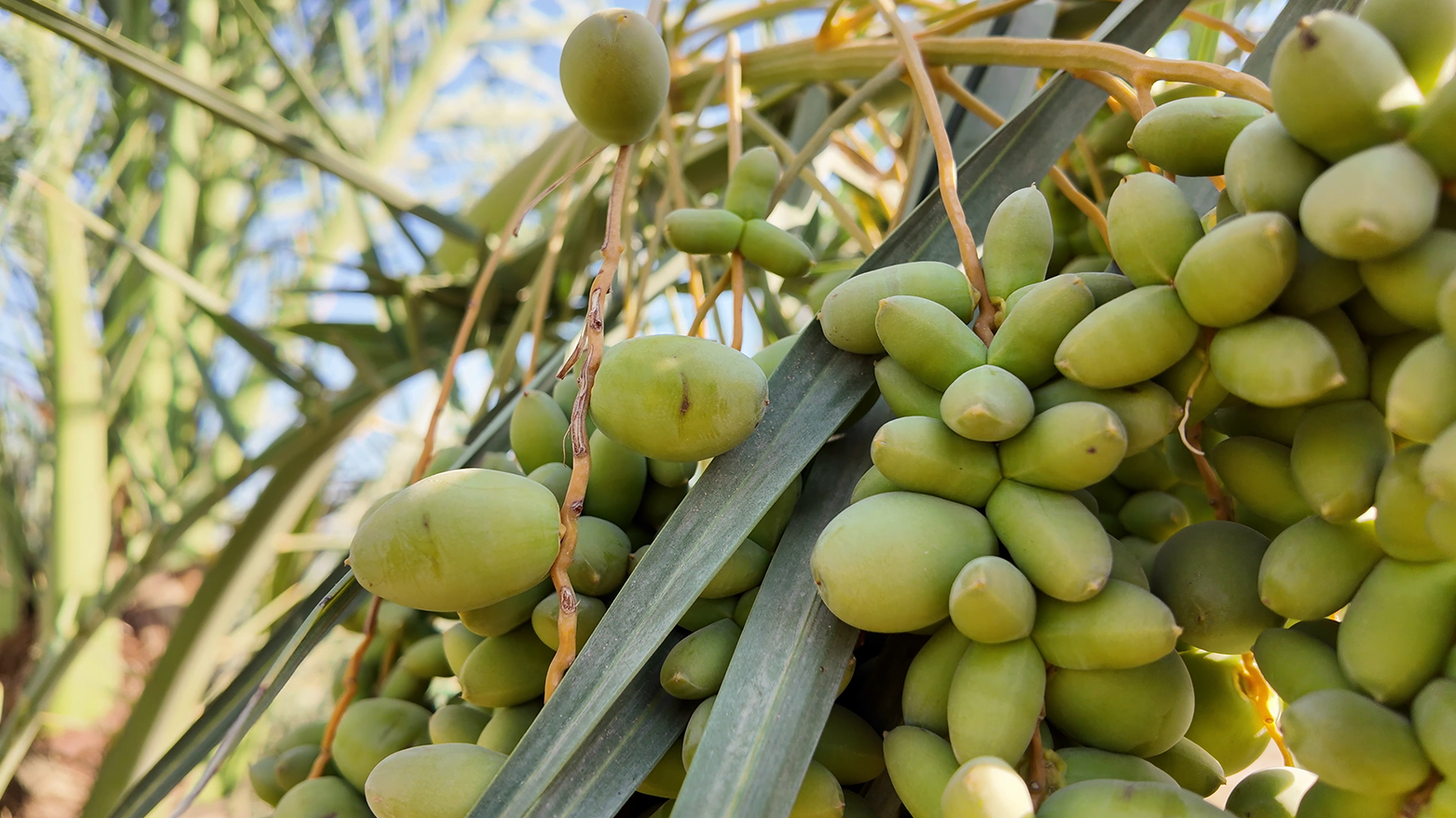
ERBIL (Kurdistan24) - Three years ago, when Kurdish farmer Diari planted thousands of imported date palms along the Sirwan River, some people laughed. They doubted that premium varieties such as Barhi and Medjool could thrive in the soil and climate of the Kurdistan Region.
Today, the trees are bearing fruit, and the farmer has expanded his plantation from a few donums to about 70, with more than 20,000 palms and offshoots.
The story, reported by Kurdistan24 correspondent Harem Jaf, is a small but revealing example of the region's agricultural potential, showing how fertile land, experimentation and persistence can turn an unfamiliar crop into a commercial venture.

A Gamble on Premium Dates
When Jaf first visited Diari three years ago, the farmer had imported nearly 5,000 date palms from the United Arab Emirates, selecting the Barhi and Medjool varieties for their quality and high market value.
At the time, the plantation covered only two or three donums.
Diari said he expected the trees to begin producing fruit within two to three years, despite the skepticism surrounding the project.
"Many did laugh," he recalled. "But now you can see for yourself that they are bearing fruit."
One of the dates displayed during Kurdistan24's latest visit measured more than seven centimeters, according to the report.
What began as an experiment has since become a much larger agricultural operation.

From a Few Donums to 70
Diari told Kurdistan24 that his plantation along the Sirwan River now covers about 70 to 71 donums and contains between 3,500 and 4,000 mature date palms.
Including new offshoots and saplings, his total stock has grown to more than 20,000 trees.
His biggest problem, he said, is no longer whether the palms will grow, but where to plant them.

"We have so many offshoots that we need more space," Diari said, adding that he expects to transplant more of the young palms next year.
The farmer has also expanded his work beyond his own fields and secured the Kurdistan agency for a British company involved in distributing the trees.
For Diari, the goal goes beyond selling dates.
He wants the Garmian area, traditionally known in Kurdistan for its hot climate and agricultural potential, to become a stronger center for date production.
Testing the Palms Beyond Garmian
The experiment has also extended to other parts of the Kurdistan Region.
Diari said 20 palms were given to a friend in Erbil, where they were planted in Kasnazan. The Barhi palms produced fruit this year, encouraging him to consider planting Medjool there as well.

He said the trees have also shown promise in areas toward Makhmour, Mosul and Kirkuk, suggesting that the varieties may be adaptable to more moderate climates beyond the hotter areas where dates have traditionally been cultivated.
The results challenge the idea that premium date varieties are limited to Iraq's traditionally recognized date-growing areas.
Bringing Premium Dates Closer to Consumers
For Diari, the commercial case is just as important as the agricultural one.
He said he had previously seen imported Barhi and Medjool dates sold in Erbil shopping centers for between 15,000 and 20,000 Iraqi dinars per kilogram.
His ambition is to produce comparable quality locally and eventually sell it for around 5,000 dinars per kilogram.

"Why should we pay that much?" he asked. "If we produce them locally, we can bring the price down."
Local production, in his view, could reduce reliance on imports while creating opportunities for farmers, workers and agricultural businesses inside the Kurdistan Region.
Technology Meets Fertile Soil
The plantation also relies on tissue-culture date palms, a propagation method that Diari says has already proved successful in Arab countries.
He argued that these palms can outperform some traditional Iraqi varieties and believes their introduction could modernize date cultivation in the Region.
The experiment reflects a wider characteristic of Kurdistan's agriculture: the ability to combine fertile soils and favorable microclimates with newer farming techniques and imported crop varieties.

From orchards and vineyards to grains, vegetables and fruit, farmers across the Region have increasingly experimented with crops traditionally associated with other climates.
The success of Diari's palms does not mean every variety will thrive everywhere, but it offers evidence that the boundaries of what can be cultivated locally may be broader than previously assumed.
A Farm Built on Persistence
Diari said he has invested everything he has in the project. His challenge now is finding enough land to accommodate the growing number of palms.
For a farmer who was once told his idea would fail, that shortage is perhaps an unexpected measure of success.
Three years after Kurdistan24 first documented the experiment, the trees have matured, fruit has reached the market and the plantation has expanded many times over.
The story is ultimately less about dates than about what can happen when agricultural ambition meets fertile land.

In Garmian, where the summer heat is often considered a challenge, Diari has turned it into an advantage.
His palms are now producing premium fruit, while the growing plantation suggests that the Kurdistan Region's agricultural potential may extend well beyond the crops traditionally associated with its fields.
As the farmer puts it, the objective is not simply to prove that Barhi and Medjool can grow there. It is to make them part of what Kurdistan can produce for itself—and eventually for markets beyond its borders.
