Oil Falls as Trump Pledges ‘Most Crushing’ Economic Campaign Against Iran
Markets brace for tougher US measures against Tehran as Brent crude falls toward $92 a barrel amid broader investor concerns over the Middle East conflict and global economy
ERBIL (Kurdistan24) — Oil prices fell on Monday as investors awaited details of a new US campaign to isolate Iran’s economy, with President Donald Trump describing the initiative as the “most crushing” financial operation ever directed against Tehran.
Both major crude benchmarks declined about 2 percent in early trading, with Brent crude falling to around $92.68 a barrel and West Texas Intermediate dropping to $85.39.
US Treasury Secretary Scott Bessent is expected to provide further details on the administration’s plan during a news conference on Monday.
Washington warned its allies and China last week to support Trump’s renewed effort to intensify economic pressure on Iran as the conflict in the Middle East approaches the six-month mark.
US Vice President JD Vance described the strategy as a “delicate dance,” acknowledging that Iran could attempt to retaliate by applying economic pressure on the United States.
Asked whether Washington would seek to pressure China over its economic ties with Iran, Bessent told CNBC that “many conversations are best to have in private,” while urging Beijing “to get with the program.”
The prospect of tougher sanctions and economic measures against Iran comes as markets remain sensitive to developments in the Middle East and their potential impact on energy supplies and global trade.
Asian markets mostly lower
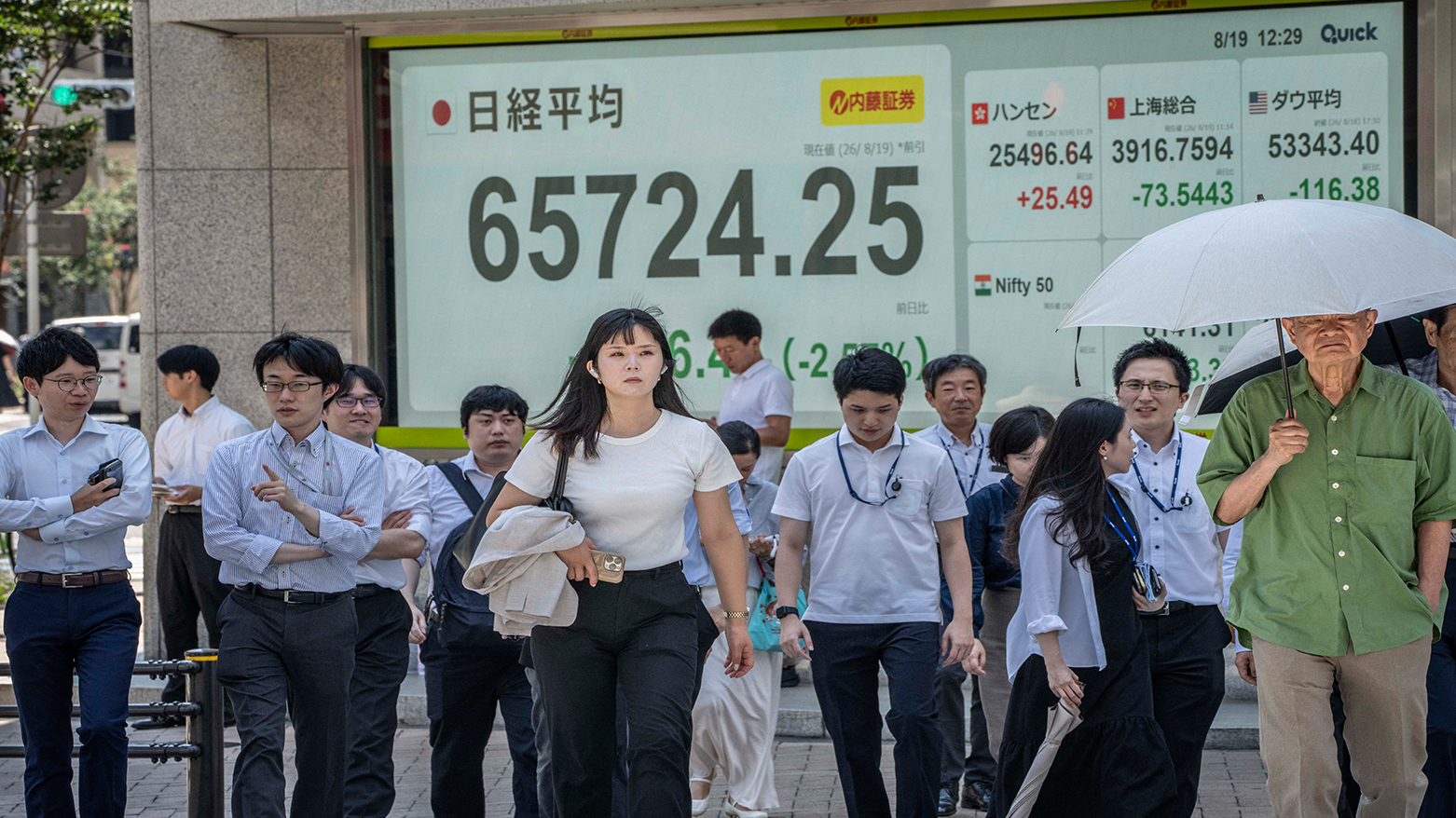
Asian equities were mostly lower on Monday, with South Korea’s tech-heavy Kospi falling 1.4 percent after Samsung Electronics announced that it had spent about $80 billion buying back its own shares following weeks of volatile trading.
Samsung and rival SK hynix had reached record highs in June amid optimism over the artificial intelligence boom, but both have since retreated as investors reassessed the outlook for the technology sector.
Hong Kong’s Hang Seng Index fell 2.1 percent despite Shein announcing that its long-awaited market debut in the Chinese financial hub will take place on September 1. The fast-fashion company is expected to be valued at close to $27 billion in the listing.
Markets in Tokyo, Shanghai, Taipei and Wellington also declined, while Sydney, Jakarta and Bangkok posted gains. Manila and Kuala Lumpur were broadly flat.
Nvidia earnings in focus
Investors are also turning their attention to Nvidia, the world’s most valuable company and a key bellwether for the global AI industry, ahead of its earnings report later this week.
The results are expected to provide fresh clues about whether the massive investment cycle in artificial intelligence can continue at its current pace as AI technology expands into more areas of the global economy.
“The spending machine is still running, but the bill is getting heavier,” said Stephen Innes of SPI Asset Management.
“Nvidia must now show that the most expensive investment boom in modern market history can still pay its bills.”
Chinese technology giant Alibaba is also keeping investors focused on AI after announcing Sunday that it plans to issue $10.2 billion in new shares in Hong Kong to finance its global AI ambitions.
Alibaba, which has developed the open-source Qwen family of AI models, has invested tens of billions of dollars in the technology. Investors are increasingly looking for evidence that such heavy spending can ultimately generate significant returns.
Focus on US monetary policy
Markets are also awaiting the annual gathering of central bankers, economists and finance officials in Jackson Hole, Wyoming, later this week, where investors will look for signals about the direction of US monetary policy.
The meeting comes after the US Treasury intervened in the bond market last week by purchasing its own bonds in an effort to push borrowing costs lower. The move followed a surge in the 30-year Treasury yield to levels not seen since 2007, shortly before the global financial crisis.
US bond yields have risen amid persistent inflation concerns and growing scrutiny of the country’s fiscal position after US federal debt surpassed $40 trillion.
At around 0215 GMT, the Nikkei 225 was down 0.3 percent at 65,799.25, while the Hang Seng was down 2.1 percent at 25,455.95. Shanghai’s Composite Index fell 0.5 percent to 3,887.81.
In currency markets, the dollar traded at 158.82 yen, compared with 159.03 yen on Friday, while the euro stood at $1.1684 and the pound at $1.3651.
Brent North Sea crude was down 1.8 percent at $92.68 a barrel, while West Texas Intermediate fell 1.9 percent to $85.39.