Houthi Commander to Kurdistan24: Saudi Arabia Uses Holy Cities for Political Pressure
A Houthi commander told Kurdistan24 attacks on Saudi Arabia will continue unless Riyadh ends its Yemen blockade, while denying Iranian arms support.
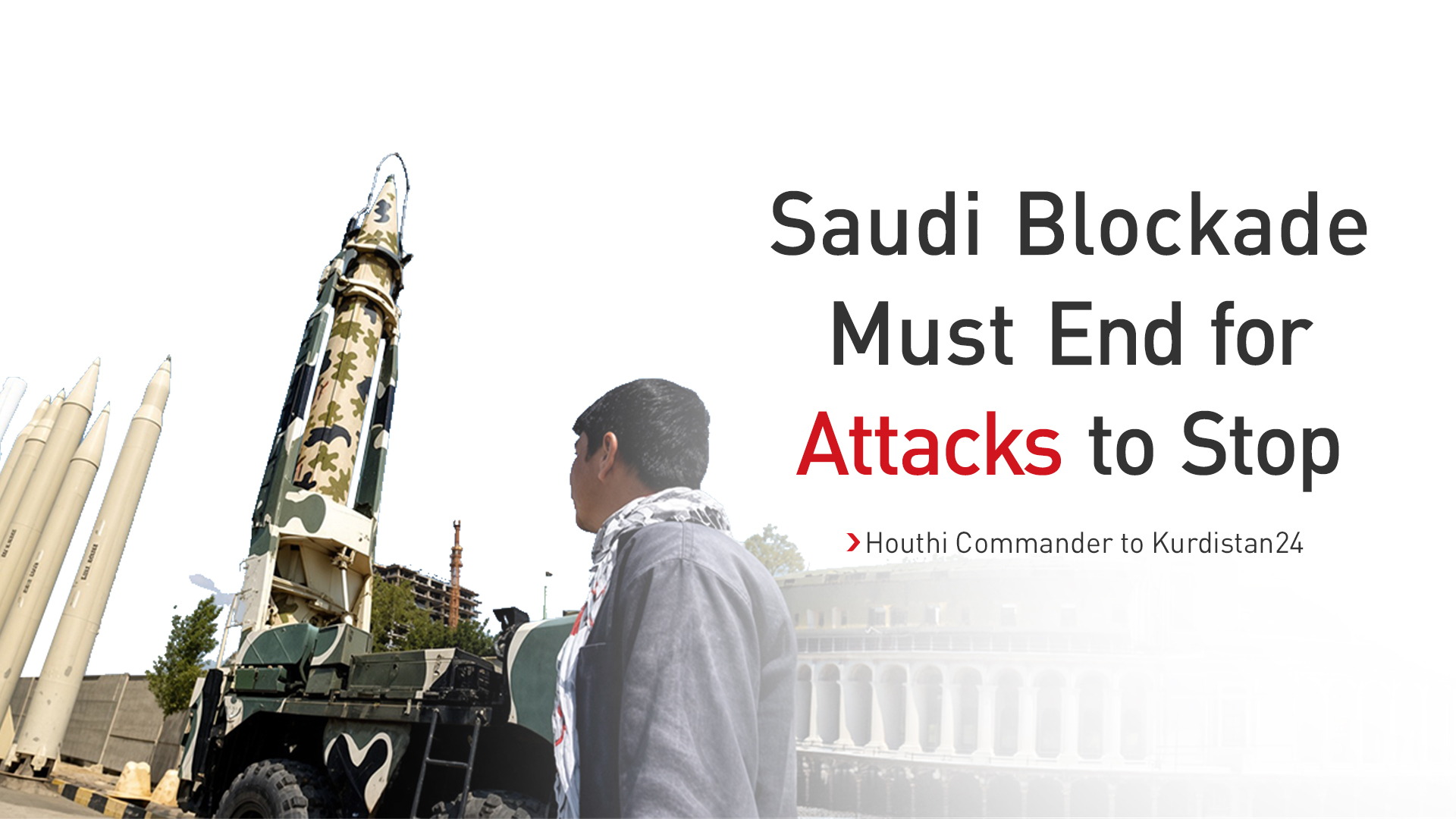
ERBIL (Kurdistan24) - A military commander from Yemen's Houthi movement has vowed that attacks on Saudi Arabia will continue unless Riyadh ends military operations and lifts what the group describes as a blockade of Yemen, while rejecting Saudi accusations involving the Islamic holy cities and denying that Iran supplies the Houthis with weapons.
Abdulghani Ali al-Zubaidi told Kurdistan24 in an exclusive interview on Sunday that the group regarded its missile campaign as a response to Saudi military action.
"Our missile attacks against Saudi Arabia will continue," al-Zubaidi said. "This is only natural because Riyadh continues to attack Yemen."
He said the attacks would stop if Saudi Arabia halted its military operations and ended its blockade. Otherwise, he warned, the Houthi response could intensify.
His remarks came a day after Saudi Arabia said its forces intercepted a Houthi ballistic missile aimed at Riyadh, the first reported targeting of the Saudi capital since the latest phase of the Yemen conflict began. The Associated Press reported that no casualties or confirmed damage resulted from the intercepted missile.
The Houthis separately claimed attacks against what they described as sensitive locations in Riyadh and facilities belonging to Saudi Aramco in the Red Sea port of Yanbu. Saudi authorities said attempted attacks on several areas, including Yanbu, were thwarted.
Agence France-Presse reported that explosions were heard in Riyadh and that its journalists saw an Aramco-branded fuel tank burning near the airport, while the Saudi-led coalition said its air defenses had intercepted the ballistic missile targeting the capital.
Dispute Over Mecca
Al-Zubaidi also rejected accusations that the Houthis had targeted civilians or Islamic holy sites.
"If Saudi Arabia has evidence, it should present it," he told Kurdistan24.
He then accused Riyadh of invoking Islam's two holiest cities to build political pressure against the group.
"We know, however, that Saudi Arabia uses Mecca and Medina for political purposes and to exert pressure on Yemen," he said.
Saudi Arabia had accused the Houthis days earlier of attempting to target Mecca, describing the incident as an attack on the holy city. The Houthis denied the accusation.
AFP reported that Riyadh accused the group of targeting Mecca on Sept. 16, while the Houthis called the allegation a "worn-out lie."
The competing claims could not be independently resolved from the material supplied for this report.
Saudi officials have also accused the Houthis of targeting civilian infrastructure elsewhere in the kingdom. The Houthis, by contrast, say their operations are directed at military, strategic and energy-related targets.
Houthi Commander Denies Iranian Weapons Support
Al-Zubaidi also rejected longstanding allegations of Iranian military support.
"Iran does not support us in any way," he said. "We have our own facilities in Yemen for manufacturing weapons and ammunition, and we meet our military requirements domestically."
His account conflicts with how the Houthis are described by both AFP and AP, which refer to the movement as supported or backed by Tehran in their reporting on the current conflict. Neither of the supplied reports independently establishes the origin of individual weapons used in the latest attacks.
The disagreement over Iran's role has become especially important as the renewed Saudi-Houthi confrontation unfolds alongside the wider war involving Iran and the United States.
The US State Department warned Saturday that the Saudi-Houthi confrontation "has the potential to escalate rapidly" and renewed travel warnings for Americans in the Middle East.
Competing Narratives Over Yemen's War
Al-Zubaidi also disputed the description of Yemen's conflict as a civil war.
"If it were not for Saudi intervention, Yemenis could resolve their own problems," he said, arguing that Yemeni factions had previously reached an internal agreement that was then obstructed by Saudi Arabia and its allies.
The broader chronology in the supplied reporting describes a conflict that began in 2014, when the Houthis seized Sanaa and other areas and forced out the internationally recognized government. Saudi Arabia intervened militarily in March 2015 as leader of a coalition supporting that government.
A United Nations-mediated truce in 2022 substantially reduced large-scale fighting for several years, but hostilities intensified again in July 2026.
Since July 2, the Houthis have pursued what they call a "blockade in response to a blockade," directing attacks toward Saudi Arabia and restricting Saudi maritime movement through the Bab al-Mandab Strait.
The waterway is a critical route for international commerce and energy shipments, making the confrontation significant beyond Yemen and Saudi Arabia.
The renewed fighting has already disrupted maritime traffic and Saudi energy exports, while more than 110,000 people have been displaced in Yemen, according to UN figures cited by AFP.
For al-Zubaidi, however, the conditions for de-escalation remain straightforward: an end to Saudi military operations and the lifting of restrictions on Yemen.
Saudi Arabia presents the confrontation differently, accusing the Houthis of missile and drone attacks threatening its civilians, infrastructure and sovereignty.
With both sides offering sharply conflicting accounts of the targets, causes and outside involvement in the conflict, the latest exchanges around Riyadh and the Red Sea suggest that the confrontation is moving further from the relative calm that followed the 2022 truce.