Iraqi Air Force Commander Says Missions Now Conducted Independently
Iraq's Air Force commander says domestic missions are now conducted independently as Baghdad pursues 14 Rafale fighters, drones and greater technical self-sufficiency.
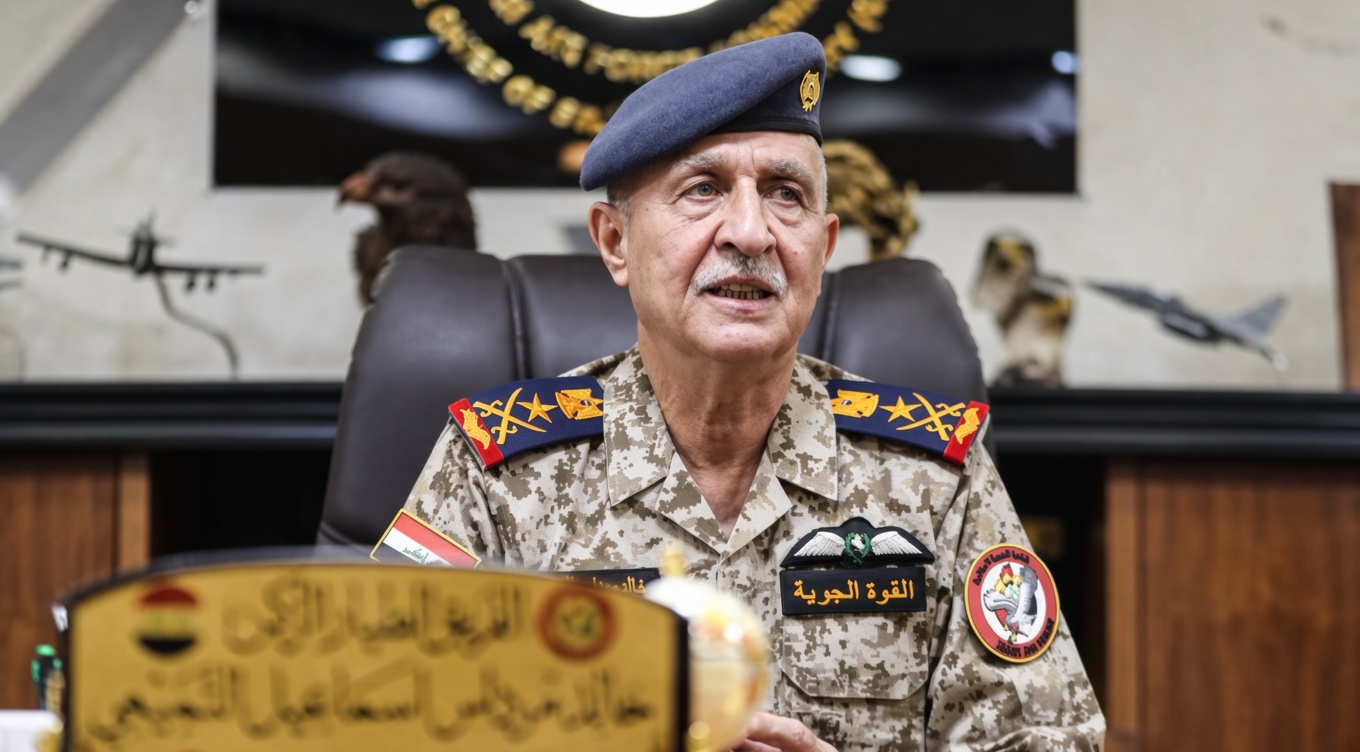
ERBIL (Kurdistan24) - Iraq's Air Force now conducts all missions inside the country independently and without direct support from international coalition forces, its commander said on Monday, as Baghdad approaches the final stage of a security transition that will place greater responsibility on Iraqi forces after more than a decade of international assistance.
Lt. Gen. Khalid al-Tamimi, Commander of the Iraqi Air Force, told the official Iraqi News Agency that no coalition force has carried out an air mission inside Iraqi territory since the beginning of 2026.
His comments come as the international coalition's current military framework approaches its Sept. 30 deadline and provide an Iraqi military assessment of how far domestic capabilities have developed ahead of that transition. Contemporary Iraqi reporting similarly quoted al-Tamimi as saying air missions are being conducted independently and Iraqi crews are maintaining the country's F-16 fleet.
Al-Tamimi drew a distinction between foreign military forces and international companies that continue to provide paid technical services.
"Those companies are present in countries around the world and provide services in exchange for payment," he said, adding that Iraq is developing its own workshops and warehouses to create a more complete domestic support system.
The Air Force commander also rejected reports that the United States controls maintenance of Iraq's F-16 fighter jets.
According to al-Tamimi, Iraqi engineers and technical personnel now carry out the maintenance work themselves.
He said engineers who entered the field after 2004 have accumulated extensive experience, received training abroad and, in some cases, risen to the rank of brigadier general.
Specialized outside support has not disappeared entirely. Al-Tamimi said the Air Force sometimes uses Pratt & Whitney for engine repairs, but maintained that a substantial portion of that work can now be completed inside Iraq.
That distinction is central to his description of Iraqi military independence: Baghdad may continue purchasing specialized services and equipment from international companies while Iraqi personnel increasingly assume responsibility for operations and routine technical sustainment.
At the same time, the Air Force is looking to expand and modernize its combat fleet.
Al-Tamimi said Iraq is in advanced negotiations over the proposed purchase of 14 French Rafale fighter aircraft.
He described the Rafale as a sophisticated platform that would also be considerably more expensive than Iraq's existing F-16 aircraft.
But he cautioned that acquiring advanced fighters requires more than purchasing the aircraft themselves.
"We do not want simply to bring in aircraft and accumulate them without having a proper plan," al-Tamimi said, noting that preparing pilots to operate such aircraft could require five years.
The remarks indicate that training, maintenance and long-term operational capacity are being considered alongside the proposed acquisition itself.
Iraq is also seeking greater capability in unmanned aviation.
Al-Tamimi said efforts are underway to manufacture drones domestically and that there is a proposal to establish a dedicated command responsible for unmanned aircraft.
Drones are currently grouped under the supervision of the Office of the Commander-in-Chief, according to his account.
The modernization effort comes as Iraq reassesses its security requirements after years in which the international coalition played an important role in the campaign against ISIS.
The coalition was established in 2014 after ISIS captured Mosul and large areas of Iraq, prompting Baghdad to seek international military assistance.
The Iraqi Air Force subsequently became a major component of the campaign, carrying out tens of thousands of missions against the militant organization.
Al-Tamimi said the terrorist threat inside Iraq is now very limited and that smaller security breaches can generally be contained within hours.
He nevertheless acknowledged that ISIS has not disappeared completely.
Sleeper cells remain in difficult terrain, he said, leaving Iraqi security forces with a continuing counterterrorism requirement even as the international coalition structure changes.
The transition was agreed by Iraq and the United States in 2024. The plan moved the relationship away from the coalition framework and toward longer-term bilateral security cooperation, while allowing coalition support for operations against ISIS in Syria to continue through the second phase of the arrangement. Iraqi and U.S. officials have described the change as a transition rather than an end to security cooperation.
Previous Kurdistan24 reports detailed that Sept. 30, 2026, remains the announced deadline for the remaining American military presence under that framework, while intelligence cooperation with Washington is expected to continue.
The transition has also intensified debate over whether Iraq's own security institutions are prepared to prevent an ISIS resurgence.
Al-Tamimi's assessment presents the Air Force as increasingly capable of carrying out that responsibility independently, while still pursuing new aircraft, technical capabilities and domestic manufacturing.
The commander also disclosed a recent loss that illustrates the security risks still facing military infrastructure.
He said a missile struck an Antonov transport aircraft at a base in Baghdad, setting it on fire and rendering it unusable.
"Because the cost of repairing it exceeded the cost of purchasing it, we decided to remove it from service entirely," al-Tamimi said, describing the aircraft as a major loss that could not easily be replaced.
The Iraqi Air Force itself dates to April 1931. Its infrastructure was largely destroyed following the fall of the former Iraqi regime in 2003 before the force was rebuilt with U.S. assistance and equipped with aircraft including F-16s, T-50s, L-159s and Cessnas.
For years, foreign contractors played a significant role in keeping parts of that fleet operational. Missile attacks and other security concerns periodically led contractors to withdraw personnel, increasing pressure on Iraq to train its own engineers and technical specialists.
Al-Tamimi's comments suggest that Baghdad now sees those investments as part of a wider move toward military self-reliance.
The challenge after Sept. 30 will be to sustain that capacity while addressing the ISIS cells that remain, maintaining existing aircraft and preparing personnel for increasingly advanced systems.
The proposed Rafale purchase and domestic drone program are part of that longer-term effort. But al-Tamimi's emphasis was equally on the less visible elements of air power — trained pilots, Iraqi engineers, repair facilities and the institutional capacity required to keep aircraft flying after they have been purchased.