Al-Zaidi: Iraq Now Controls Its Decisions, Territory and Weapons
Iraqi prime minister says post-coalition Iraq will pursue balanced foreign policy while ensuring weapons and security decisions remain under state authority
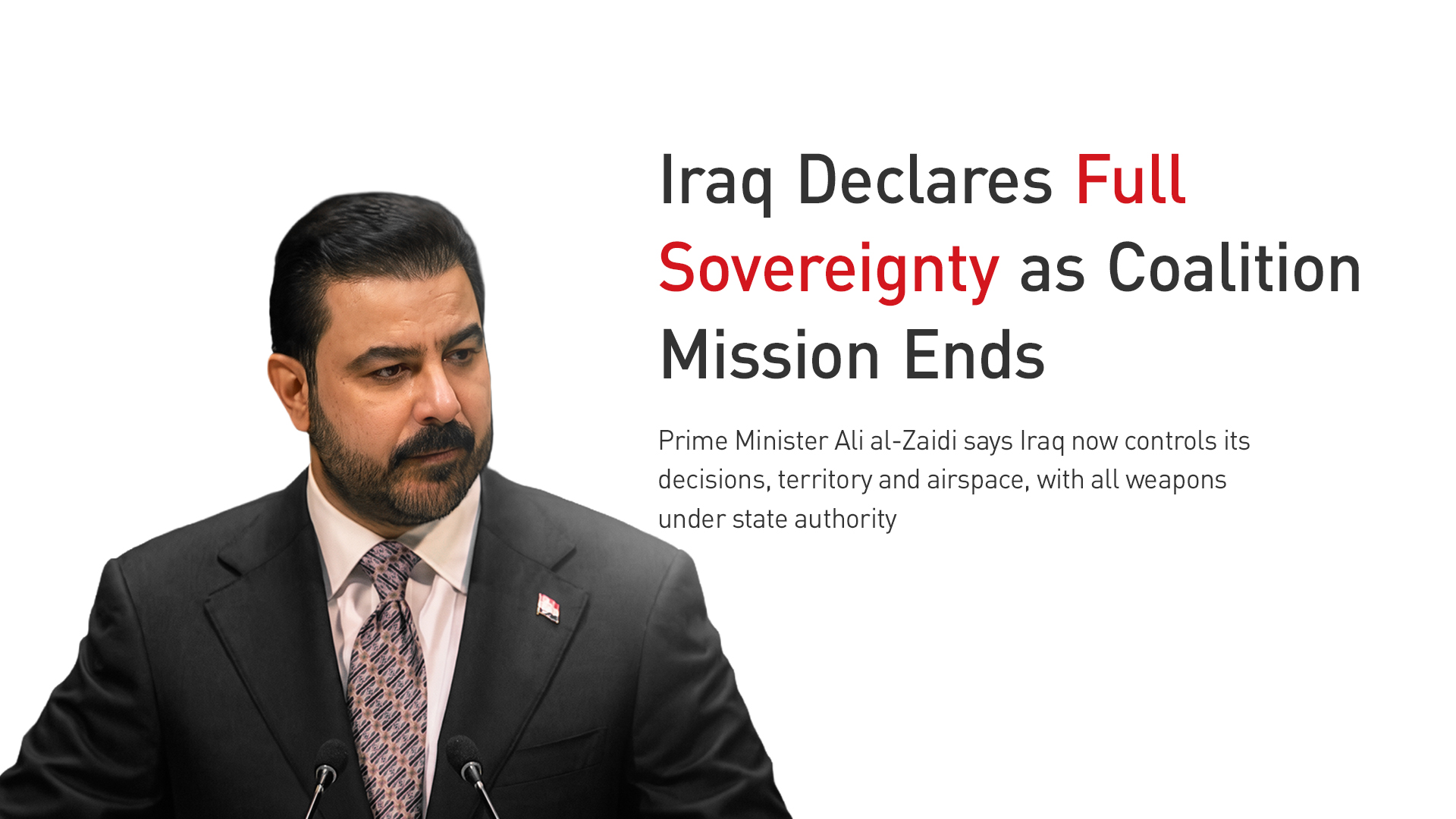
ERBIL (Kurdistan24) — Iraqi Prime Minister Ali Faleh al-Zaidi said Saturday that Iraq has entered a new phase of full sovereignty in which the state controls its decisions, protects its territory and airspace, and ensures that all weapons remain under the authority of the commander-in-chief of the armed forces.
In a National Day address to the Iraqi people, Al-Zaidi said Iraq had regained full sovereignty following the completion of the international coalition’s military mission on Sept. 30, describing the development as the beginning of a new phase in which Iraq would assume full responsibility for its security and national decisions.
“We are today a state that possesses its decision, protects its land and sky, and in which weapons are subject to the commander-in-chief of the armed forces,” Al-Zaidi said, according to highlights of his speech released on Saturday.
The prime minister also said Iraq would continue pursuing a balanced foreign policy based on the country’s supreme national interests, mutual respect and shared interests with other states.
He said Baghdad was working to protect Iraq from the consequences of regional conflicts while preserving its security, sovereignty and national decision-making.
Al-Zaidi said he had assumed responsibility at a particularly complex time and that his government had faced successive challenges requiring it to protect Iraq’s interests, security, sovereignty and independent decision-making from the repercussions of conflicts in the region.
The remarks come just days after the United States-led Global Coalition formally completed its military mission in Iraq on Sept. 30.
Al-Zaidi had described the conclusion of the mission as the beginning of a new era in which Iraq would take full responsibility for protecting its territory and sovereignty, while security cooperation with coalition countries continues through intelligence sharing, training, expertise and technology.
The transition has placed renewed emphasis on the Iraqi state’s ability to exercise exclusive authority over weapons and armed formations. Al-Zaidi said during the sovereignty ceremonies that there would be no weapons outside the framework of the law and no armed force outside state institutions.
Iraqi authorities have also linked the new sovereignty phase to regulating weapons in accordance with the constitution and addressing the status of armed factions.
The prime minister’s National Day remarks also follow his earlier call for Iraq to prevent its territory from being used as a launchpad for attacks against neighboring countries. In his sovereignty address on Oct. 1, Al-Zaidi identified the prohibition of attacks against neighboring states from Iraqi territory and the regulation of weapons as key elements of the country’s newly declared sovereignty.
Al-Zaidi said Iraq’s ability to move beyond repeated crises would depend on national unity and social cohesion, calling for a country that accommodates all its citizens.
“The greatest thing we need today is preserving our unity in a homeland that has room for everyone,” he said.
Reflecting on Iraq’s post-2003 political experience, Al-Zaidi said Iraqis had made decisive sacrifices to protect their democratic state and adopted a permanent constitution establishing the peaceful transfer of power.
He said decades of political instability had deprived Iraq of development opportunities and repeatedly forced the country back to what he described as “zero-sum” starting points.
Beyond security and foreign policy, the prime minister said his government was seeking to strengthen Iraq’s economic resilience through diversification, international partnerships, private-sector development and job creation.
He pointed to plans for one million residential plots, an intergenerational fund, economic cities and the Development Road project, which he said would position Iraq as a trade route, energy corridor and investment hub linking East and West.
He also pledged to continue combating corruption, protecting public funds and strengthening preventive oversight, while moving toward performance-based budgeting in which government spending is linked to measurable results.
Al-Zaidi concluded by pledging that Iraq’s national interest would remain above all other considerations and that the citizen would remain at the center of government policy, with a strong and just state as the ultimate objective.