Yemen Launches Offensive to Retake Bab al-Mandab From Houthis
Saudi-backed government forces attack Houthi positions near the strategic strait as Sanaa declares a broader campaign to reclaim territory seized by the Iran-aligned group
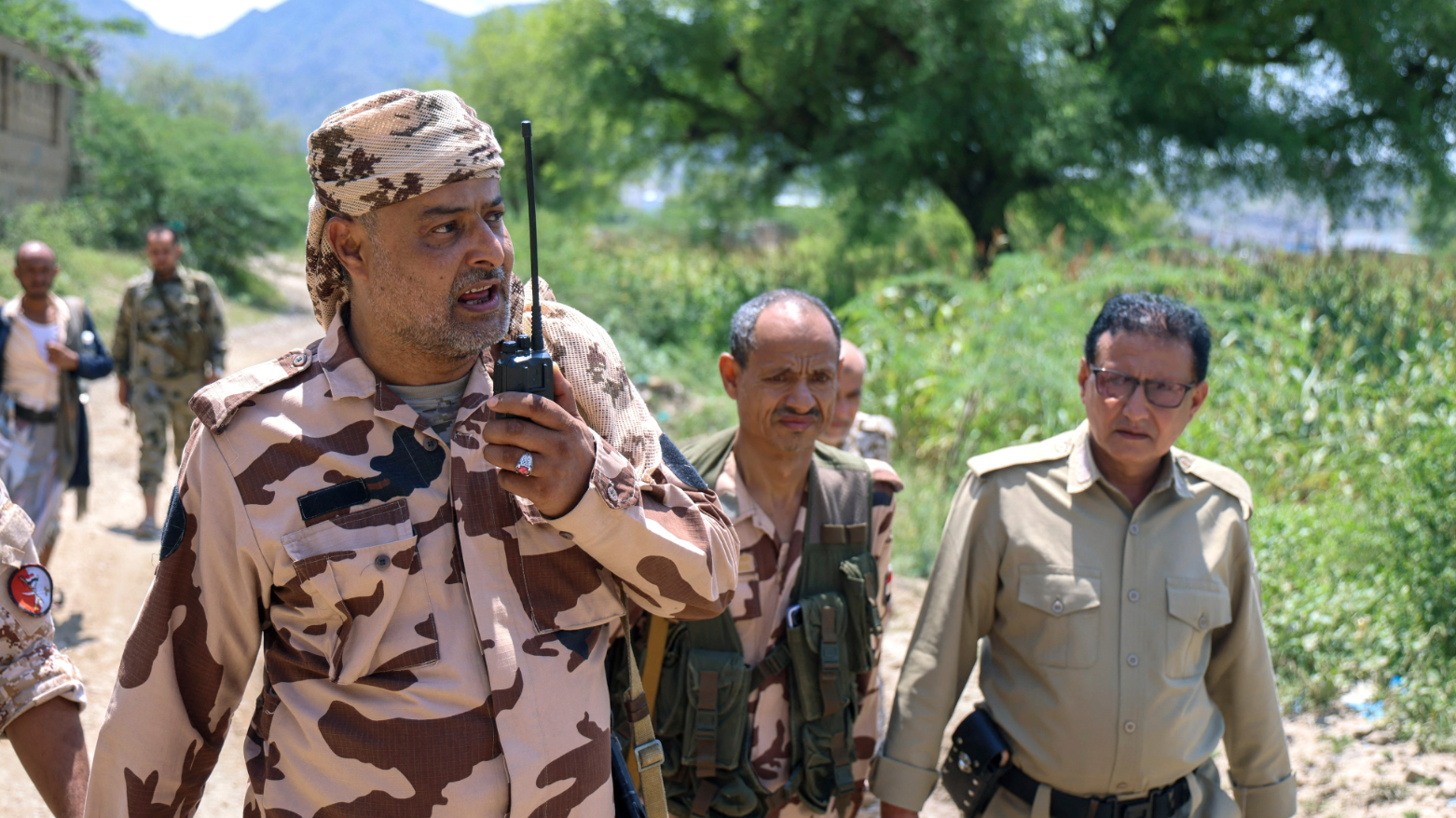
ERBIL (Kurdistan24) — Yemen’s internationally recognized government has launched a major military campaign to retake territory captured by the Iran-backed Houthi group, with government forces attacking Houthi positions near the strategic Bab al-Mandab Strait as fighting intensifies across the country.
Yemeni military sources said Monday that government forces attacked Houthi positions in the Dhubab district overlooking Bab al-Mandab, while the pro-government Giants Brigades said some of its first units had arrived in the area.
Yemeni forces said they had carried out 1,122 operations against Houthi positions across several fronts as part of what they called the “Battle for Liberation.”
The campaign was announced Sunday by Rashad al-Alimi, head of Yemen’s Presidential Leadership Council, who said the military operation would continue until Houthi-held territory was reclaimed and state authority restored.
The offensive comes after the Houthis made major territorial gains during a September offensive, including advances along the Red Sea coast and around Bab al-Mandab.
Battle for a Strategic Chokepoint
Bab al-Mandab is one of the world’s most important maritime chokepoints, linking the Red Sea with the Gulf of Aden and providing a gateway between the Indian Ocean and the Suez Canal.
The Houthis’ September offensive enabled them to advance roughly 150 kilometers along the Red Sea coast, capture the port city of Mocha and reach the Bab al-Mandab area, according to conflict-monitoring organization ACLED.
The group’s stronger position around the strait has increased the risks to Red Sea shipping and given it greater leverage over maritime traffic in the region.
The latest government offensive therefore goes beyond the struggle for territory inside Yemen. Regaining the approaches to Bab al-Mandab would be strategically important for the internationally recognized government and Saudi Arabia, while limiting the Houthis’ ability to exert pressure on one of the world’s key commercial waterways.
Saudi Arabia has been preparing an offensive aimed at breaking the Houthi hold over the strait, with Yemeni forces expected to form the main ground component of the campaign.
Reuters reported last week that Riyadh was planning to support the operation with air power and intelligence.
Houthi Advances Continue
Despite the government’s announcement, the new offensive has yet to halt Houthi advances on the ground.
On Sunday, Houthi forces cut the main supply route linking the government-held city of Taiz with Aden, effectively tightening their encirclement of Taiz, according to AFP.
The Houthis have also captured the strategic town of Turbah, located on a key road connecting Taiz and Aden, according to AP.
Taiz remains under government control but has long been surrounded on several sides by Houthi forces and remains one of the principal battlefronts in Yemen’s civil war.
“It is a significant development, but I think it is still too early to say that we are witnessing a decisive turning point,” Ahmed Nagi, a senior analyst for Yemen at the International Crisis Group, told AFP.
The fragmented nature of the anti-Houthi camp also presents a major challenge to the government’s campaign.
ACLED has noted that anti-Houthi forces operate through separate command structures and have struggled with divisions and rivalries, while the Houthis benefit from more centralized command and years of military preparation.
Wider Regional Conflict
The renewed fighting in Yemen is taking place against the backdrop of the wider Middle East conflict and has emerged in recent weeks as one of its most active fronts.
The Yemeni war itself predates the current regional conflict. The Houthis seized Yemen’s capital, Sanaa, in 2014 and subsequently took control of large parts of the country’s north.
Saudi Arabia intervened at the head of an anti-Houthi coalition in 2015 in support of the internationally recognized government.
The current escalation has nevertheless drawn the Yemeni conflict more closely into the wider regional confrontation. The Houthis are aligned with Iran, while Saudi Arabia remains the principal external backer of the internationally recognized government.
The group has also intensified attacks on Saudi territory during the latest escalation.
Reuters reported that Houthi forces have responded to Saudi-led strikes with missile and drone attacks against Saudi targets, including energy infrastructure, further raising the risk that the Yemeni battlefield could generate wider regional economic and security consequences.
Humanitarian Crisis Deepens
The renewed fighting is also worsening an already severe humanitarian crisis.
The September Houthi offensive killed hundreds of combatants and forced more than 145,000 people to flee their homes, according to figures cited by AFP.
UN agencies have reported rapidly changing displacement figures as the fighting has spread.
The International Organization for Migration reported about 145,000 people displaced within Yemen as of Sept. 28, while the World Health Organization cited a higher figure of about 180,000 displaced across 10 governorates.
Yemen remains one of the world’s poorest countries, with years of conflict severely damaging its economy, infrastructure and public services.
The latest offensive now places the internationally recognized government before a difficult military objective: reversing the Houthis’ recent territorial gains while preventing the conflict from further destabilizing the Red Sea and drawing additional regional powers into the fighting.
For now, government forces have reached the approaches to Bab al-Mandab and begun attacking Houthi positions there, but control of the strategic strait itself has not yet been restored to the Yemeni government.
The coming battles around the chokepoint and the Taiz-Aden corridor will determine whether the new campaign can turn the government’s declared “Battle for Liberation” into a sustained reversal of Houthi gains.