Barzani Calls for Kurdistan Parliament to Resume Work, New Government to Be Formed
Prime Minister Masrour Barzani urges lawmakers to end boycott and says Kurdistan is seeking air-defense and anti-drone systems from Baghdad and international partners
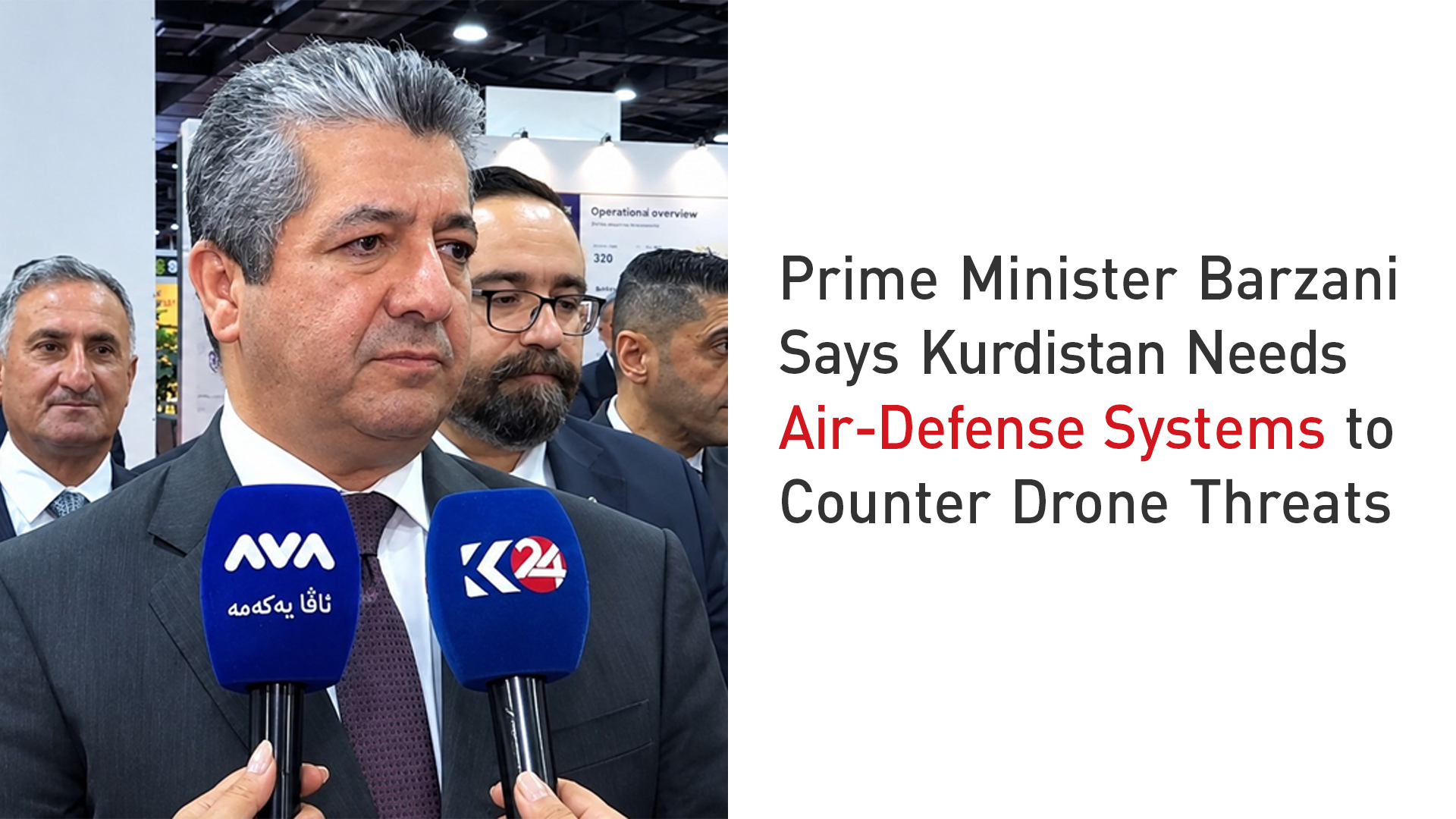
ERBIL (Kurdistan24) — Kurdistan Region Prime Minister Masrour Barzani on Tuesday called for the Kurdistan Parliament to resume its work and for the formation of a new regional government, while saying his administration was in talks with Baghdad and international partners to obtain air-defense and anti-drone systems.
Barzani made the remarks on the sidelines of the seventh Hawler International Technology Exhibition (HITEX) in Erbil, where he addressed journalists on a range of political, security and economic issues.
Barzani urges parliament to resume work
Barzani strongly criticized lawmakers who have boycotted parliamentary sessions, urging all members to return and carry out the responsibilities for which they were elected.
"I called yesterday at the University of Duhok graduation ceremony for all members of parliament to return and reactivate Parliament, because this is truly a national responsibility of those whom the people elected," Barzani said.
He said lawmakers should use Parliament as the appropriate venue to raise their concerns and criticism, arguing that elected representatives should not avoid their responsibilities by staying away from parliamentary sessions.
"I hope every member of parliament comes. If they have something to say, let them come and say it in Parliament," he said, adding that Parliament should be reactivated as soon as possible.
Barzani also linked the functioning of Parliament to the formation of the next Kurdistan Regional Government (KRG), saying the legislature must be operational for the necessary steps toward establishing a new cabinet to proceed.
The Kurdistan Parliament has remained largely inactive amid political disagreements following the 2024 parliamentary elections, while the current KRG continues to operate pending the formation of a new government.
Political discussions in the Kurdistan Region have focused on activating Parliament and forming the next cabinet since the October 2024 parliamentary elections.
Coalition withdrawal and Peshmerga readiness
Addressing the conclusion of the international Coalition's military mission in Iraq, Barzani said the withdrawal had been anticipated because the Coalition's mandate was primarily focused on fighting ISIS.
He stressed, however, that the departure of Coalition forces did not mean an end to their relations with Iraq or the Kurdistan Region.
Barzani said that during the war against ISIS, the Peshmerga and Iraqi security forces had carried out most of the fighting, while the Coalition's role was largely supportive.
He said the Peshmerga and Iraqi security forces are now at a high level of readiness to confront potential threats and argued that there was no reason to fear a security vacuum in the Kurdistan Region.
Kurdistan seeks air-defense, anti-drone systems
Barzani said the acquisition of air-defense and anti-drone capabilities was among the most important remaining military requirements for the Kurdistan Region.
"We are in ongoing talks with the federal government and our friends to provide us with this system. If we obtain it, there will be no remaining threat," he said.
He also warned about the possibility of security gaps emerging in some areas and called for greater coordination between Erbil and Baghdad to prevent terrorist groups from exploiting any such gaps.
The request for stronger air defenses follows a series of drone attacks targeting sites in the Kurdistan Region in recent months. Iraq's federal parliament, for example, condemned August drone attacks targeting the KRG prime minister's office and a security headquarters in Erbil and called for measures to prevent further attacks.
Barzani optimistic on Baghdad-Erbil ties
On relations with Baghdad, Barzani expressed optimism, saying improved relations with the federal government could help resolve longstanding disputes between the two sides.
He said discussions were continuing over the Kurdistan Region's financial entitlements, including salaries and the federal budget, and reiterated that Erbil was seeking to secure the Region's full constitutional financial rights.
Barzani said the KRG and federal government were engaged in continued dialogue to address outstanding issues, while emphasizing the importance of resolving disputes through constitutional mechanisms.
The issue of Kurdistan Region employee salaries and financial entitlements remains a central point in Baghdad-Erbil relations.
Security and political priorities converge
Barzani's remarks came as the Kurdistan Region enters a new security phase following the end of the Coalition's military mission and the recent formalization of the Peshmerga unification process.
The KRG described the process as the foundation for a modern, professional and unified force, while Barzani has identified strengthening military capabilities and acquiring advanced weapons and air-defense systems as priorities for the next phase.
The KRG has also said the unified Peshmerga will operate under a single Ministry of Peshmerga Affairs command structure, while closer coordination between the Peshmerga and Iraqi Army is expected to remain an important component of Iraq's broader security framework.
Against that backdrop, Barzani's call for Parliament to resume work and facilitate the formation of a new government places political institutionalization alongside security preparedness and Baghdad-Erbil financial coordination as key issues facing the Kurdistan Region.