DEM Party Urges Swift Peace Steps, Warns Over Hasakah
DEM Party spokesperson Ayşegül Doğan called for faster legal steps in Türkiye's peace process, a formal role for Abdullah Öcalan and action to establish a parliamentary monitoring committee.
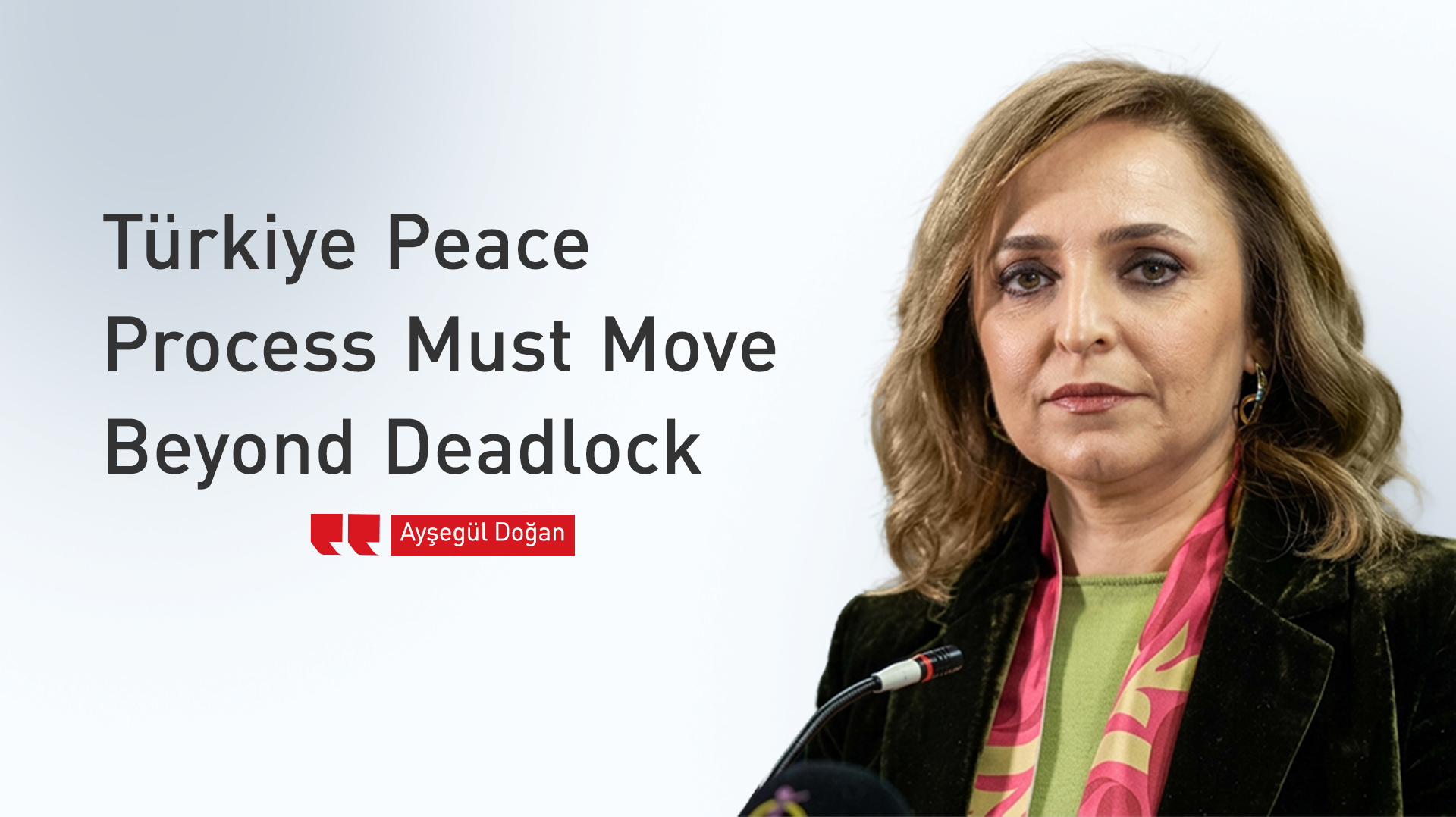
ERBIL (Kurdistan24) - Türkiye's Peoples' Equality and Democracy Party (DEM Party) on Friday called for accelerated legal and political steps in the country's peace process, urging parliament to establish a monitoring mechanism and warning that continued uncertainty could undermine confidence in the initiative.
DEM Party spokesperson Ayşegül Doğan made the remarks at the party's headquarters in Ankara following a meeting of its Central Executive Board, addressing the peace process alongside political, economic and regional developments.
With Türkiye's new parliamentary term underway, Doğan called directly on Parliament Speaker Numan Kurtulmuş to move quickly and transparently toward establishing the monitoring committee stipulated in the peace framework law.
She said the body should be formed on a multi-party basis and argued that the process should now shift from broad political commitments toward concrete implementation.
According to Doğan, the framework legislation was approved with 467 votes.
She also said the Freedom Movement had announced the complete withdrawal of its armed forces from Türkiye and the destruction of its weapons, arguing that there was therefore no longer an armed threat inside the country.
That was the DEM Party spokesperson's characterization of the security situation.
Doğan said disputes over terminology and bureaucratic disagreements should not be allowed to delay further progress.
"The process needs to gain momentum through new steps rather than being left in a state of deadlock," she said.
A central element of the DEM Party's position remains the role of imprisoned Kurdistan Workers' Party leader Abdullah Öcalan.
Doğan said Öcalan's effective and formal participation through a peace and political coordination mechanism was indispensable if the process was to succeed.
She also said the İmralı delegation was continuing talks with government officials, including representatives of the ruling Justice and Development Party.
According to Doğan, the delegation recently met Turkish Vice President Cevdet Yılmaz to discuss a roadmap for the next phase.
She expressed hope that those contacts would continue through a more formal and institutional structure.
At the same time, Doğan criticized what she described as continuing practices of political repression, arguing that they contradicted the atmosphere required for a peace process.
She pointed to the arrests of mayors and journalists and accused authorities of failing to implement rulings by the European Court of Human Rights.
"Such practices are in no way compatible with the spirit of peace and cannot build social trust," she said.
The DEM Party spokesperson also turned to the latest unrest in Hasakah in Western Kurdistan, describing the tensions there as an attempt to provoke confrontation between Kurdish and Arab communities.
"What is happening in Hasakah is a conspiratorial attempt to create division and confrontation between Kurdish and Arab communities," Doğan said.
Her description represented the DEM Party's political assessment of the unrest. The supplied material does not establish who, if anyone, organized a coordinated plan behind the violence.
Doğan condemned attacks on Kurdish cultural and national symbols and warned that developments in Hasakah should not be treated as an isolated local issue.
"Any fire ignited there will have dangerous consequences for the entire region," she said, calling for disputes to be addressed through dialogue.
The warning followed unrest in Hasakah in which Arab protesters attacked Kurdish residents, damaged vehicles and chanted anti-Kurdish slogans, according to Kurdistan24 correspondent Ekrem Saleh.
The violence prompted Kurdish youths in several neighborhoods to mobilize, while Internal Security Forces deployed across the city, closed roads and sought to prevent direct clashes between Kurdish and Arab communities.
Security forces later restored calm, although movement remained limited amid fears of renewed tension.
Doğan also raised concerns over what she described as pressure and violations affecting Syriac Christian property and churches in the İdil district of Şırnak, calling for an immediate end to discriminatory practices.
Her remarks placed the DEM Party's domestic peace agenda alongside broader concerns about communal relations in neighboring Syria.
The party's central demand, however, remained focused on Türkiye: removing uncertainty surrounding the peace process, translating the framework law into concrete measures, formalizing political dialogue and establishing mechanisms capable of sustaining the process.
For Doğan, the next stage depends on whether political commitments are followed by legal action and whether the process can build enough public confidence to avoid another period of stagnation.