Trump Tells Kurdistan24 He Is Concerned About Houthi Saudi Attack
President Donald Trump told Kurdistan24 he was concerned and "not happy" about the Houthi attack on Riyadh's King Khalid International Airport, as Saudi-Houthi fighting escalates.
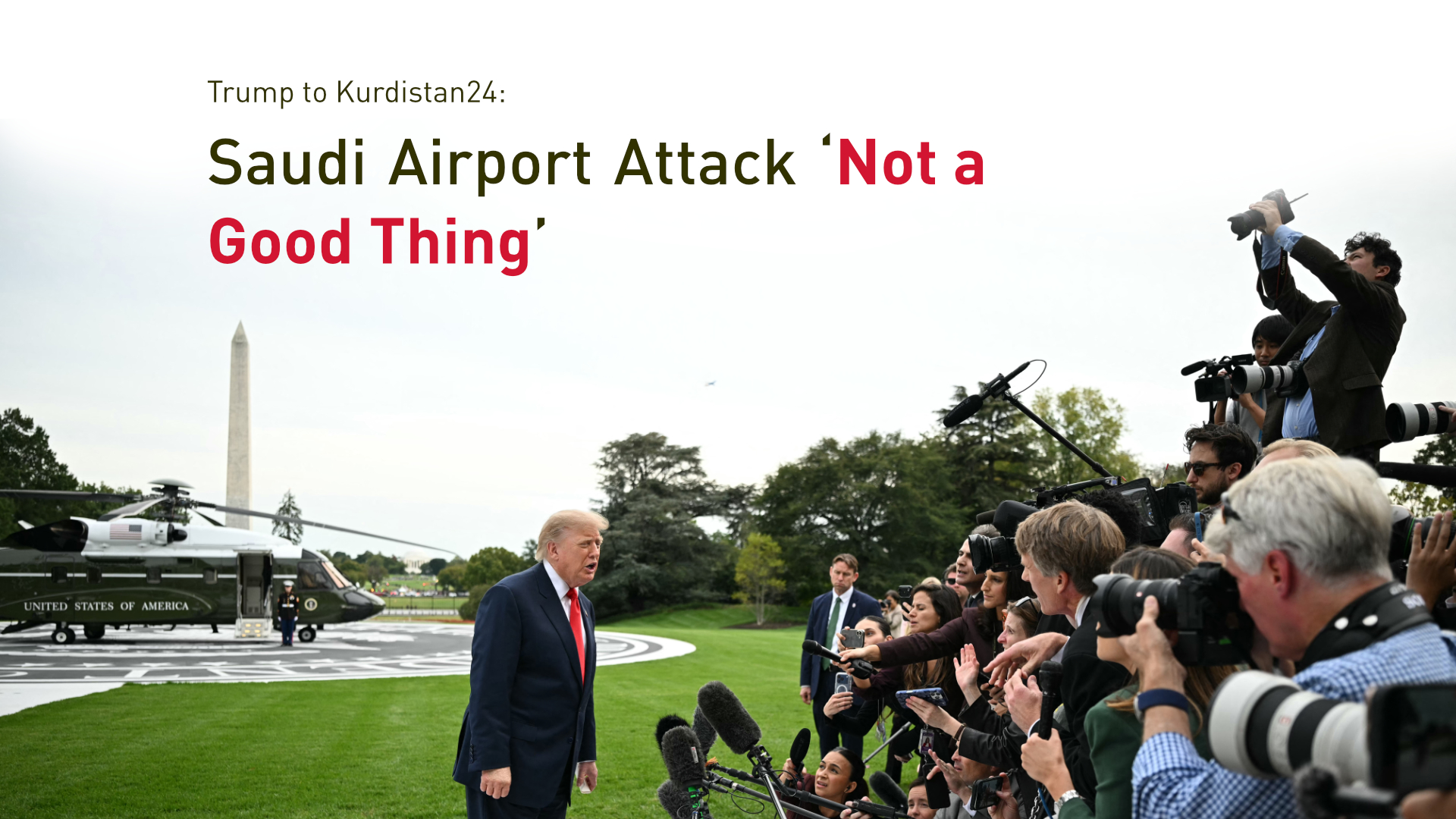
ERBIL (Kurdistan24) - U.S. President Donald Trump has expressed concern over the Houthi attack on King Khalid International Airport in Riyadh, telling Kurdistan24 that the strike on the Saudi capital was "not a good thing" as fighting between the Iran-backed group and Saudi-supported forces intensifies.
Responding early Saturday, Oct. 10, to a question from the director of Kurdistan24's Washington bureau about the attack, Trump said he was unhappy with the development.
"It is not good, it is not a good thing. I am not happy about it," Trump said.
His remarks followed a series of attacks that have sharply escalated tensions between Yemen's Houthis and Saudi Arabia.
Saudi aviation authorities said Friday that attacks targeting King Khalid International Airport and a Saudia Airlines aircraft the previous day killed three Saudi citizens.
The Houthis claimed responsibility for targeting the airport, while Saudi authorities did not initially identify those responsible in their statement on the casualties.
The violence has since been followed by intensified military operations inside Yemen.
The Saudi-led coalition said Saturday that it had destroyed 136 military targets in Houthi-controlled areas during what coalition spokesperson Turki al-Maliki described as a "large-scale operation."
According to AFP, al-Maliki said the operation was targeting Houthi personnel and military capabilities.
The Houthi-affiliated Almasirah television channel reported Saudi missile strikes in Yemen's northwestern Saada governorate.
The conflict between the Houthis and Yemen's internationally recognized government, which is backed by Saudi Arabia, reignited in July and has increasingly spilled across the Saudi border.
In recent fighting, Houthi forces have seized territory along Yemen's Red Sea coast, while Saudi-backed government forces have attempted to recover lost areas, including around the strategically important Bab al-Mandab Strait.
The latest fighting has also affected civilian aviation.
The attacks on Riyadh airport prompted disruptions to flights, with FlyDubai canceling services to several Saudi destinations and Pakistan International Airlines suspending flights to Riyadh.
The broader confrontation has also reached the Houthi-held Yemeni capital, Sanaa.
Residents reported heavy explosions overnight, while Anees al-Asbahi, spokesperson for the Houthi-run Health Ministry, said strikes injured six people, including a child.
AFP separately reported Houthi media as saying two people had been killed in Saudi attacks on the airport in Sanaa.
Trump's comments to Kurdistan24 came as Washington closely watches the widening regional confrontation involving Saudi Arabia, Yemen's Houthis and Iran.
In another part of his remarks, Trump addressed energy relations with Moscow, describing a new fuel understanding between Russia and the United States as highly significant.
"The agreement between Russia and the United States on fuel is a very significant agreement," Trump said.
He thanked Russian President Vladimir Putin and said the arrangement would result in large quantities of Russian oil and diesel being sent to U.S. markets.
Trump did not provide further details in the supplied remarks about the volume, timetable or broader terms of the agreement.
His comments come as energy security has assumed greater importance amid regional conflict and disruptions affecting major shipping routes.
Trump also addressed Iran, describing the situation facing Tehran as extremely difficult and unfavorable.
He did not elaborate further in the supplied remarks on his assessment of Iran's situation.
The comments came as Iran-backed Houthi forces remain engaged in fighting with the Saudi-backed Yemeni government and as the conflict increasingly affects neighboring Saudi territory and major transportation infrastructure.
Saudi Arabia entered Yemen's war in 2015 in support of the internationally recognized government after the Houthis captured Sanaa and other major areas.
The renewed hostilities have again placed strategic sites such as Bab al-Mandab, airports and Red Sea coastal territory at the center of the conflict.
Trump's response to Kurdistan24 focused specifically on the attack against Saudi Arabia, signaling concern from Washington as the confrontation expands beyond Yemen's internal battlefields.
His brief statement did not outline any new U.S. policy or response to the attack, but made clear his dissatisfaction with the strike.
For Saudi Arabia, the latest violence has brought the Yemen conflict directly back to major civilian and transportation infrastructure, including one of the kingdom's most important international airports.
With the Saudi-led coalition now carrying out expanded operations against Houthi targets and the Houthis continuing attacks beyond Yemen, the exchange has further raised the stakes in an already volatile regional conflict.