Rubio: Unlike North Korea, Iran's Leadership Pursues Expansionist Ambitions
Rubio contrasts Iran with North Korea, warning that Tehran's expansionist ambitions make preventing Iranian nuclear weapons a central U.S. security objective.
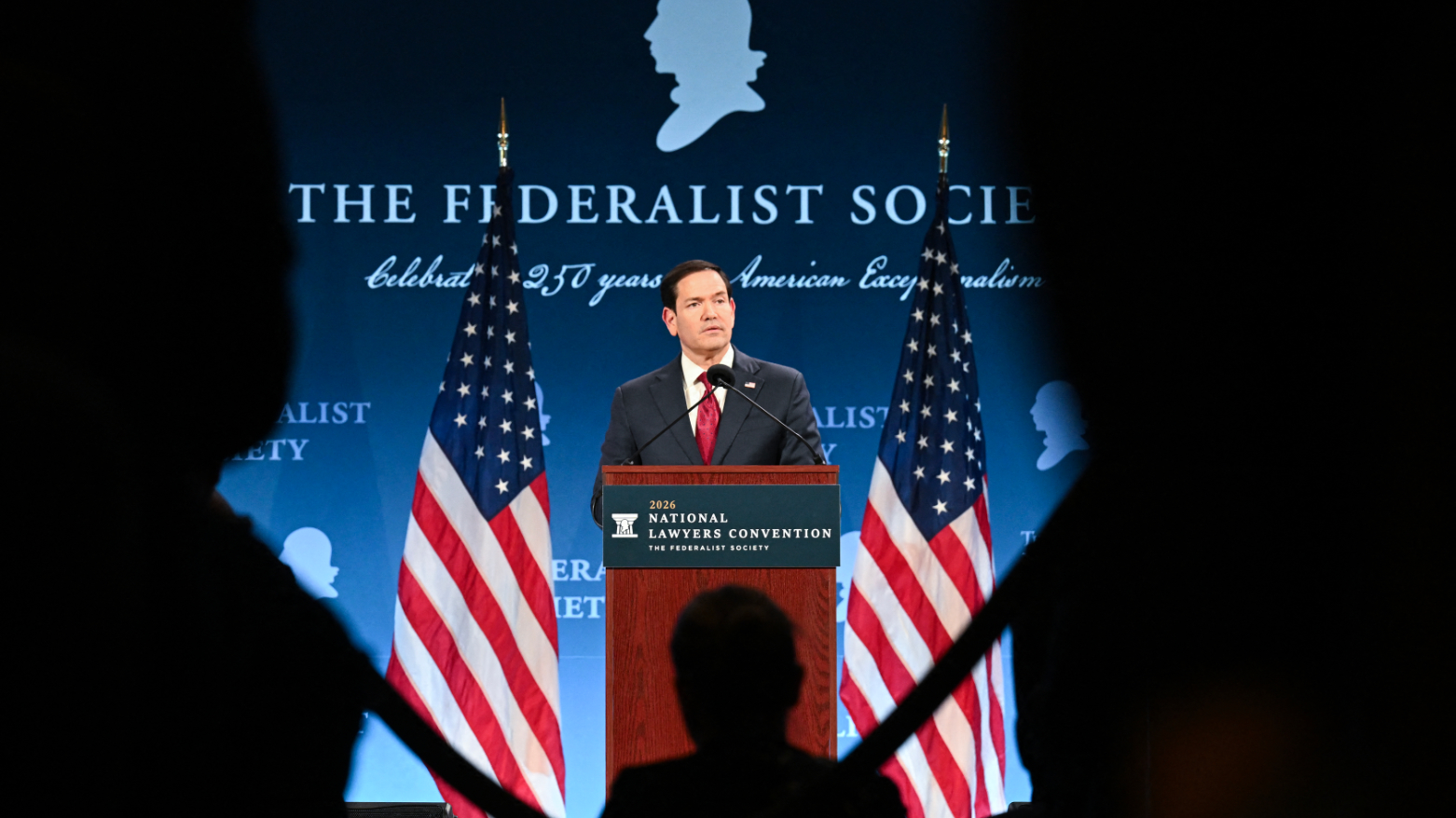
ERBIL (Kurdistan24) - U.S. Secretary of State Marco Rubio contrasted Iran with North Korea on Friday, arguing that Pyongyang's leadership is primarily concerned with keeping its regime in power while Tehran's rulers pursue a revolutionary agenda that would make an Iranian nuclear weapon especially dangerous.
Speaking at the Federalist Society's 2026 National Lawyers Convention in Washington on Nov. 13, Rubio said the defining measure of American success in its confrontation with Iran was preventing the country from obtaining nuclear weapons. He maintained that economic pressure had weakened Tehran sufficiently to make further U.S. military action unnecessary for now.
"Victory is ensuring that they never have a nuclear weapon," Rubio said during a question-and-answer session after his speech.
North Korea as a Point of Comparison
The comparison came when a law student asked what an American victory in the conflict with Iran would look like.
Rubio pointed to North Korea to distinguish what he regarded as the strategic intentions of the two governments. Although he criticized the North Korean leadership, he argued that it was focused on regime survival rather than conquering neighboring countries.
"He just wants to survive in his regime," Rubio said of North Korea's leader, adding that he did not believe Pyongyang was seeking to invade Japan or China.
Tehran's leadership, by contrast, was motivated by a revolutionary mission extending beyond Iran's borders, Rubio argued. "These people are expansionist. They're revolutionaries," he said, asking his audience to consider the consequences if such a leadership possessed nuclear arms.
The comparison represented Rubio's assessment of the governments' intentions, rather than an established prediction about how either would use nuclear weapons.
Tehran's Leadership and Nuclear Ambitions
Rubio traced Washington's confrontation with Tehran to the 1979 Islamic Revolution, asserting that Iran had been waging war against the United States in various forms ever since.
"The problem with this regime is its revolutionary nature," he said.
He distinguished the Iranian government's ordinary political institutions from the clerical leadership, which he described as motivated by religious ideology and a mission to export revolution. In his account, that distinguishes Tehran from states with which Washington has conventional diplomatic disagreements.
Rubio accused Iran of seeking nuclear weapons despite its denials. He argued that its uranium enrichment activities, missile development and drone arsenal could provide the means and protection for a future nuclear capability.
He suggested that countries pursuing civilian nuclear power, such as Japan and South Korea, did not need to develop the capabilities he attributed to Tehran.
The secretary of state did not announce a new negotiating framework, verification mechanism or deadline for addressing Iran's nuclear program. He instead described preventing Iran from obtaining a weapon as the overriding objective of U.S. policy.
Iraq and Iran-Backed Armed Groups
Rubio cited Tehran's relationships with armed organizations across the Middle East as evidence for his assessment of its regional objectives, mentioning Hezbollah in Lebanon, Iraqi militias, the Houthis and armed forces that supported the former Syrian government under Bashar al-Assad.
Discussing Iraq specifically, Rubio alleged that Iran-aligned militias had plotted attacks against U.S. interests and neighboring countries, including with sophisticated weapons. He did not identify particular Iraqi organizations or present new evidence about individual plots during his remarks.
He also referred to attacks attributed to Hezbollah, including the 1983 bombing of a U.S. Marine barracks in Beirut and the bombing of a Jewish community center in Buenos Aires in the 1990s, to support his characterization of Tehran as a sponsor of terrorism.
Rubio portrayed Iran's clerical leadership as a common factor behind several major regional conflicts. Those accusations were his assessment of Iranian involvement; the speech did not independently establish the responsibility of Tehran for every incident or conflict he named.
Economic Pressure and the Costs of Conflict
Rubio said Washington's economic pressure had already weakened Iran enough that additional military operations were not needed at present.
"Right now, frankly, the economic pain that we are inflicting on that regime is so great that there's no need for military action because we've weakened them so much," he said.
He acknowledged that armed confrontation is unpopular and brings economic costs. Nevertheless, he defended the decision by President Donald Trump to address the Iranian nuclear issue rather than leave it for another administration.
Rubio invoked threats to maritime traffic through the Strait of Hormuz, warning that Tehran could exercise far greater leverage over regional shipping and security if it possessed a nuclear weapon. He argued that such a development would threaten not only neighboring countries but also the United States.
He said the objective must be achieved "one way or the other," including by denying Iran the funds or equipment needed for a weapon. He did not outline a new military operation or additional sanctions at the convention.
His comments came as the region continued to experience the effects of the conflict with Iran, including the economic pressures he acknowledged in his remarks. Rubio's assessment that further military action was unnecessary did not amount to an announcement that the confrontation had ended.
International Law and U.S. Sovereignty
The discussion of Iran followed a broader address in which Rubio defended the Trump administration's foreign policy and criticized international legal institutions that he accused of obstructing American action.
He attacked the International Criminal Court (ICC), defended U.S. sanctions against it and rejected criticism of American operations involving suspected drug-trafficking boats in the Caribbean and the capture of Venezuela's Nicolás Maduro.
Rubio argued that international law was being used selectively by international officials, nongovernmental organizations and legal advocates seeking to restrict American sovereignty. He described the court as illegitimate and challenged its claim to jurisdiction over citizens of countries that have not accepted its authority.
These were his political and legal arguments, not judicial findings about the legitimacy of the ICC or the lawfulness of particular U.S. actions.
The secretary of state insisted that international institutions should not prevent Washington from acting in what it considered its national interest, a position that also shaped his explanation of the administration's approach to Iran.
Institutions, National Interests and Long-Term Strategy
Addressing an audience of lawyers and law students, Rubio traced the Federalist Society's beginnings to a small student-organized conference in 1982. He praised its influence in reshaping American legal debate over the following decades.
He argued that political change requires more than winning elections because universities, the press, foundations, businesses and professional organizations also shape the ideas that guide public life.
Using the political difficulties faced by Ronald Reagan early in his presidency, Rubio urged his audience to view electoral setbacks in the context of longer-term institutional goals. He said lasting achievements were built over decades rather than individual election cycles.
During subsequent exchanges with students, Rubio also discussed faith and the legal profession, American identity, immigration and the economic circumstances facing younger generations.
He argued that free markets should provide both prosperity and dignified work, acknowledging the financial pressures facing younger Americans and warning against treating economic indicators as the only measure of citizens' well-being.
On foreign policy, he maintained that the United States must remain engaged with the world because instability abroad can affect American security, jobs and access to markets. But he argued that such engagement should begin with the interests of American citizens, whether Washington is building alliances or managing disputes with other governments.
That emphasis carried through to his remarks on Iran. Rubio framed the confrontation as a question of U.S. security and the regional consequences of Tehran's ambitions. He made the desired outcome explicit: Iran must never acquire nuclear weapons, though he offered no detailed timetable for achieving it.