Prime Minister Barzani Details 2027 Budget Dispute, Khor Mor and Government Talks
Prime Minister Masrour Barzani outlines disputes over Iraq's 2027 budget, Khor Mor repairs and security, and talks to form the next Kurdistan government.
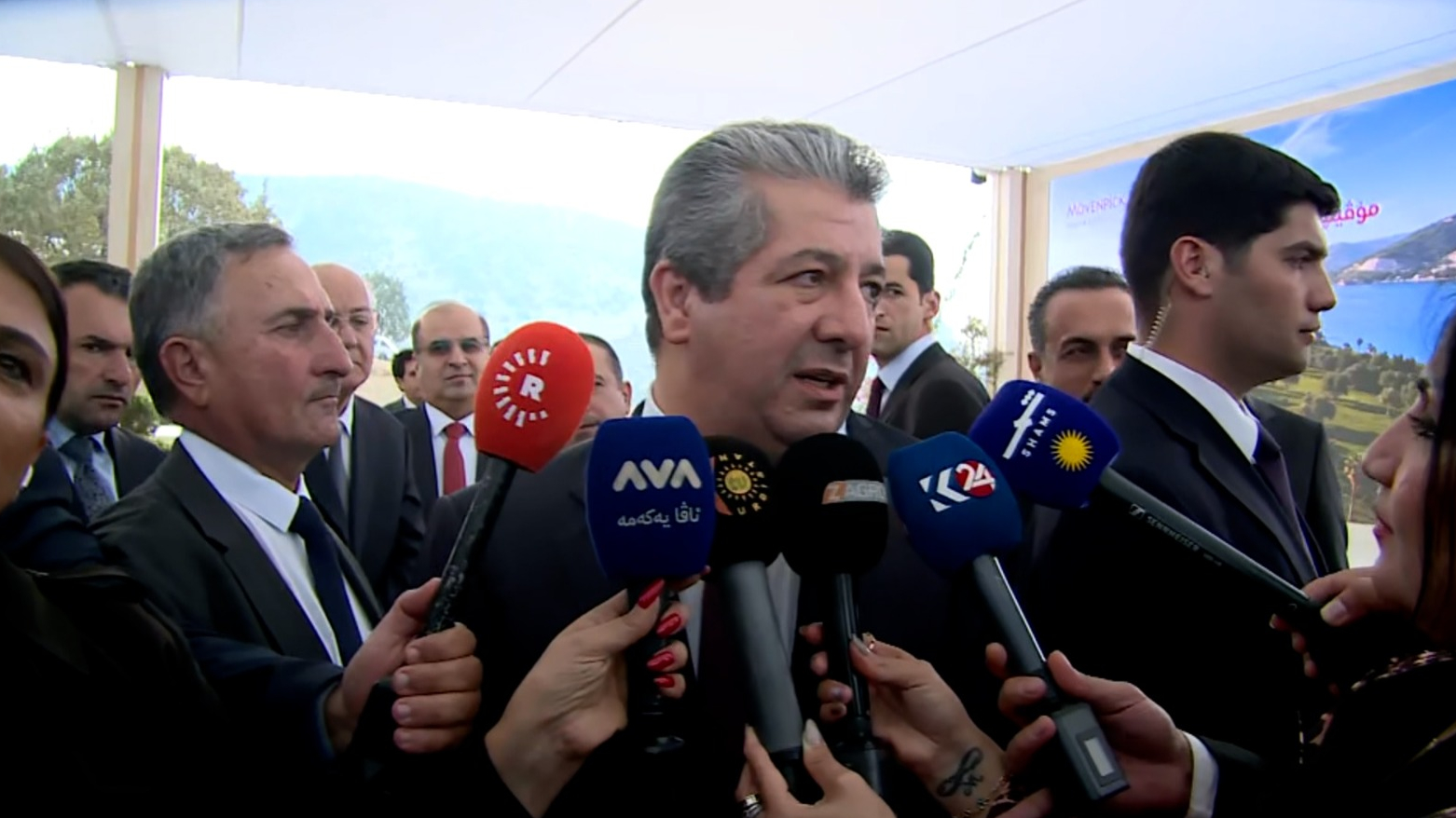
ERBIL (Kurdistan24) - Prime Minister Masrour Barzani said on Tuesday that restoring electricity supplies disrupted by the drone attack on the Khor Mor gas facility depends on repairing extensive damage and obtaining security guarantees, while disclosing details of a continuing dispute with Baghdad over the Kurdistan Region's proposed share of Iraq's 2027 federal budget.
Speaking to reporters following the foundation-stone ceremony for the Mövenpick-Gomaspan resort near Erbil on Nov. 17, 2026, Prime Minister Masrour Barzani also confirmed continuing contacts between the Kurdistan Democratic Party (KDP) and the Patriotic Union of Kurdistan (PUK) over forming a new regional government.
He reaffirmed his opposition to attempts to divide the Kurdistan Region and renewed demands for stronger air defenses.
KDP-PUK Contacts and Government Formation
Addressing the formation of the next Kurdistan Regional Government, Prime Minister Masrour Barzani said President Masoud Barzani's initiative should provide the basis for political parties to resume negotiations following the reactivation of the Kurdistan Parliament.
"Ever since the President's call, the KDP has been in continuous contact with the PUK leadership to hold a meeting," he said.
Prime Minister Masrour Barzani expressed the KDP's willingness to establish a government together with the PUK but emphasized that the outcome must reflect election results and respect the electorate's choices.
He insisted that reopening Parliament was intended to safeguard institutional legitimacy, not target any political party.
He said the door remained open to parties prepared to set aside narrow political interests, expressing hope that constructive negotiations would produce a government soon.
Khor Mor Damage and Electricity Restoration
The consequences of the drone attack on the Khor Mor gas facility occupied a substantial portion of the press conference.
Prime Minister Masrour Barzani described the damage as extensive and cautioned that restoring electricity generation depended on technical repairs and assurances against future attacks.
"It depends on the extent of the damage caused to the refinery," he explained, adding that those responsible for operating the facility also required credible security guarantees before normal operations could resume.
He said an investigative committee had been established to identify the perpetrators and those responsible for supporting the attack, expressing hope that its findings would be announced promptly and those involved brought to justice.
Khor Mor, he explained, has been a major source of natural gas for electricity generation throughout the Kurdistan Region, with electricity also supplied to other parts of Iraq.
Prime Minister Masrour Barzani recalled previous requests to the federal government for guarantees that energy infrastructure would not face further attacks, saying such assurances remained essential.
He also reiterated longstanding requests for anti-drone and anti-missile capabilities, saying the Kurdistan Regional Government had approached Baghdad, international allies and friendly countries for assistance.
"Unfortunately, such capabilities are not adequately available so far," he said, arguing that stronger defenses were necessary to protect economic infrastructure, security installations and civilians.
Baghdad Budget Dispute: 13 Trillion Versus Nearly 30 Trillion Dinars
Turning to the proposed 2027 federal budget, Prime Minister Masrour Barzani revealed that an initial draft allocated just 13 trillion Iraqi dinars to the Kurdistan Region from an overall budget of 216 trillion dinars.
He rejected the proposed allocation as unfair, arguing that the Kurdistan Region's share should reflect what he described as its 14.14 percent proportion of Iraq.
"If so, nearly 30 trillion should go to the Kurdistan Region. On what basis is it 13 trillion?" he asked.
Prime Minister Masrour Barzani said discussions with federal financial authorities had failed to produce a convincing justification for the proposed allocation, particularly concerning deductions for sovereign and governing expenditures.
Following extensive negotiations in Baghdad, he said both sides had reached an understanding that public-sector salaries in the Kurdistan Region should be paid separately, as they are elsewhere in Iraq.
For investment and operational expenditures, he outlined two alternatives.
Under the first, half of the relevant federal revenues would be transferred to Baghdad, with the federal government financing the Kurdistan Region's operating and investment expenditures.
Under the second, the Kurdistan Region would retain its non-oil revenues and finance those expenditures itself, excluding salaries, while oil revenues would continue to be transferred to the federal government through the State Organization for Marketing of Oil (SOMO).
Although understandings had been reached during negotiations, Prime Minister Masrour Barzani said additional provisions that had not been discussed were subsequently introduced by federal ministers.
Consequently, the matter remains unresolved.
"We continue our talks with the federal Government. We have no final result yet," he said.
Parliament, Halabja and Kurdistan's Unity
Asked about a legal challenge concerning Parliament, which a reporter attributed to the PUK and New Generation, Prime Minister Masrour Barzani welcomed the Federal Supreme Court's rejection of the lawsuit.
He criticized attempts to dissolve the legislature, describing Parliament as an institution established through the democratic participation and sacrifices of the Kurdish people.
He also praised residents of Halabja who, according to the reporter, had removed tables, chairs and a banner associated with an initiative to separate Halabja from Sulaimani.
"I commend the people of Halabja and all those loyal Kurds who oppose this campaign; I shake their hand and thank them in Sulaimani, in Halabja, Erbil, Duhok, wherever they are," Prime Minister said.
"I ask all our brothers and sisters in Kurdistan to oppose this campaign, because this is a betrayal of the gains of our martyrs, our Peshmerga, our experience, and dismantling the Kurdistan Region's entity is not something any patriot or loyal person accepts," Prime Minister Barzani added.
Prime Minister Masrour Barzani urged people throughout the Kurdistan Region to oppose campaigns threatening its political and institutional unity.
"It is truly regrettable that someone would go and file a complaint in court to dissolve your parliament, a parliament that is the fruit of the votes of Kurdistan's people, whom people voted for, the blood of our martyrs, the fruit of the toil and labor of our Peshmerga," Prime Minister said.
"We have a long history; we have waged a long struggle against dictatorship and tyranny in order to build an entity. Now that this entity is built, some people, without feeling any responsibility, go and ask to dissolve this entity," he added.
"The Kurdistan Region will certainly stay united, and no one has the right nor the ability to divide Kurdistan," he declared.
"I thank the Federal Court for rejecting this lawsuit, and the people of Kurdistan must know and remember who is working to advance the Kurdistan Region and protect this entity, and who is undermining it. We have more elections ahead. People should remember these stances," Prime Minister Barzani said.
Winter Fuel and German Delegation
On winter fuel supplies, Prime Minister Masrour Barzani said Baghdad had promised an initial delivery of approximately 50 million liters of fuel.
He expressed hope for further allocations, emphasizing that the initial quantity would be insufficient for mountainous communities experiencing severe winter conditions.
He also confirmed meeting Germany's development minister, saying their discussions covered bilateral relations, internal developments in the Kurdistan Region, relations with Baghdad and wider regional affairs.
International Investment and Tourism
Returning to the occasion of the press conference, Prime Minister Masrour Barzani welcomed Accor's investment involvement through the Mövenpick-Gomaspan development.
He described the international hospitality group's presence as an indication of confidence in the Kurdistan Region's stability and an opportunity to expand tourism.
Prime Minister Masrour Barzani said the resort would provide additional opportunities for residents and international visitors to enjoy Kurdistan's natural landscape, while encouraging other companies to undertake comparable projects.
He linked such investments to his government's broader objective of strengthening the Kurdistan Region's economy and expanding opportunities for its people.
Full Transcript of Prime Minister Barzani's Press Conference Following the Launch of Mövenpick-Gomaspan Resort on Tuesday:
Reporter: did its biggest project there. What does this tell us? I always asked: when does parliament reopen? It worked: it reopened. When's Government formed?
Prime Minister Barzani: First, I am pleased that a company like Accor, by bringing the Mövenpick hotel, is coming to Kurdistan. This paves the way and shows the Kurdistan Region's stability in every aspect.
And this also helps Kurdistan's people in terms of tourism. I also hope the people of Kurdistan can, once this and similar projects finish, benefit more from such projects and enjoy the beauty and nature of Kurdistan.
I commend them. I hope there are many more, and other companies undertake such projects in Kurdistan.
Thank God, parliament reopened, and the Government depends on that. We urge that President Barzani's initiative becomes a basis for every political party to come and hold talks to form the Government.
The door is open. Reopening parliament was not against any party. Rather, it was to protect the legitimacy of parliament and the Kurdistan Region.
And now we are ready to engage with any political party ready, for the sake of the people of Kurdistan, to put aside their narrow personal and party interests and come talk to us.
We are ready, and open-hearted, and we can help a great deal to form the Government very soon.
Reporter: Kak Masrour, is there any effort for a KDP-PUK meeting? My second question: on Khor Mor... Is there contact for a KDP and PUK meeting? Secondly, as you know, in Khor Mor people wonder when power will normalize and gas output resumes.
Prime Minister Barzani: Ever since the President's call, the KDP has been in continuous contact with the PUK leadership to hold a meeting.
The KDP states this very frankly and sincerely: we have no message that is Only words to speak; rather, from our hearts we want to form a Government together that serves all the people of Kurdistan.
Yet at the same time, everything must be in proportion, and the vote of Kurdistan's people must be respected, and election results become the basis to form a Government in the future.
Sadly, what happened at Khor Mor harmed all the people of Kurdistan and Iraq as well, because Khor Mor was a major, huge source for generating electricity for all Kurdistan's people, and from Kurdistan it also sent power to Iraq.
A committee has been formed over this attack on Khor Mor to reach findings and find out who was behind this crime, who carried it out, and who backed it.
I hope this committee soon reaches a result, revealing the names and parties involved, and face legal justice,
Reporter: When will power normalize?
Prime Minister Barzani: It depends on the extent of the damage caused to the refinery, as it is clear that Khor Mor suffered immense damage, at the site that was struck by a drone.
And until they repair it—that is one part, a technical one, I'd say— another part is that they want security guarantees that such an attack will not occur again.
This request was previously made to the federal Government, to the Prime Minister, who himself promised that there would be no more attacks on such economic infrastructure in the Kurdistan Region working to produce energy.
We hope those who did this face justice and that it is never repeated. The assurances and guarantees that everyone needs should be provided to them.
Reporter: Mr. Prime Minister, Iraq's Federal Court revoked the injunction on parliament that PUK and New Generation filed a lawsuit over. What about this error?
My other question: today Halabja's people removed the tables, chairs, and banner set up to separate Halabja from Sulaimani; they cleared them away and supported a united Kurdistan Region. What about the people of Halabja?
Prime Minister Barzani: First, I commend the people of Halabja and all those loyal Kurds who oppose this campaign; I shake their hand and thank them in Sulaimani, in Halabja, Erbil, Duhok, wherever they are.
I ask all our brothers and sisters in Kurdistan to oppose this campaign, because this is a betrayal of the gains of our martyrs, our Peshmerga, our experience, and dismantling the Kurdistan Region's entity is not something any patriot or loyal person accepts.
It is truly regrettable that someone would go and file a complaint in court to dissolve your parliament, a parliament that is the fruit of the votes of Kurdistan's people, whom people voted for, the blood of our martyrs, the fruit of the toil and labor of our Peshmerga.
We have a long history; we have waged a long struggle against dictatorship and tyranny in order to build an entity. Now that this entity is built, some people, without feeling any responsibility, go and ask to dissolve this entity.
I thank the Federal Court for rejecting this lawsuit, and the people of Kurdistan must know and remember who is working to advance the Kurdistan Region and protect this entity, and who is undermining it.
We have more elections ahead. People should remember these stances.
Reporter: PM Masrour Barzani, regarding protecting the Kurdistan Region from drone strikes, especially targeting oil sites, are you seeking to acquire air defenses, or in talks with the Iraqi government to resolve this?
Prime Minister Barzani: We have requested it. We have long demanded that the Regional Government have anti-missile forces or capabilities, as well as anti-drone defenses.
Unfortunately, such capabilities are not adequately available so far. We have asked the Federal Government, the allies, and all our friends to help us secure air defense so that we can protect both our economic infrastructure, these fields, and Kurdistan's people.
Because it is not Only fields and economic sites that are targets of such terrorist attacks, but security and military sites, and even civilians, have been targeted.
We hope this needed support is provided to the Kurdistan Region so that these attacks can no longer disrupt our economic infrastructure or disrupt citizens' lives.
Reporter: Kak Masrour, will all get oil?
Prime Minister Barzani: We requested it, and the federal Government promised, so far I think 50 million barrels—million liters, they promised this as a first batch.
We hope further batches will follow. Because as you know, the Kurdistan Region, especially the mountains, is very cold, and this is not enough.
So we hope to secure the needed fuel step by step.
Reporter: Today, the German Development Minister was here. They reportedly were keen to meet politicians and visit Kurdistan. What did she tell you, and on Kurdistan's share of the 2024 budget, has Baghdad promised to resolve the issues and set Kurdistan's share?
Prime Minister Barzani: Visits by foreign delegations to Kurdistan are all important, and we—I met the honorable Minister, and we discussed bilateral relations, Kurdistan's internal situation, our ties with Baghdad, and the regional situation in general; we discussed these points.
Regarding your second question—
Reporter: Kurdistan's share—
Prime Minister Barzani: —in the budget for
Reporter: 2027.
Prime Minister Barzani: We have tried, but so far the budget has not been debated. A draft was prepared, but we did not agree with it, because frankly, there was great injustice against the rights of the people of Kurdistan in it.
Out of 216 trillion, they allocated 13 trillion to Kurdistan. After my visit to Baghdad, we had a lengthy discussion there with the Finance Minister and the Baghdad Government in general, and we asked them on what basis they set that share for us.
The Kurdistan Region is 14.14% of Iraq, so in terms of budget allocation, that share must be taken into account. If so, nearly 30 trillion should go to the Kurdistan Region. On what basis is it 13 trillion? They really had no convincing answer.
They used some figures, and then argued that sovereign and governing expenses must be deducted, where the Kurdistan Region has its share. But nothing was designated there for the Kurdistan Region, which led to a lengthy discussion, and they were convinced that there is injustice in providing the share allocated to the Kurdistan Region.
We later spoke with the Prime Minister, and on several points we agreed, to be honest, that Kurdistan Region salaries, like those of all other people of Iraq, be paid and kept separate.
To fund the budget share for investment and operating expenses, as they call it, for this we had two proposals: half of federal revenues to the federal Government be returned, and the federal Government covers the share for investment and operating costs for the Region, or all non-oil revenues remain with the Region, and its Government assumes responsibility for all budgets except salaries, while oil revenue goes to the federal Government, sold via SOMO, and is already with the federal Government.
We agreed on this. But after my return, some changes were made, and ministers added some clauses that were never discussed at all during our talks.
So this matter remains pending so we can reach a final conclusion.
Reporter: Will any delegation go to Baghdad over these changes?
Prime Minister Barzani: We continue our talks with the federal Government. We have no final result yet.
Reporter: Will Kurdistan Region stay united?
Prime Minister Barzani: The Kurdistan Region will certainly stay united, and no one has the right nor the ability to divide Kurdistan.
Reporter: Thank you. Thank you.