Prime Minister Masrour Barzani's Special Panel at the World Youth Summit in Kurdistan
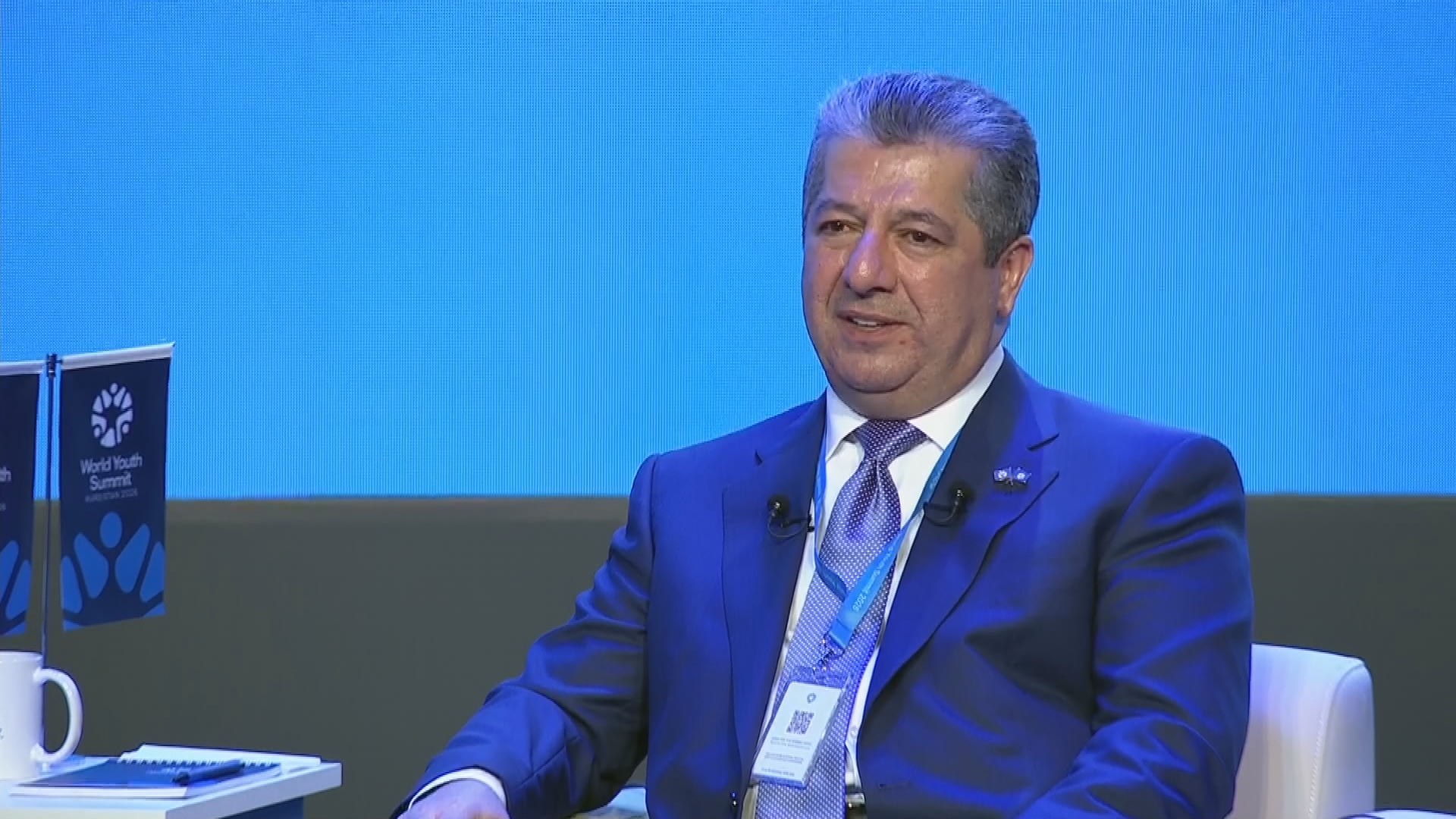
ERBIL (Kurdistan24) - On Tuesday, Nov. 24, 2026, Kurdistan Region Prime Minister Masrour Barzani participated in a special panel at the first World Youth Summit in the Kurdistan Region.
Full Transcript of Prime Minister Masrour Barzani's Special Panel
Moderator: A very warm welcome, Prime Minister. Greetings and welcome to our distinguished guests. As you can see, we have gathered here today at the World Youth Summit. We have nearly 800 people in this hall, with many more joining us online and through television. We also have many distinguished and dear guests, including officials and ministers, and people here from 47 different countries around the world. I would like to begin with one question and hear your thoughts. What do you hope will come out of our gathering here today, particularly for young people?
Prime Minister Masrour Barzani: Thank you very, very much. First, allow me to extend a warm welcome to all the participants and our dear guests. Welcome to Erbil. Welcome to Kurdistan. Welcome to your own home. We are extremely pleased and honored by your presence, particularly those distinguished guests who have come from far away. I hope you have an enjoyable time, and I wish all of you success at this summit. Thank you very much. I would also like to thank the organizers of this summit at Kurdistan Foundation. It is truly a remarkable initiative to hold the World Youth Summit in Erbil for the first time.
I hope this will be a beginning and a starting point for connecting the youth of the Kurdistan Region with young people around the world. I hope it will also become a starting point for exchanging ideas, developing young people and creating opportunities to showcase the abilities of our youth, just like young people everywhere else in the world. Together, we can cooperate with one another and envision a better and more stable country for all of us. So, in response to your question, I believe this is a very positive initiative. I congratulate you on what you have done. Our participation, of course, is intended to support the potential of our own young people at events such as this, and I wish you every success.
Moderator: Over the next few days, we will witness a number of very interesting discussions. One that particularly interests me is about leadership. In your view, are leaders born or are they made?
Prime Minister Masrour Barzani: I believe it is both.
Part of it relates to genetics, physical ability and mental capacity, and in that respect God has to help you to some extent. But the other part is how you develop yourself, particularly within the society in which you live. Through the trials of life, how do you test yourself? How much can you develop yourself? How much can you learn from those around you and from your society? How can you make the right decisions, particularly during difficult times, without losing hope?
All of these things undoubtedly influence the development of the personality of someone who may become a leader. Leadership has different meanings. Every person needs to exercise some form of leadership in their own life - in managing their own life, their relatives, their family and their community. But as that role grows and expands, and as a person's public standing increases, the leader's responsibilities naturally become greater.
Building trust, understanding people, listening, engaging with them and maintaining communication between a leader and citizens are extremely difficult and important responsibilities. Any leader can become a successful leader if they are able to earn the trust of their people.
Moderator: Your comments on the qualities of a leader were very interesting. I was actually going to ask you directly what you think the qualities of a good leader are, but you have already answered that. I would like to ask you something different now, something a little more personal. In your everyday life, during those parts of the day when you are no longer acting as Prime Minister and you are relaxing or resting, what do you like to do? Do you have hobbies, or do you mainly prefer spending time with your family?
Prime Minister Masrour Barzani: If I have the time, of course I have interests and hobbies, and sometimes I like to spend time on them. Because I do not have much free time, I prefer to spend the limited time I do have with my family and children. But if I happen to have some additional time, I enjoy horse riding. From time to time, I like to go riding. I exercise as well.
Sometimes, if I have an opportunity, I like to go out and see the surrounding areas. I particularly love nature. I enjoy going outdoors and seeing some of our beautiful natural landscapes. But all of that depends on how much time is available for these kinds of activities.
Moderator: God willing, you will have the opportunity.
Prime Minister Masrour Barzani: Yes, God willing.
Moderator: You are also very fond of painting, Prime Minister. I wanted to know whether that is an interest you have had since your youth or something you discovered later in life.
Prime Minister Masrour Barzani: I have loved drawing since I was very young.
I enjoyed it and gradually began practicing and working on it. Later, I tried to teach myself more. I had several teachers who were able to help me improve my painting, particularly oil painting - oil on canvas and similar techniques.
I managed to develop myself to some extent professionally. Later, at university, I also tried to further develop my abilities in painting and related areas. Whenever I have the opportunity and the time, I still sometimes occupy myself with it.
Moderator: Very interesting. I will return to your university experience shortly. But staying with young people and their interests, one thing many young people are now engaged with is video games. I have noticed that in the Kurdistan Region, young people are not only users of video games, but we now have talented people who are actually developing them. I wanted to know whether you have any familiarity with video games or whether you have ever played them yourself.
Prime Minister Masrour Barzani: I see them and know something about them to a certain extent. There are some very impressive and enjoyable things being created now, but I do not know very much about them. When I was younger, we tried them a little. When Areen was very young, I would sometimes play football games with him, but he would beat me every single time!
I also remember one occasion when I wanted to play with my nephews and nieces. They were playing together, and I heard one of them say to the other, "Let's deliberately lose and let him win!" After that I got up and said, "By God, I am never playing with you again!"
So I do not know very much about video games, but there is no doubt that impressive things are being created. I am pleased if our young people have reached a level where they are able to develop games themselves. There are many old traditional Kurdish games that they could revive through video games and these kinds of technologies, allowing everyone to experience them.
But what I would like, and what I ask of young people and children, is that they learn these kinds of technologies because that is a good thing, but technology should not become a substitute for everyday life. It should not replace social relationships with relatives, family, mothers and fathers, friends and loved ones.
It is therefore important to maintain balance - a balance between how far you enter this new world and ensuring that you do not become disconnected from the real world in which you live. Maintaining that balance is very important, and young people should keep that in mind.
Moderator: Thank you. I completely agree. Fortunately, young people today have the opportunity to pursue interests and hobbies. But if I am not mistaken, you were only 16 years old when you first became a Peshmerga. I would like to understand what the circumstances were like at that time that made it necessary for even someone of your age to take up arms. Was that the first time in your life that you had to confront responsibility?
Prime Minister Masrour Barzani: We were displaced when I was 16 years old. We were refugees in a neighboring country. At the time, I was still at school. I was in secondary school and had one year remaining. But during the summers, I very much wanted to experience the life of the Peshmerga. Believe me, the older people I saw around me, all the people I was proud of and admired, were Peshmerga - from my father to relatives and all those heroic Peshmerga whom I saw around me.
My life was intertwined with theirs. So I never saw myself as separate from them. When I took up arms and wanted to become a Peshmerga, I wanted to be like them. I wanted to experience their lives. There was something inside me - a desire and passion. I had always been deeply fascinated by the life of the Peshmerga and wanted to become one.
There were many people, many young people, and all of them wanted to become Peshmerga. At the time, there were not many other opportunities available either. Life as refugees was certainly not easy. So I wanted to spend the time I had in the mountains with the Peshmerga.
There was something about being there, feeling absolute freedom in those mountains and living as a Peshmerga, that I genuinely loved. So it was not out of necessity. It was because of my own desire and choice that I wanted to become a Peshmerga.
Moderator: Had I known that, perhaps we could have changed the title of this panel to "When You Seek Responsibility," rather than "When Responsibility Finds You."
Prime Minister Masrour Barzani: Everyone faces responsibility in their life. You do not always necessarily want to be responsible. Sometimes, as you said, responsibility grabs you whether you want it or not. Life's hardships mean that everyone, depending on their circumstances, must face responsibility.
Moderator: Certainly. I would like to discuss another subject that I personally find very interesting: knowing languages. Some people may argue that because of advances in artificial intelligence, perhaps in the very near future knowing different languages will no longer have the status and importance it once did. But you speak English, Kurdish and Arabic very well. I am particularly interested in your English. How did you learn it?
Prime Minister Masrour Barzani: From the beginning, you naturally study some English at school. I wanted to learn it quickly, but until I reached my youth, I was not particularly good at it. Later, when I had the opportunity - although I returned to university somewhat late - I tried to improve it. I finished secondary school at the age of 17, but I was not able to return to university until I was approximately 22.
During that period, I tried to improve my English to some extent.Later, when I had the opportunity, I went to London and then to the United States. At university, I made a very serious effort. Particularly in Britain, I worked hard on learning the language and improved considerably. Later, when I went to university, I continued working to improve my English. With all due respect, however, I do not believe technology can replace learning a language.
Knowing languages is important. Every additional language a person learns creates the strength of another person within themselves. Every language therefore gives a person additional strength and capability. I particularly like learning the languages of the peoples around us, those with whom we interact daily, as well as languages that connect us with the wider world.
The world has become very small now. Every language you learn is undoubtedly useful. I still hope to continue, and if I can, I would still like to learn other languages.
Moderator: In your view, has knowing different languages - and having lived in several different societies yourself - had a major impact on your outlook on life or made things easier for you?
Prime Minister Masrour Barzani: Certainly. Learning a language has an impact, particularly when knowing the language is not simply about speaking it but also about learning about the culture and history of the people who speak it. Understanding what a people's history has been, how they developed and what they achieved - all of these can become lessons from which you can learn.
Every nation and every language has its own history filled with experience. By understanding their culture through their language, you can interact more effectively with the international community and better understand their perspectives. That is extremely important in political life.
You should not look at the world solely from your own perspective. You also need to understand how the other side sees the world and how they view different issues. That greatly helps people understand one another better.
Moderator: Later, you went to study in Washington, the capital of the United States, and I am very pleased that you studied the same field that I did: international relations. I would like to know what your experience was like going to such a distant and unfamiliar country to study. At the same time, do you think it is normal and beneficial for our young people to go abroad for education?
Prime Minister Masrour Barzani: America is a multicultural country. At the university where I studied - American University in Washington - you could see students from most countries around the world. There were students from Asia, Africa, Europe, America, Latin America - from everywhere.
So I was not the only person who was different. Everyone had their own form of difference. What I found particularly striking was that I felt I was a young person who had been given the opportunity to come to a highly developed country and study at a good university.
I felt that I carried a responsibility far greater than myself. I often thought to myself that there must be many Kurdish young people who were smarter, more talented and more capable than me, but who had not been given this opportunity. So I felt I had to do everything I could. At the time, I was the only Kurd at that university.
I wanted the young people, students, friends and professors there to know that I was at least no less capable than anyone else. I worked extremely hard. I studied my lessons very seriously and devoted myself intensely to my studies because I wanted to prove a point: that I too could do what others could do.
I believed that when people looked at me, they were looking at a Kurd. They would not say, "This individual." They would say, "A Kurd. Can this Kurd succeed or not?" And my objective was not merely to succeed. I wanted to be among the best. By God's grace, I was able to achieve that as well.
Moderator: I found that very interesting because, in a way, you also spoke about identity. I was going to ask whether you felt very different from your classmates simply because you came from here. But I particularly liked what you said about feeling that responsibility because you had been given this opportunity and felt that you had to make the most of it. When you were so focused on studying and working hard, did you still manage to make friends?
Prime Minister Masrour Barzani: Of course. I had friends too.
Moderator: And if we brought one of those friends onto this stage today, how do you think they would describe you at that time?
Prime Minister Masrour Barzani: It is difficult for me to say how they would describe me, but I think they would probably say I was a serious person. Perhaps I was not much fun when it came to going out and such things because I was very, very focused on my studies.
Moderator: Some time after you returned here following your studies, you established the Barzani Charity Foundation. I would like to know what your vision was at the time in establishing an organization of that kind, particularly because I do not believe organizations and institutions of that nature were very common at the time.
Prime Minister Masrour Barzani: There were several reasons. We live in a country filled with enormous natural and national wealth and resources, but unfortunately we have not been able to benefit sufficiently from them. As a result, our people have not received the level of services they should have. After all the wars, killings, arrests and destruction, many people were left in very difficult circumstances.
As you know, 4,500 villages and rural communities in Kurdistan were destroyed. Many people became refugees or were forced into camps. After that period, we saw that unfortunately there were still many people whose standard of living was not sufficient for them to support themselves and their families. Of course, people in such circumstances still exist today.
I believed that we needed to help one another through a charitable organization in which assistance would be provided without making people feel indebted. Why did we choose the Barzani name? Because the immortal Barzani devoted his entire life to serving his people and nation.
I believed, on the one hand, that continuing the immortal Barzani's philosophy of service should never stop. On the other hand, I believed that we were indebted to this great man and that whatever we did should carry his name so that we could continue serving the path he had established. So it was about honoring the name of the immortal Barzani and carrying that message to people through a charitable organization where assistance comes without obligation or discrimination.
The Barzani Charity Foundation operates without political or geographical discrimination, not only in the Kurdistan Region but also in neighboring countries and even as far as Africa, Asia and many other places, including Europe.
The Barzani Charity Foundation has been able to operate in all those places and has also received formal recognition from the United Nations. It has therefore become an international organization that every Kurd can be proud of. I am proud that we began establishing this organization from the very beginning.
But the original idea was that we should give back whatever we were capable of giving to those who were in need and required assistance, without making them feel indebted in any way. That is extremely important.
When you do charity, you should never make the recipient feel indebted to you. I believe that is the Foundation's message. I will conclude this point with what the immortal Barzani used to say: "It is an honor for a person to be a servant of his nation."
Moderator: The reason I raised this issue is because it made me think about social responsibility. All of us have responsibilities toward society, while society also has responsibilities toward us. You established this institution around 2005, if I am not mistaken, at a time when there were not many opportunities and not much had been institutionalized. Using that example, do you think it is understandable when a young person becomes frustrated about how they can participate in society? And what advice would you give to a young person who wants to feel a greater sense of ownership toward their homeland?
Prime Minister Masrour Barzani: First and foremost, young people must understand that the country does not belong to someone else who will then give it to them. It belongs to them. They are the owners of the country. Our young people should therefore never think of themselves as strangers or outsiders waiting for someone else to hand this country to them.
They themselves own this country. The connection between a young person and their country must therefore come from within. I ask all young people to have the strongest possible relationship with their homeland. Their roots must be firmly planted in this soil and in this country. It belongs to them. They must build it themselves. They must move it forward themselves. They must also identify responsibilities for themselves and ask, "As a citizen, what can I do for my country?"
They should not simply wait. Why does a young person become frustrated? Perhaps because someone or some institution has failed to serve them at the level required. But is that young person a guest who should simply wait for someone to serve them? No. They are the owner of the house.
Young people should therefore never simply wait for someone to come and serve them or create employment opportunities for them. At the same time, of course, it is the responsibility of the government and of those officials for whom young people vote and whom they expect to represent them to provide services and create employment opportunities.
So responsibility exists on both sides. Young people need to feel a much stronger sense of duty and responsibility themselves toward their relationship with their country. There was also another part of your earlier question that I did not answer. You asked whether young people should go abroad. If a young person can go abroad to further their education, just like anyone else, that is completely normal.
But they should not go in order to distance themselves from their country. They should go to gain experience and then return.
Moderator: Do you genuinely believe that one day we can make the Kurdistan Region less dependent on oil, particularly through tourism and more broadly through economic diversification?
Prime Minister Masrour Barzani: Yes. From the beginning of the Ninth Cabinet, we adopted a policy of diversifying our economy. We did not want to depend only on oil and gas. Instead, through agriculture, industry, tourism and every available avenue, we sought to develop other sectors of the economy.
To a considerable extent, we have been successful. In agriculture, very significant achievements have been made. Domestic agricultural production increased substantially. Many farmers who previously had to throw away their produce were later able to sell their products within the Kurdistan Region because of the policies adopted by the government.
In addition, international markets were opened for them. Exporting agricultural products abroad has also had a major impact. This is extremely important for ensuring food security because a country needs to be able to depend on its own domestic production. We have achieved a great deal in this area, but there is still enormous room for further progress, particularly scientifically - how we can produce more and with better quality.
Tourism is another area. Kurdistan has many extremely attractive and beautiful places, and every part of Kurdistan has its own unique beauty. We have tried to give greater attention to tourism. There are measures that the government must take, including building roads and infrastructure, providing services and developing the banking sector, which is extremely important for foreign tourists.
On some of these issues, we also need cooperation with the federal government because they are not sectors entirely under our authority. But we have tried through every possible means to facilitate an increase in the number of tourists visiting the Kurdistan Region. Tourism creates employment opportunities.
It introduces and showcases Kurdistan's beautiful nature to visitors. It promotes cultural interaction and interaction between businesses and trade. In every respect, it can provide major benefits to citizens. We have already started this process and have major projects.
Some projects have been completed. Some are under construction. Some are approaching completion, and preparations are underway for others. We hope to further develop the tourism sector in the future. This can create many employment opportunities for young people.
Once a foundation is established, more opportunities emerge and others in the private sector can come forward and create similar businesses. Creating opportunities opens a much larger door for the private sector to come forward. I see that many of our young people learn from one another and can undertake these kinds of initiatives.
There is another point I would like to mention, which is government support in creating opportunities for young people. We have a project called "Gashanawa" (Bloom). Through this project, the government helps young people develop themselves. If they already have a business, they can expand it. If they have a good idea for establishing a business, they can create something that involves not only themselves but also friends and other people who can work together and manage that business.
It has been a successful project and a successful experience. Many young people have benefited from it. We will continue. If we receive the support we need, particularly in terms of the budget, and the Kurdistan Region receives its financial entitlements in full, believe me, Kurdistan will witness tremendous economic progress and development in a very short period of time, God willing.
Moderator: Another subject that I personally consider extremely important is the Kurdish diaspora. There are now hundreds of thousands, perhaps millions, of Kurds living in the diaspora. Some are abroad for education, some for work, while others left long ago because of circumstances and now live there permanently with families and subsequent generations. To what extent do Kurds in the diaspora have a place in your plans and agenda? Have you considered giving them responsibilities and involving them?
Prime Minister Masrour Barzani: Much of this depends on that young person's own sense of responsibility. If they have not disconnected themselves from their country, society and history, they will naturally feel that responsibility. You do not necessarily need an official position or responsibility in order to serve your nation. Through positive words, by building relationships or by succeeding in whatever profession you pursue in that country, you can help your homeland.
The individual's own sense of responsibility therefore has a major effect on how they can contribute to their country. But we, as the Kurdistan Regional Government, have also had programs. We have had one or two experiences where we invited young people from abroad to return and visit the country, to see it and create greater interaction. Some may never have seen their homeland in their lives and may not have developed a strong emotional connection with it.
Returning, visiting and interacting with their own society, and experiencing life differently in their own country, can have an impact on them. God willing, we will work more on this issue.
Moderator: Another subject is that every new generation arrives at a table that has already been prepared for it by the previous generation. In our case here, it was your generation and the resistance and struggle you went through that meant my generation does not know those experiences and, fortunately, will hopefully never experience them. But young people like me are now thinking about what we can do for the future and what we can leave behind for the generations that follow us. What do you think our generation should focus on most for future generations?
Prime Minister Masrour Barzani: Life is constantly changing, and I hope the new generation never has to live the life of previous generations because it was extremely difficult. Displacement and living under oppression are not things anyone should wish for. God willing, they will never experience them. But it is good for them to learn from them. The new generation needs to understand how these achievements were obtained and how much hardship was endured to achieve them.
Today, some people may wish for certain things or become influenced by certain political propaganda, but unfortunately this often comes from not knowing what life under oppression was like, what displacement was like and how the absence of freedom makes life miserable. I hope the new generation never repeats or experiences such a life. But for the future, they need foresight, a global outlook and engagement with the world.
They should look toward making progress every day and becoming more successful. At the same time, they should never forget where we came from, what we currently have and what is realistically possible for us. They need a realistic outlook. It is very good to aspire to make enormous progress, but it must happen step by step. And every step we take must be firm and solid so that we never have to go backward again.
Moderator: Listening to elders and learning from them is a valuable and deeply Kurdish tradition. But I would like to reverse the question today. Is there anything that you yourself have learned from young people?
Prime Minister Masrour Barzani: Of course. The ambitions and aspirations young people have today are much broader than what we had in the past. We used to say, "If only we could return from displacement. If only we could have a free homeland. If only we could live with dignity. We would ask for nothing more." By God's grace, you have all of those things now. But you want much more than that. I congratulate you for that, and I hope, God willing, that you succeed in achieving all your goals. Thank you very much.
Moderator: What is your message to young people in general and to the World Youth Summit in particular?
Prime Minister Masrour Barzani: I ask all our dear young people: do not place limits on your success. Do not say, "This is enough." Go as far as you possibly can. Continue succeeding and moving forward.
Consider this the advice of your brother to you. I also congratulate the organizers of this summit. It is genuinely something to be proud of, and I am pleased that young people from many countries around the world have come here to participate with you.
Engage with the culture here. Learn from Kurdistan's experience and from our history. I hope every one of these distinguished guests will become an ambassador carrying the message of our nation: that we seek equality, peace and stability not only for our own Region and our surroundings, but for the entire world. I wish you success, and I hope you continue organizing and holding this summit in the years ahead.