Poetry, Nationhood and Resistance: The Enduring Legacy of "Kîne Em?"
Şivan Perwer's "Kîne Em?" echoes Kurdish demands for unity, equality and constitutional rights as tensions between Erbil and Baghdad intensify.
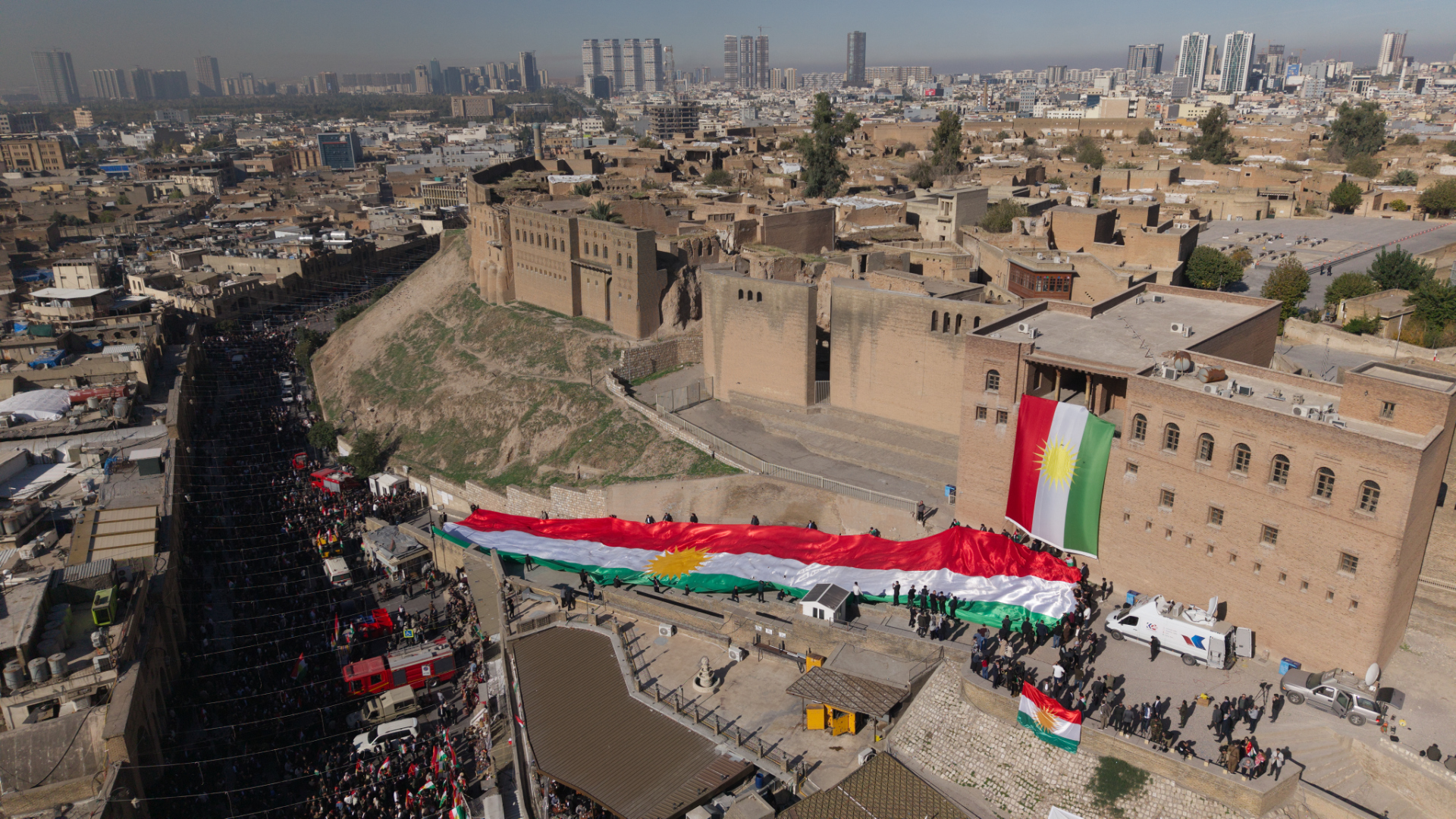
ERBIL (Kurdistan24) - More than four decades after Şivan Perwer gave voice to one of Kurdish literature's most powerful declarations of collective identity, the question at its heart has acquired renewed political urgency: Who are we?
In "Kîne Em?", the celebrated Kurdish singer transforms the poetry of Cegerxwîn into something greater than a song. It is an invocation of history, a confrontation with collective suffering, and an insistence that a people divided by political borders, tribal allegiances and religious differences still constitute a nation.
Today, as the Kurdistan Region faces a renewed confrontation with Baghdad over its constitutional authority, the song's language of unity, resistance and equality finds a contemporary political resonance.
Speaking to Kurdistan24 on Thursday, Perwer delivered a message remarkably close to the central argument of his celebrated anthem: Kurdish political survival, he maintained, depends not merely on resisting outside pressure but on overcoming internal divisions and building a shared national consciousness.
From "Who Am I?" to "Who Are We?"
The origins of "Kîne Em?" lie in the revolutionary poetry of Cegerxwîn, the influential Kurdish poet whose writing combined national identity, social emancipation and a profound concern with the historical circumstances of the Kurdish people.
The poem was originally conceived around an individual question: "Kî Me Ez?" - "Who Am I?"
Perwer transformed that singular question into the collective "Kîne Em?" - "Who Are We?"
In a 2013 interview, Perwer recalled making the alteration because the collective expression better reflected the Kurdish condition. He also remembered Cegerxwîn defending his adaptation against criticism, regarding it as a completion rather than a distortion of the original work.
That grammatical transformation carries the philosophical weight of the entire composition.
The solitary individual becomes a collective subject. Personal identity becomes national consciousness. The question is no longer simply what defines one Kurdish person, but what binds together communities separated by geography, political authority, class and religion.
The song begins with farmers, workers and laborers, grounding Kurdish identity in the lives of ordinary people rather than exclusively in the achievements of rulers or political elites.
It then moves across mountains, villages and ancient civilizations, invoking the Medes, Hurrians, Gutians and other peoples through whom the poet constructs a historical imagination of Kurdish continuity.
Yet the poem is equally unforgiving toward internal fragmentation. Tribal chiefs, feuding elites and religious sectarianism appear as forces that have contributed to political weakness and collective dispossession.
This is precisely where Perwer's latest remarks find their deepest connection with Cegerxwîn's poetry.
Perwer's Warning: A Nation Cannot Be Built on Tribalism
During his Kurdistan24 appearance, Perwer praised President Masoud Barzani's decades of political struggle while arguing that the responsibilities of national development must extend beyond military and political leadership.
He suggested that someone who had spent much of his life as a Peshmerga might not have had the opportunity to devote himself to philosophical study.
"However, there are yet others who must bring culture to the Kurdish people. Bring science to the Kurdish people. Bring history to the Kurds," he said.
Perwer then turned to what he regarded as one of the fundamental obstacles to Kurdish nationhood: the persistence of tribal identity as a substitute for national consciousness.
"If you're not nationalist, you can't have a state; with tribalism you won't obtain a state," he argued.
His criticism extended to Kurdish political figures who invoke bourgeois ancestry or tribal standing as marks of distinction. For Perwer, neither hereditary status nor social prestige is sufficient to establish the institutions of a modern nation.
He called instead for a political identity embracing different Kurdish tribes and religious communities, including Ezidis, Alevis, Sunnis and Christians.
The question, he suggested, is not whose tribe or religion should prevail, but what common political structure can protect them all.
"A state is law, a state is discipline, a state is protection. Without a state, you perish," Perwer declared.
His argument reaches beyond the immediate constitutional dispute between Erbil and Baghdad. It concerns statehood itself and the relationship between national identity, public institutions and the protection of individual rights.
Nevertheless, it speaks directly to the concerns now shaping the political atmosphere in the Kurdistan Region.
When Poetry Meets a Constitutional Crisis
The current confrontation followed measures announced by Iraqi Prime Minister Ali al-Zaidi on Nov. 24, concerning federal control over border crossings and oil operations. Iraq's Federal Supreme Court subsequently affirmed federal authority over border security and related responsibilities.
Baghdad has presented its actions as measures to enforce federal law and combat illicit activities. The Kurdistan Regional Government (KRG), meanwhile, has rejected what it considers unconstitutional encroachments upon its authority and the federal principles established after 2003.
On Thursday, thousands gathered in Erbil, carrying Kurdistan flags and demanding protection of the Region's constitutional status. Kurdish political parties, including the Kurdistan Democratic Party (KDP) and Patriotic Union of Kurdistan (PUK), expressed a common position opposing measures they considered unconstitutional.
Against this backdrop, the closing passages of "Kîne Em?" acquire particular force.
The poem declares:
"We do not desire war. We desire equality."
What follows is an appeal for dialogue and brotherhood, met repeatedly by the refusal of an adversary.
Read through the present political circumstances, the poem's opposing voices can take on new meanings.
The collective "we" may be understood as the people and institutions of the Kurdistan Region, seeking recognition of their constitutional rights. The opposing figure, described in the poem as rejecting reconciliation, may be interpreted by contemporary Kurdish audiences as representing the federal authorities in Baghdad.
The emotional correspondence is unmistakable: the frustration of seeking recognition, the insistence on equality, and the fear that political achievements secured through generations of struggle might be diminished.
The Contradictions That Give the Song Its Power
"Kîne Em?" is not an uncomplicated peace anthem. Its revolutionary vocabulary includes images of explosions, armed resistance and violent confrontation.
Cegerxwîn's references to proletarian struggle, Marx and Lenin also place the work within a particular intellectual and political tradition.
But its declaration of peaceful intent stands alongside that militancy, revealing a central contradiction in the experience the poet sought to express: the desire to live without oppression, combined with an unwillingness to accept subjugation.
Its enduring significance lies partly in that tension.
For Kurdish listeners today, the song can articulate both an insistence on political rights and an aspiration for coexistence. It can express defiance without requiring that every contemporary dispute be interpreted as a call to armed confrontation.
Perwer's remarks add another dimension. His emphasis on education, culture and equal legal protection suggests that national survival cannot be secured through resistance alone. It also requires institutions capable of holding a diverse society together.
A Question That Remains Unanswered
Perhaps the most enduring achievement of Cegerxwîn's poetry and Perwer's musical interpretation is that they transform Kurdish identity from a matter of ancestry into an ongoing question of collective responsibility.
The song asks what makes a people a nation. Perwer's recent remarks ask what that nation must do to overcome its divisions and protect its future.
Between those questions lies the present predicament of the Kurdistan Region: a constitutionally recognized federal entity seeking to safeguard its powers while negotiating its relationship with Baghdad.
The political circumstances have changed since Cegerxwîn wrote his poetry. The question has not.
"Kîne Em?" continues to resonate because it does not simply ask Kurds to remember who they were. It challenges them to consider who they are together, what binds them beyond their differences, and what kind of political future they intend to build.