From the Vatican Today: A Page Was Burned… But Its Meaning Survived
A burned Syriac prayer-book page presented to Pope Leo XIV becomes a symbol of Christian survival, heritage, faith, and the determination of Christians of the East to remain in their ancestral homeland.
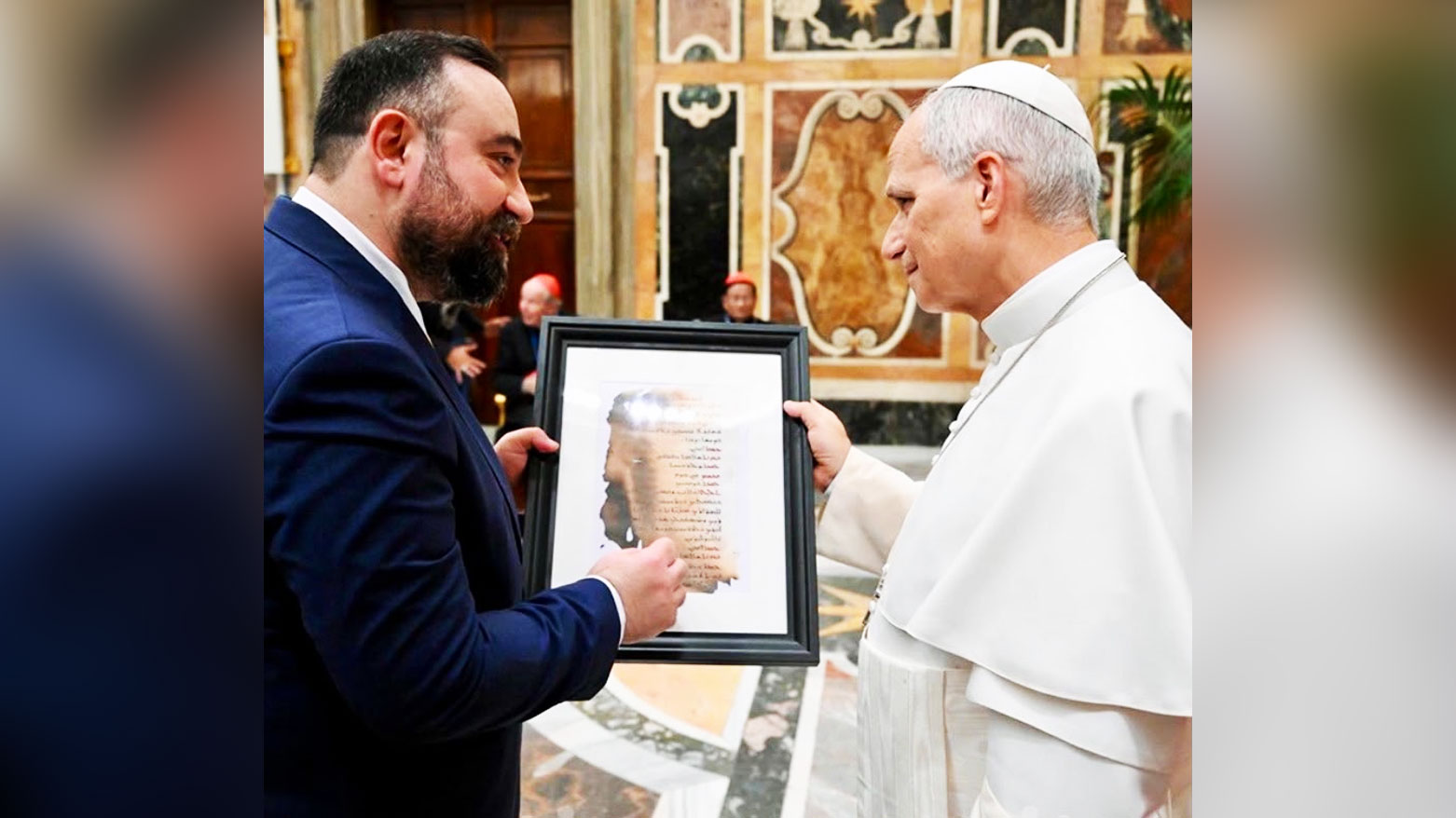
Today, 21 August 2026, in the heart of Rome, at the Vatican, I experienced something far greater than a meeting. It was a blessed day; one that will remain deeply engraved in my memory and heart.
Alongside Catholic distinguished public figures; ministers, parliamentary leaders, legislators, advisers, and members of Congress from the United States, Europe, Africa, Asia, and the Middle East; I had the great privilege of receiving the fatherly blessing of His Holiness Pope Leo XIV, listening to his words, and joining him in prayer for humanity and peace, and for a Church that continues to carry its faith, mission, and hope in a world burdened by war, suffering, and uncertainty.
On this blessed occasion, I was deeply honored to present His Holiness with a gift; small in size, yet carrying within it the history of a people, the memory of a homeland, and the testimony of an ancient Christian presence:
A partially burned page, written in Syriac, from an old Christian prayer book.
The fire consumed part of the page.
But it could not consume its words.
The page came from a prayer book damaged during the destruction inflicted by ISIS terrorists upon our ancient churches; churches whose roots reach back to the earliest centuries of Christianity. It was later recovered after the liberation of our areas by the heroic Peshmerga forces, under the leadership of President Masoud Barzani, in cooperation with the Iraqi security forces and with the support of the International Coalition.
I did not want this gift to be merely an artifact that survived a fire.
I wanted it to be a living witness to the story of the Christians of Kurdistan, Iraq, Mesopotamia, and the East; and also a reminder of those who stood beside us during the darkest days of persecution and displacement.
The flames that touched its edges are the same flames that swept through our villages, churches, homes, and memories.
The part that was lost reminds us of what we, too, have lost: lives, homes, churches, villages, families forced into exile, and a Christian presence that has tragically diminished in a land where Christianity has lived since its earliest days.
But what remained of the page is what matters most.
The words remained.
The prayer remained.
The language remained.
The faith remained.
The Church remained.
And so did we.

Our Christian presence in the East has been wounded. Parts of our communities have been lost or scattered across the world. Yet our presence has not lost its meaning. Our mission has not been extinguished. And our roots have not been severed from the land that has carried the faith of our fathers and forefathers for generations.
The Syriac language in which this prayer was written; the language of our Chaldean, Assyrian, Syriac, and Aramaic heritage; is more than writing preserved on a burned piece of paper.
It is the voice of our churches.
The prayer of our ancestors.
The memory of our people.
It is the testimony of a people who, despite persecution, massacres, displacement, and terrorism, have insisted on remaining witnesses to Christ in their ancestral homeland.
As I placed this page into the hands of the Holy Father, I felt that I was not simply offering him a fragment from the past.
I was carrying a message from the Christians of Kurdistan, Iraq, and the East to the Universal Church and to the world:
They tried to burn the prayer book;
but the prayer survived.
They tried to destroy the churches;
but the faith survived.
They tried to uproot us from our land;
but our roots are still alive and deep within it.
This burned page is not a symbol of our end.
It is a testimony to our survival.
And as long as there is a Christian in this land raising a prayer in the language of his ancestors; as long as a church bell still rings; as long as a mother teaches her children the faith of their fathers and the language of their heritage; the story of Christianity in Mesopotamia and the East is not over.
And it will not become a page that history simply turns.
My profound gratitude to His Holiness Pope Leo XIV for his paternal blessing, his prayers, and his closeness to the Christians of the East.
On a day such as this, we ask neither for privilege nor for pity.
We ask, and we pray, for something far more fundamental:
To remain in our homeland; free, safe, equal, and with dignity.
To preserve our faith, our heritage, our language, and our mission; and together with our brothers, sisters, and partners, to build a homeland spacious enough for all its people; a homeland founded upon justice, equality, coexistence, and peace.
Ano Jawhar Abdoka
The Vatican
21 August 2026