
Abdulkareem Shakir
Writer
Beyond the Headlines: What a Week in China Taught Me About the Story We Were Told
Most of us in Iraq and the Kurdistan Region have never been to China, yet almost all of us have an opinion about it. We formed that opinion the way we form many opinions about distant places: through the news. And for decades, the news we consumed about China came, directly or in translation, from Western media. The picture it left in our minds was fairly consistent: a grey, closed, crowded country, a factory for cheap goods, a society that is controlled rather than lived in, and a rising power to be feared.
In October 2026, I had the chance to test that picture against reality. I traveled to China as a member of a delegation of journalists and media figures from the Kurdistan Region, representing Kurdistan24, at the invitation of the Consulate General of the People's Republic of China in Erbil. From 18 to 26 October we visited Beijing and Shanghai: historic sites, a technology district, a university, museums and ordinary city streets.
Part of the purpose of the visit, our hosts were open about it, was to show us a China different from the one we know from Western headlines. I want to be equally open with readers. A guided week cannot show a country of 1.4 billion people in full, and a hosted trip naturally shows a country at its best. So in this article I have tried to do two things: describe honestly what I saw, and check my impressions against independent data and research. Where the evidence supports the Western picture, I say so. Where it contradicts it, I say that too.

1. A country that moves at a different speed
The first thing that challenges the stereotype is simply the experience of moving through China. On 23 October we travelled from Beijing to Shanghai by bullet train, a journey of more than 1,300 kilometres that took about as long as a drive from Erbil to Baghdad, in a quiet, clean carriage that left and arrived on time. This is not a showcase line. By the end of 2025, China's high-speed rail network had reached 50,400 kilometres, out of a total railway network of 165,000 kilometres, and the railways carried 4.255 billion passenger trips in that single year. China's high-speed network alone is longer than the rest of the world's high-speed lines combined.
Our airports, Beijing Daxing and Shanghai Pudong, told the same story: enormous, efficient and new. Daxing did not exist a decade ago. For a visitor from a region where electricity cuts, unfinished roads and delayed projects are part of daily life, the lesson is not that China is perfect. It is that large-scale public infrastructure, planned over decades and actually completed, changes how ordinary people live.
2. From steel mills to humanoid robots
On 21 October we spent the day in Beijing's Shijingshan District, accompanied by local officials. Shijingshan used to be home to Shougang, one of China's largest steelworks, a symbol of the old heavy-industry China that many of us still imagine. The steel plant was moved out of the city, and the site was turned into Shougang Park. It hosted venues for the 2022 Winter Olympics, which we also visited. Inside the same park, Beijing opened its first humanoid robot data training center in 2025: a 3,000-square-metre facility where more than 100 humanoid robots are trained on tasks such as assembling parts, cleaning and harvesting tomatoes, to generate data for robotics companies. Watching those machines learn was a clear sign of how far the country has moved from the "cheap factory" image.

The same shift is visible on the roads. In 2025, new energy vehicles, mainly electric and plug-in hybrid cars, outsold petrol cars in China for the first time, with about 12.8 million sold. In Beijing and Shanghai, the green licence plates of electric cars are everywhere, and many of the brands are Chinese names that most of us in Kurdistan have never heard of, but soon will.
We also visited the Shijingshan District Integrated Media Center, which combines local television, online news and social media in one newsroom. As journalists, this was one of the most interesting stops for us. It also reminded us of an important difference between our media systems, which I return to below.
3. The question of poverty
Perhaps the strongest fact against the old stereotype is about poverty. According to a 2022 joint study by the World Bank and China's Development Research Center, nearly 800 million people in China rose above the international extreme-poverty line over the past four decades. That accounts for about three-quarters of the reduction in extreme poverty in the whole world over the same period.
Economists still debate how this happened and how to measure it, and some researchers argue that the official story underplays the hardship of the reform years. But the scale of the change is not seriously disputed. For readers in Iraq, a country rich in oil yet still struggling with unemployment and poor services, it raises an uncomfortable question: what can sustained, long-term development planning achieve when it is actually carried through?
4. A civilisation that keeps its memory
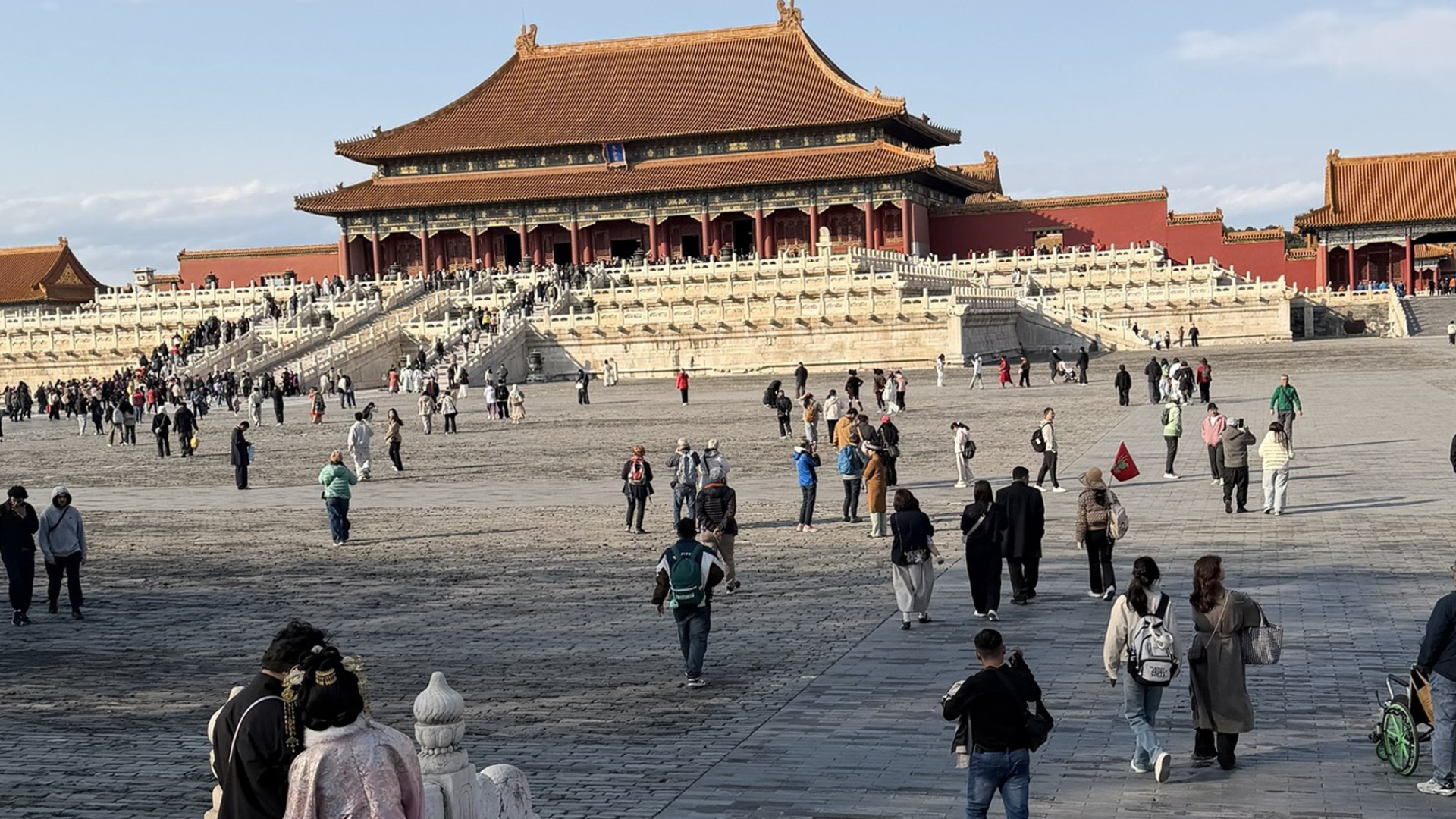
Modern China is not only towers and trains. Our programme was full of history: the Great Wall, the Palace Museum in the Forbidden City, the Temple of Heaven, the old hutong lanes of Nanluoguxiang, the Qianmen and Dashilan streets in Beijing, and Yu Garden and the City God Temple in Shanghai. What struck me was not just that these places survive, but that they are full of Chinese families and young people, not only foreign tourists. Heritage there is part of everyday life.


On 22 October we visited the Military Museum of the Chinese People's Revolution and its new exhibition on the 90th anniversary of the Long March, which I have written about separately. The exhibition presents 875 relics and tells 60 personal stories from the march, and it is built to pass the memory of sacrifice on to young people. In Shanghai, we also visited the site of the First National Congress of the Communist Party of China, held there in 1921. These visits showed how carefully the Chinese state preserves and presents its own history. They are also, of course, an official narrative, told in a particular way.


In Shanghai's Urban Planning Exhibition Hall, the city's history is told through its plans. Pudong, the district of skyscrapers across the river from the Bund, was mostly farmland and warehouses until development began in 1990. One wall displays the city's master plan for 1999 to 2020, drawn when Shanghai had about 15.7 million people and an economy of about 422 billion yuan. The plan set out where the city would grow, how Pudong would be organised, and where a new deep-water port would be built, and much of it has since been carried out. Standing at the Oriental Pearl Tower on our last morning, it was hard to believe that this skyline is younger than many of the members of our delegation.


5. The people we met
Statistics explain a country; people make you understand it. Throughout the week, the warmth of the welcome we received was the most consistent experience of the trip. Our guides, the officials in Shijingshan, and the experts and students who held a discussion with us at China Foreign Affairs University were open, curious about Kurdistan and Iraq, and willing to discuss difficult questions.
Just as striking were the ordinary moments. We walked through busy streets in both cities late in the evening and felt completely safe. Shopkeepers, students and passers-by were friendly and patient with visitors who did not speak their language. The image of a cold, suspicious society did not match what we experienced.
Shanghai also showed us how a modern city can live alongside its past. On a rainy morning on Wukang Road, in the old French Concession area, people on electric scooters and pedestrians with umbrellas moved past restored buildings from the 1920s. Preservation there is not a museum behind glass; it is part of the daily life of the street.

6. Why the picture in our minds is so different
If what we saw was so different from what we expected, where did our expectations come from? I believe there are several reasons, and not all of them are about bad intentions.
- We see China through a third party. Few journalists from Iraq or the Kurdistan Region report from China directly, and very few of us speak Chinese. Most of what reaches us is filtered through Western outlets, written for Western audiences and shaped by Western concerns.
- Geopolitics shapes the story. China and the United States are strategic rivals, and coverage of a rival tends to focus on threats. A clear example is the idea of Chinese "debt-trap diplomacy," which was repeated widely. A 2020 study by Chatham House, the London think tank, found that the evidence for a deliberate Chinese strategy to trap countries in debt and seize their assets is weak, and that recipient governments themselves often drove the most controversial projects.
- News favours problems over progress. This is true of all media, including ours. A new railway line is rarely news; a crisis always is. A country that is mainly in the news for its problems will be remembered for its problems.
- Our own public is already more divided than we think. Surveys by Arab Barometer have found that in several Arab countries, China is viewed as favourably as the United States, or more so. The single negative image is not shared by everyone in our region. It is strongest among those of us who rely most on Western sources.
7. A balanced picture, not a new stereotype
It would be easy, after such a visit, to replace one stereotype with another: to go from "China is a threat" to "China is a paradise." That would be no more accurate, and it is not what I want to do.
China has a political and media system that is different from ours, and it should be understood on its own terms rather than through the lens of others. The newsroom we visited in Shijingshan is technically impressive, and it works within a media model that differs from the one we know in Kurdistan. Like every major country, China also faces its own challenges, from a slowing property sector to competition for jobs among young graduates, which Chinese officials and media themselves discuss openly.
A one-week programme is not enough to judge every aspect of a country this large, and I do not claim to. My point is simpler. Western coverage of China is not entirely false, but it is incomplete, and for many of us it has been the only lens. A country with real achievements and real challenges deserves to be seen in full, and we deserve the chance to see it for ourselves.
8. What Kurdistan and Iraq can take from this
China is already one of Iraq's most important partners. According to Iraq's Ministry of Trade, Iraq exported about 33 billion dollars of goods, mostly oil, to China in 2025, and imported about 17 billion dollars from it. In the Kurdistan Region, Chinese companies already work in infrastructure and telecommunications, and the Chinese Consulate General in Erbil has been discussing more investment with the Kurdistan Regional Government. A relationship this important cannot be built on second-hand stereotypes.
From what I saw, I would suggest four lessons:
- Plan for decades, not for terms. Shanghai's planning hall and Beijing's railway network are the result of plans carried through over 20 or 30 years. Our region needs the same patience with infrastructure, electricity and urban planning.
- Invest in technology and skills. The robot training center in Shijingshan is a reminder that the next stage of development depends on education, research and data, not only on natural resources.
- Protect and present our heritage. China uses museums, restored old streets and historic sites to connect young people with their history. Kurdistan, with its ancient citadels and its long modern struggle, could do far more.
- Build our own window on the world. We need more Kurdish and Iraqi journalists reporting directly from China and from Asia in general, more students learning Chinese, and more direct media exchanges, so that we form our views from our own observation, not only from others' headlines.
I went to China with a picture in my mind that I had never chosen; I had simply absorbed it. I came back with a more complicated one: a country of remarkable speed, ambition and hospitality, with a long memory and real challenges of its own. The most important lesson of the trip was not about China at all. It was about us, and about how easily we accept a story about the world when no one gives us the chance to see it for ourselves.
The answer is not to trust a new story blindly. It is to go, to look, to ask questions, and to tell our readers what we find, including the parts that do not fit anyone's narrative.