U.S. Marines Seize Iranian Vessel as Maritime Clashes Threaten Ceasefire Talks
In the Arabian Sea, the choreography of de-escalation has faltered into a kinetic theater. By seizing the M/V Touska, Washington has traded economic attrition for the rappelling lines of Marines, leaving the region suspended between the dry ink of diplomacy and the cold salt of war.
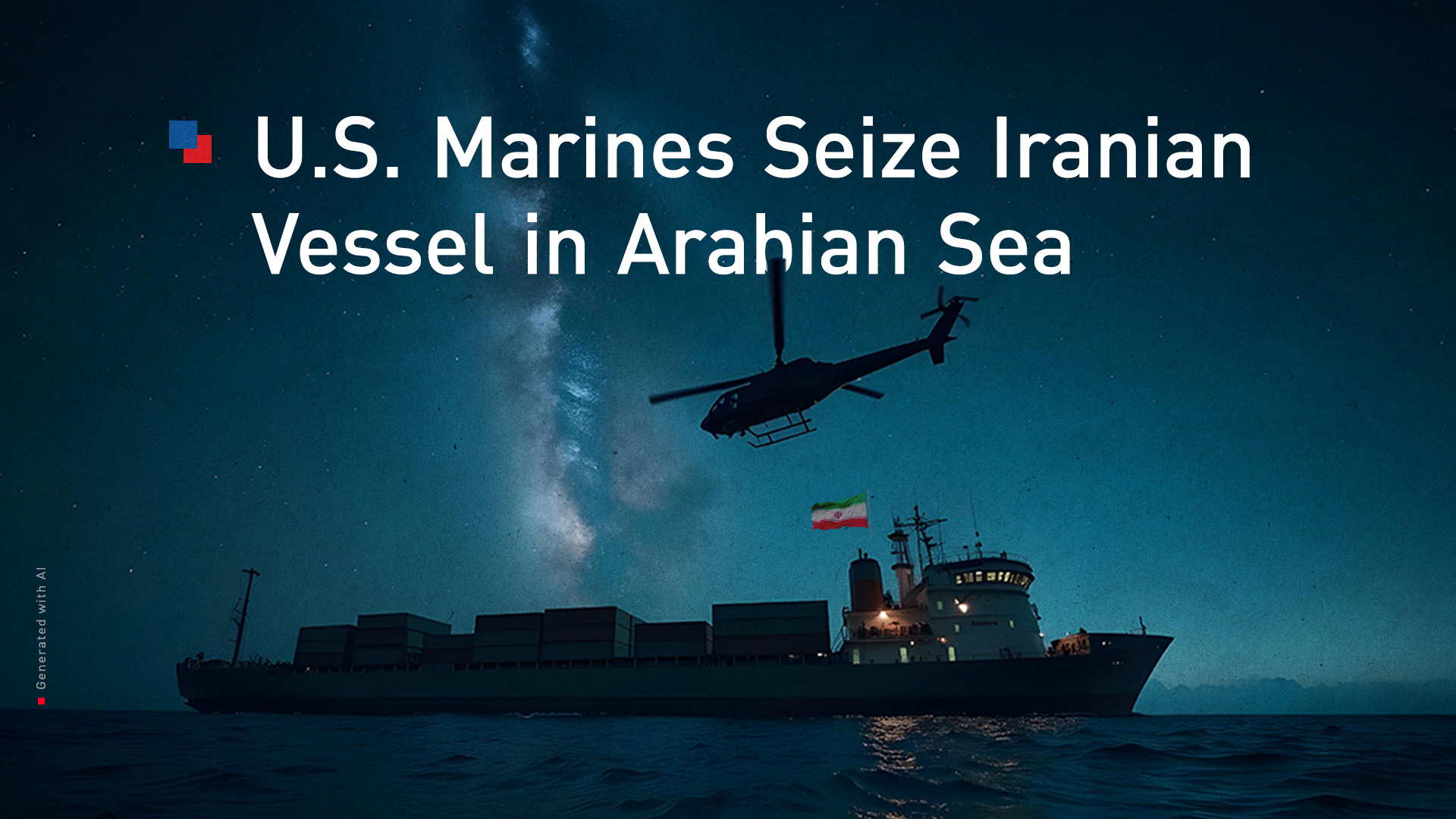
ERBIL (Kurdistan24) - The United States Central Command (CENTCOM) confirmed on Monday that U.S. Marines conducted an airborne boarding operation to seize the Iranian-flagged commercial vessel M/V Touska in the Arabian Sea.
The tactical interdiction, executed on Sunday after the guided-missile destroyer USS Spruance disabled the ship's propulsion following a six-hour standoff, marks a severe kinetic escalation in maritime hostilities just days before a regional ceasefire is scheduled to expire.
The forced seizure of the Touska transforms the contested waters of the Middle East from a zone of reciprocal economic blockades into an active theater of direct military confrontation.
As global oil markets surge in response to the renewed closure of the Strait of Hormuz, this escalation threatens to permanently dismantle the fragile, Pakistani-mediated diplomatic framework.
A collapse of these negotiations would likely precipitate an immediate return to full-scale regional warfare, dragging global energy supply chains and neighboring states deeper into an intractable geopolitical crisis.
According to video footage and statements published on the social media platform X by CENTCOM, the operation was initiated when the commercial ship failed to comply with repeated warnings from U.S. forces.
📹 U.S. Marines Seize Iranian Vessel as Maritime Clashes Threaten Ceasefire Talks
— Kurdistan 24 English (@K24English) April 20, 2026
U.S. Central Command (CENTCOM) confirmed Monday that U.S. Marines boarded and seized the Iranian-flagged commercial vessel M/V Touska in the Arabian Sea. The operation occurred after the USS… pic.twitter.com/VORRo28MTX
In the released audio, a U.S. mariner is heard instructing the vessel: “Vacate your engine room. We are about to subject you to disabling fire.”
CENTCOM reported that Marines subsequently departed the amphibious assault ship USS Tripoli by helicopter, rappelling onto the deck of the Touska to secure custody of the vessel.
U.S. President Donald Trump addressed the incident on social media, stating that the Navy “stopped them right in their tracks by blowing a hole in the engineroom” and confirming that U.S. forces were inspecting the cargo.
In a swift reciprocal declaration, Iran’s joint military command characterized the U.S. boarding as an act of “maritime piracy” and a direct violation of the ceasefire, vowing an imminent response. The semiofficial Tasnim news agency later reported that Iran retaliated by launching drones in the direction of U.S. military vessels.
The maritime domain has rapidly devolved into the conflict's primary choke point. The United States continues to enforce a naval blockade against Iranian ports, a measure Iranian Foreign Ministry spokesperson Esmaeil Baqaei labeled an act of aggression and a “war crime” for allegedly inflicting collective punishment on the civilian population.
In retaliation, Tehran has leveraged its geographic command over the Strait of Hormuz—a vital conduit that traditionally facilitates one-fifth of the world’s globally traded oil and liquefied natural gas.
While Iran briefly reopened the strait on Friday in recognition of a localized 10-day ceasefire between Israel and Hezbollah in Lebanon, it reinstated total closure on Saturday in response to the ongoing U.S. blockade.
Iranian Parliamentary Speaker and chief negotiator Mohammad Baqer Qalibaf explicitly linked the two maritime operations in a televised address, stating, “It is impossible for others to pass through the Strait of Hormuz while we cannot.”
The escalating naval hostilities have severely disrupted international shipping. The International Maritime Organization (IMO) confirmed 24 security incidents in the Strait of Hormuz and across the Middle East since March 1, including a recent attack on the French-flagged container ship CMA CGM Everglade north of Oman.
Citing a high risk of attack or miscalculation, the United Kingdom Maritime Trade Operations (UKMTO) center has elevated the security threat level in the Persian Gulf to “critical.”
The kinetic developments at sea have cast profound doubt over the viability of a second round of peace negotiations in Islamabad. The White House indicated that an American delegation, led by Vice President JD Vance, is scheduled to arrive in Pakistan on Monday.
Utilizing a maximalist negotiating posture, President Trump stated he offered Tehran a “reasonable deal,” accompanying the diplomatic overture with an explicit threat to destroy every power plant and bridge in Iran if the terms are rejected.
Iranian leadership has signaled deep institutional skepticism regarding the talks.
Iranian President Masoud Pezeshkian engaged in a telephone consultation with Pakistani Prime Minister Shehbaz Sharif on Sunday, wherein Pezeshkian warned that U.S. actions and threatening rhetoric have amplified suspicions that Washington intends to “betray diplomacy.”
Correspondingly, Iranian state broadcaster IRIB, citing unnamed sources, reported that Tehran currently harbors no plans to participate in the upcoming round of talks.
The diplomatic deadlock occurs against a backdrop of devastating regional attrition. The six-week conflict has resulted in the deaths of at least 3,000 people in Iran, nearly 2,300 in Lebanon, and dozens across Israel and Gulf Arab states, alongside 13 U.S. service members.
The cessation of hostilities remains highly volatile across interconnected fronts.
In southern Lebanon, the 10-day ceasefire faced a significant breach on Sunday afternoon. The Iran-backed group Hezbollah issued a formal statement claiming its fighters detonated explosives near the village of Deir Siryan, destroying four Israeli tanks within an eight-tank convoy.
The Israeli military did not immediately comment on the specific tactical claim, though Israeli Defense Minister Israel Katz subsequently warned that the military will use “full force” in Lebanon—even during the truce—if Israeli troops face ongoing threats.
Further complicating the security environment in the Levant, the Israeli military confirmed on Monday that an image circulating on social media depicting an Israeli soldier striking a statue of Jesus Christ with a sledgehammer in southern Lebanon was authentic.
The Israeli army condemned the action, stating via social media that it views the incident with “great severity” and that the matter is currently being addressed through the chain of command by the Northern Command.
Simultaneously, the Syrian interior ministry announced that its security forces thwarted a cross-border sabotage plot in Quneitra province involving rocket-launching equipment. Syrian officials attributed the plot to Hezbollah; the Lebanese group formally denied the accusation.
Within Iran, the state security apparatus has maintained a rigorous internal posture. On Monday, the judiciary’s Mizan news agency reported the execution of two men—Mohammad Masoum Shahi and Hamed Validi—accused of committing arson on behalf of the Israeli intelligence service, Mossad.
The exiled opposition group Mujahedeen-e-Khalq (MEK) claimed the individuals as members, alleging they were tortured and convicted for actions predating their detention. According to rights groups, the executions raise the number of MEK members hanged since the war began to eight.
Concurrently, Iranian military leadership asserted that operational readiness has been restored during the operational pause.
Brig. Gen. Seyed Majid Mousavi, commander of the Revolutionary Guard’s Aerospace Force, stated on state television that Iran has rapidly repaired its drone and missile launch platforms, claiming that the speed of refilling the nation's stockpiles is greater now than before the conflict began.
The international community remains highly polarized by the ongoing conflict. During a diplomatic forum, Türkiye’s Foreign Minister Hakan Fidan expressed optimism for a ceasefire extension but characterized the current Israeli government as a “fundamentalist” threat to global stability.
In Europe, Spanish Prime Minister Pedro Sánchez announced plans to formally propose the termination of the European Union’s Association Agreement with Israel. Conversely, Argentina’s President Javier Milei arrived in Israel on Sunday for a state visit to sign bilateral accords, reflecting a deep divergence in international responses to the crisis.
The synchronized deterioration of maritime security and diplomatic backchannels exposes a structural deadlock in the current conflict architecture.
With both Washington and Tehran utilizing localized economic attrition—enforced through U.S. naval blockades and Iranian critical waterway closures—military coercion has superseded political negotiation as the primary mechanism for leverage.
This paradigm severely diminishes the efficacy of third-party mediation, rendering the Pakistani diplomatic initiative highly vulnerable to tactical miscalculations at sea.
As the Wednesday deadline for the expiration of the ceasefire approaches, the institutional architecture of the Middle East remains suspended in a state of high uncertainty.
While Pakistani authorities maintain heightened security preparations in Islamabad for potential talks, the absence of an Iranian commitment and the continuous maritime hostilities leave the prospect of a negotiated settlement deeply unresolved, signaling an imminent risk of a return to comprehensive, region-wide warfare.