Türkiye says Mecca defense pact mirrors NATO’s collective defense principle
Fidan says agreement with Saudi Arabia and Pakistan targets no country unless a member state is attacked, while Egypt could potentially join
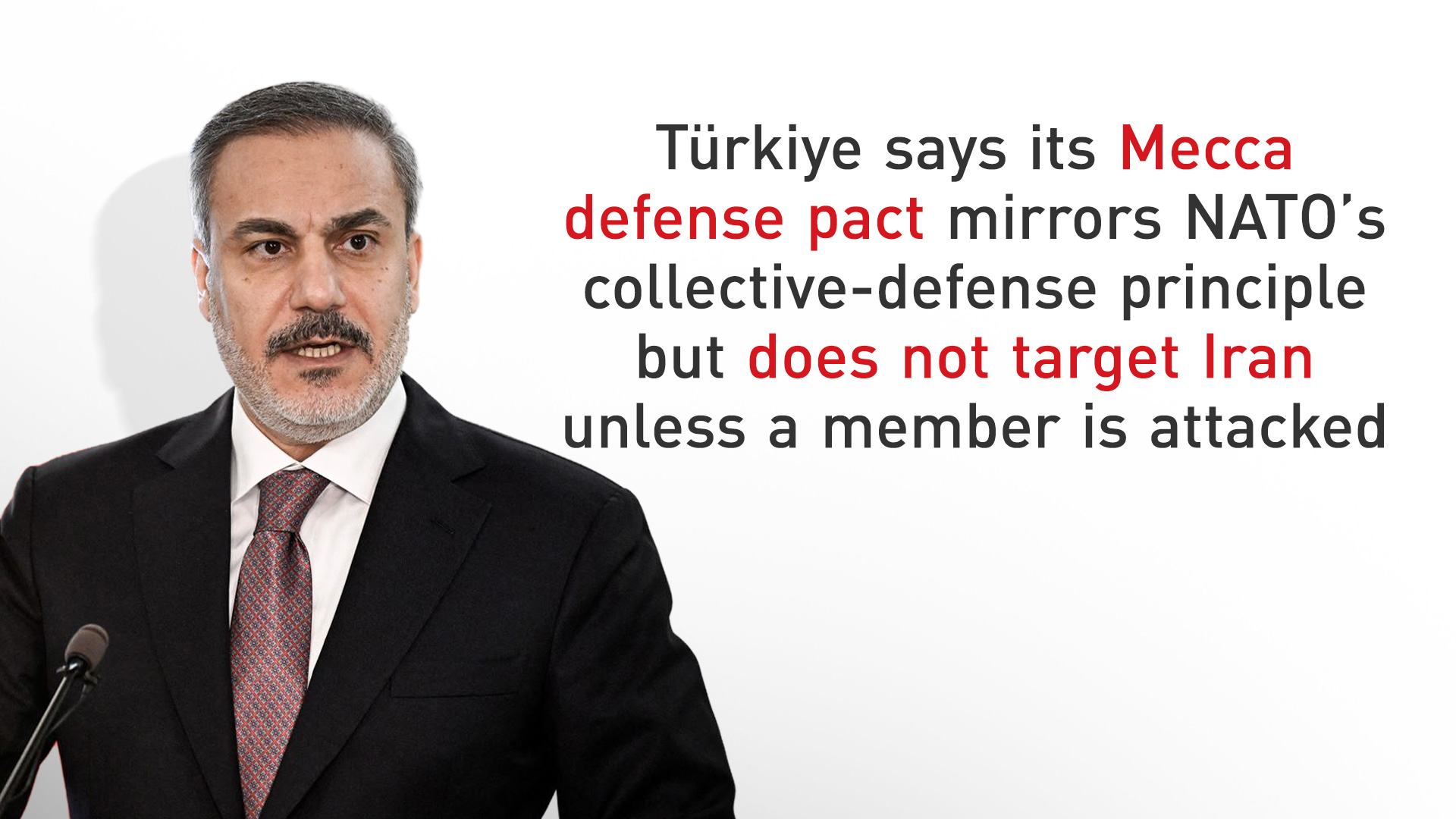
ERBIL (Kurdistan24) — Türkiye’s Foreign Minister Hakan Fidan said Saturday that the Mecca Mutual Defense Agreement signed by Türkiye, Saudi Arabia and Pakistan is technically similar to NATO’s collective defense principle, while stressing that the pact does not target Iran or any other country unless one of its members comes under attack.
Speaking to Anadolu Agency, Fidan said the agreement follows the principle of collective defense outlined in Article 5 of the North Atlantic Treaty Organization (NATO), under which an armed attack against one member is considered an attack against all.
Fidan emphasized, however, that the Mecca agreement is not directed against Iran or any other country as long as member states are not attacked.
The Turkish foreign minister said the agreement establishes a ministerial committee similar to mechanisms operating within NATO, as well as a general secretariat tasked with coordinating the pact’s activities and implementing its mechanisms.
He also said Egypt could potentially join the agreement if several technical issues are resolved.
Pact signed by Türkiye, Saudi Arabia and Pakistan
The Mecca Mutual Defense Agreement was signed Friday in the Saudi city of Mecca by Saudi Arabia, Türkiye and Pakistan in a move aimed at strengthening defense cooperation and establishing a framework for collective deterrence.
The agreement was signed during a high-level Mecca summit attended by Saudi Crown Prince Mohammed bin Salman, Turkish President Recep Tayyip Erdoğan and Pakistani Prime Minister Shehbaz Sharif.
The leaders discussed the strategic ties between the three countries as well as a range of regional and international issues of common interest.
Under the agreement, an armed attack against any one of the three countries is to be treated as an attack against all member states, reinforcing their commitment to collective defense and joint action against threats to their security and sovereignty.
The pact also seeks to expand defense and military cooperation and strengthen coordination among the three countries, with the stated aim of improving their readiness and capabilities to respond to shared security challenges.
The agreement comes as Saudi Arabia, Türkiye and Pakistan seek to deepen their strategic partnership and strengthen political and defense coordination amid rapidly changing regional security dynamics.
Türkiye seeks role in Red Sea security
Fidan also addressed maritime security in the Red Sea, saying the protection of maritime navigation is directly linked to Türkiye’s interests.
He stressed the importance of Türkiye participating in an international coalition led by Saudi Arabia aimed at protecting maritime traffic and securing key maritime routes.
The comments come amid heightened regional concerns over the security of commercial shipping routes in the Middle East and the wider Red Sea region.
Fidan’s remarks underline Ankara’s effort to expand its security role beyond bilateral defense cooperation and contribute to emerging regional mechanisms focused on collective security and the protection of international maritime trade.