Qaani Holds Baghdad Talks on Future of Iraqi Armed Groups
Iran's IRGC Quds Force chief meets Coordination Framework leaders as Sept. 30 deadline for state control of weapons approaches
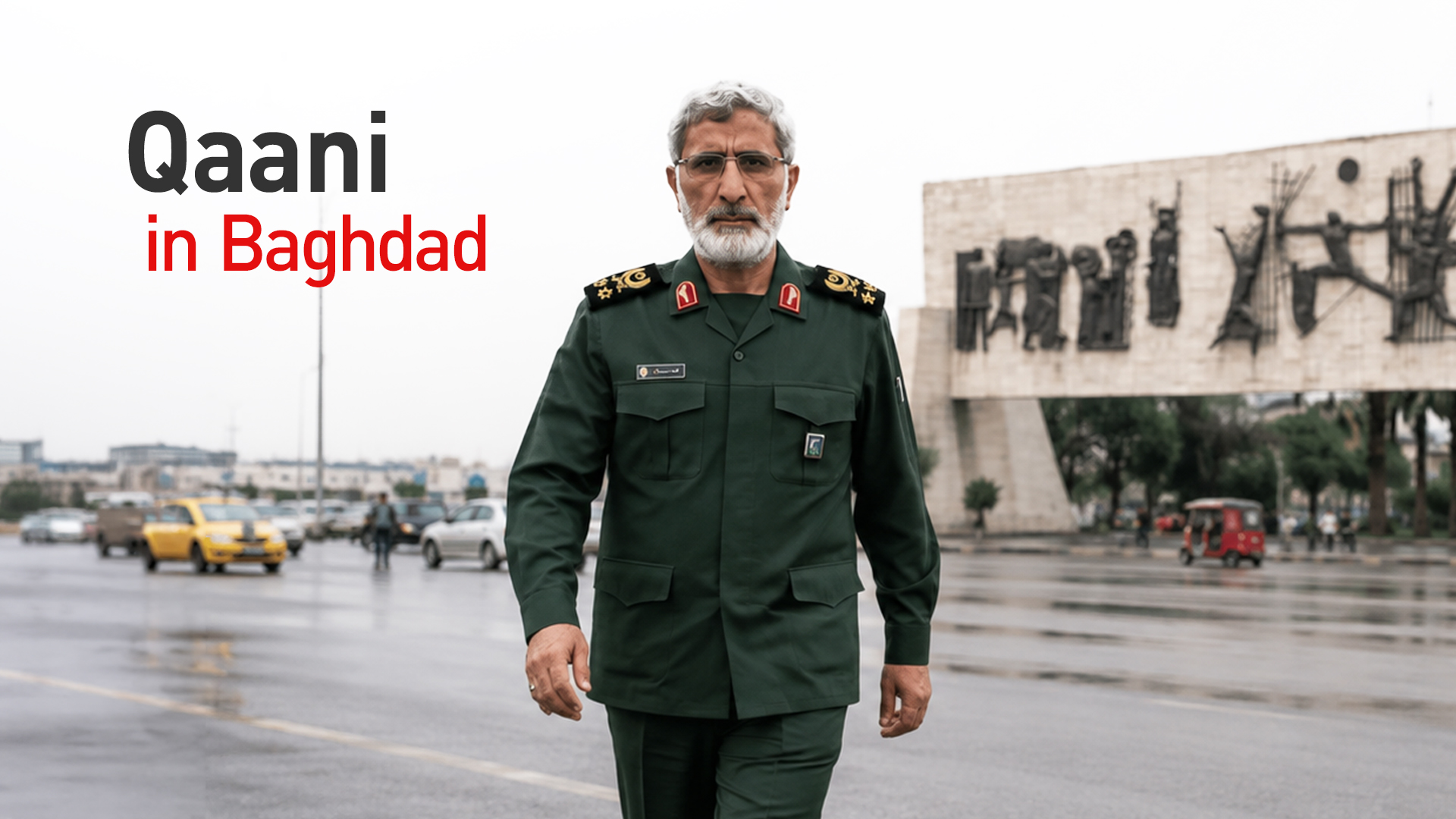
ERBIL (Kurdistan24) - Islamic Revolutionary Guard Corps (IRGC) Quds Force Commander Esmail Qaani has arrived in Baghdad for talks with senior Iraqi political and armed-group leaders, with discussions reportedly focusing on the future of weapons held by factions outside the state security structure.
An informed source told Kurdistan24 that Qaani is leading a high-level military and security delegation and has already met with figures from the Coordination Framework, including Badr Organization leader Hadi al-Amiri, as Baghdad approaches a Sept. 30 deadline to place all weapons under state control.
The unannounced visit comes at a politically sensitive moment for Iraq, where the government is attempting to resolve the status of powerful armed factions while preventing regional tensions from spilling onto Iraqi territory.
Qaani's Baghdad meetings
According to the source, Qaani has held a series of meetings with Coordination Framework leaders and commanders of several armed groups, with further talks expected during his stay.
The discussions are reportedly centered on two major issues: the fate of weapons held by Iraqi armed factions and arrangements concerning Iraq's ability to export oil through the Strait of Hormuz.
The weapons issue has become one of Baghdad's most difficult political and security challenges.
Iraqi political forces have set Sept. 30 as the deadline for bringing weapons exclusively under the authority of the state and its official institutions.
The timing of Qaani's visit has therefore drawn particular attention, as Iran maintains close political and security relationships with several of the Iraqi factions affected by the government's policy.
Baghdad presses for state control
Iraqi government spokesperson Haider al-Aboudi said Monday that no institution or organization should control weapons outside the framework of the state.
Speaking at a press conference, al-Aboudi called for armed groups operating outside official security institutions to return under state authority, saying the process requires a "deep and comprehensive dialogue."
He said there was a high degree of understanding between the government and armed groups and that Baghdad remained committed to advancing and monitoring the process.
The government's position reflects a broader effort to reinforce the authority of Iraqi state institutions amid regional instability and competing security arrangements.
Al-Aboudi also said the government expects the planned September withdrawal of US forces to proceed according to an agreed timetable, with responsibilities transferred to the Iraqi army.
Factions remain divided
Despite Baghdad's push for a unified weapons policy, Iraqi armed factions remain divided over whether and how they should surrender or regularize their arsenals.
Some groups have indicated a willingness to bring their activities into a formal state framework.
Others, including Kata'ib Hezbollah, Harakat al-Nujaba and Kata'ib Sayyid al-Shuhada, have reportedly linked any disarmament to the complete withdrawal of foreign forces from Iraq.
The disagreement presents a significant challenge for the government, particularly as the September deadline draws closer.
The State Administration Coalition has previously warned that armed activity outside state institutions after the deadline could be treated as terrorism, while Iraqi security forces have raised their readiness levels amid concerns over possible escalation.
Iran seeks to contain regional tensions
Qaani's visit also follows heightened tensions involving Iraq, Saudi Arabia and Iran-aligned armed factions.
Abdul Rahman al-Jazairi, head of the political bureau of the Iraqi National Current and a leading Coordination Framework figure, told Kurdistan24 that senior IRGC officials had recently conveyed a message to Hadi al-Amiri urging Iraqi armed groups to halt attacks against Saudi Arabia.
According to Jazairi, the message was directed toward factions including Harakat al-Nujaba, Kata'ib Hezbollah and the group led by Abu Ala al-Walai. He said Tehran was encouraging the factions to pursue political and diplomatic channels rather than military action.
The reported intervention comes as Baghdad prepares for Prime Minister Ali al-Zaidi's expected visit to Saudi Arabia, which Jazairi said would address several sensitive issues, including arms control, the economy and corruption.
The development suggests that the question of Iraqi armed groups is increasingly linked not only to Baghdad's domestic security policy but also to wider regional efforts to prevent Iraq from becoming a launchpad for attacks against neighboring states.
A broader test for Baghdad
The government faces a delicate balancing act: enforcing state authority over weapons while maintaining political support among factions that form an important part of Iraq's governing system.
The issue is further complicated by the future of US forces in Iraq.
Al-Aboudi said the September withdrawal deadline must be respected, while Jazairi separately claimed that undisclosed understandings could link the withdrawal of US forces to guarantees that armed factions keep their weapons under state control and halt drone operations from Iraqi territory.
Those claims have not been independently confirmed.
Qaani's meetings in Baghdad therefore come at a critical juncture. His discussions with Iraqi political and armed-group leaders could influence how Iran-aligned factions respond to the government's September deadline and whether Baghdad can achieve a negotiated transition toward greater state control.
For the Iraqi government, the challenge is no longer simply establishing a legal principle that weapons belong under state authority. It is determining whether that principle can be implemented without triggering a political or security confrontation with factions that retain significant military and political influence.
With the deadline approaching, Qaani's Baghdad talks are likely to be closely watched as Iraq attempts to reconcile the demands of state sovereignty, armed-group influence, the US military presence and the wider regional struggle for influence.