Why Sentence Assad to Death When International Law Forbids Extraditing Death-Row Convicts
Under international law, Assad cannot be extradited to face execution. Yet Syrian law now convicts him to death. A ruling grounded in domestic courts, suspended by global treaties.
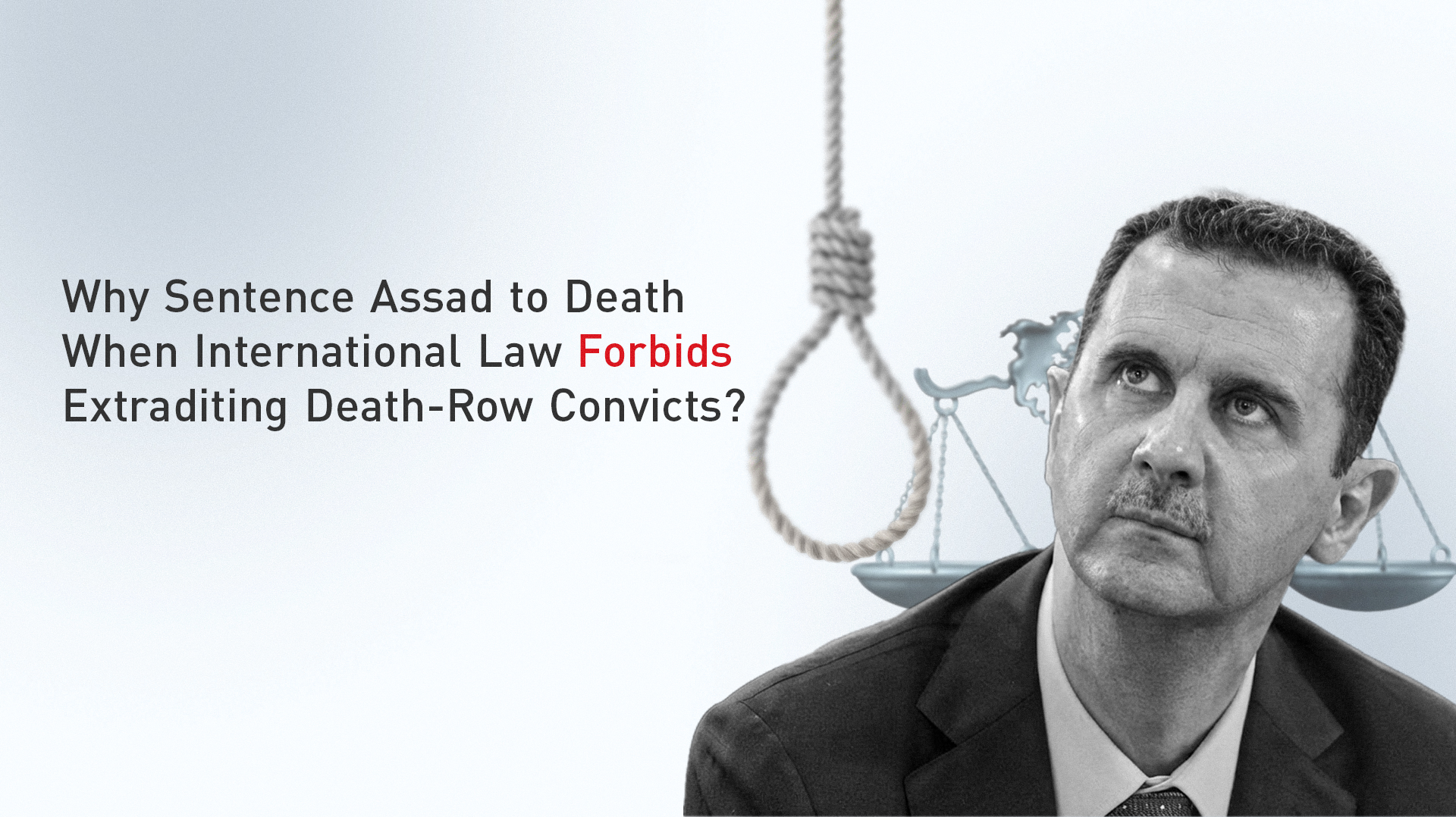
ERBIL (Kurdistan24) - Syria's Fourth Criminal Court in Damascus handed down an in-absentia death sentence against the toppled Syrian President Bashar al-Assad, raising an immediate question: if international law is widely understood to bar the extradition of individuals facing capital punishment, why issue a death sentence Damascus knows may never be carried out?
The court unanimously convicted Assad, his brother and former Fourth Division commander Maher al-Assad, and several senior security and military officials from the former government. Presiding judge Fakhreddine al-Oraibi described Bashar al-Assad as the moral perpetrator and ultimate decision-maker who directed state institutions toward committing the crimes.
The charges included premeditated murder of multiple victims, among them children, incitement to murder, torture resulting in death, kidnapping and arbitrary detention, and crimes against humanity and war crimes. Because Assad, Maher al-Assad, and most of the other defendants have fled the country — Bashar al-Assad is currently in Russia — the verdicts were issued in absentia. The only defendant present in court was Atef Najib, Assad's cousin and former head of the Political Security branch in Daraa. Other senior figures convicted included former Defense Minister Fahd Jassem al-Freij, along with security officials Louay al-Ali, Qusay Mihoub, Wafiq Nasser, and Talal al-Asimi. The court also dropped all immunities, issued arrest warrants, and directed relevant authorities to pursue the defendants internationally.
At first glance, the ruling appears to run into a well-established feature of international law. Under the principle of non-refoulment, states are generally barred from extraditing or returning a person to a country where they face a real risk of execution, torture, or arbitrary deprivation of life. That principle is anchored in several instruments: Article 33 of the 1951 Refugee Convention, which prohibits returning a refugee to territory where their life or freedom would be threatened; Articles 6 and 7 of the International Covenant on Civil and Political Rights, covering the right to life and the prohibition on cruel treatment, which the UN Human Rights Committee has interpreted as barring extradition where execution is a real risk; and Article 3 of the UN Convention Against Torture, which similarly forbids returning a person to a state where they would be at risk of torture. Given that framework, and given that Russia is under no practical pressure to hand Assad over, the death sentence might seem symbolic at best — a judgment Damascus knows cannot be enforced.
Why the law is more complicated than it first appears
That reading, however, does not capture the full legal picture. Non-refoulment protections are not absolute in cases involving war crimes and crimes against humanity. Article 1F of the 1951 Refugee Convention excludes individuals responsible for such crimes from refugee protection altogether, meaning the shield that ordinarily applies to political or religious persecution cases does not automatically extend to defendants convicted of atrocity crimes.
International extradition practice also provides a recognized pathway around the death-penalty barrier: diplomatic assurances. Under this mechanism, a requesting state can offer a formal, written commitment that a death sentence will be commuted to life imprisonment or otherwise not carried out. Where such assurances are given, the legal obstacle to extradition can be lifted even in death-penalty cases. In addition, because the Damascus verdict was issued in absentia, standard criminal procedure holds that the judgment would be automatically voided the moment a convicted defendant is apprehended or handed over, triggering a new trial in his presence with full defense rights — a trial in which a court could substitute a life sentence for the death penalty, easing the path to any future extradition. Crimes against humanity and war crimes, moreover, carry no statute of limitations and fall outside the categories of offense that typically grant a defendant a right to asylum.
What the verdict actually accomplishes
Understood in that context, the death sentence was never designed to be carried out the next morning. It serves several other functions. It formally converts Assad's legal status from former head of state to convicted criminal under Syrian law, stripping away any diplomatic or political shield he might otherwise invoke internationally. It also provides the domestic legal basis Damascus needs to request Interpol Red Notices, restricting the movement of Assad and his co-defendants across roughly 190 countries and effectively confining them to Russian territory. For the millions of Syrians affected by the former government's rule, a verdict issued from inside Damascus carries significant symbolic and moral weight, formally documenting in the state's judicial record that the events in question amounted to prosecutable crimes rather than political conflict. And because political alignments between states can shift, a completed and enforceable judgment gives Damascus a ready legal instrument should Russian interests — or the broader international political landscape — change in the future.
Ultimately, an in-absentia death sentence in a case like this is not measured by whether a court can enforce it tomorrow, but by whether it stands as a durable legal record of conviction — one that follows a defendant politically and geographically and forecloses any long-term escape from accountability.