Iraq's Militia Disarmament Hits a Wall as Civil War Warning Shadows the September 30 Deadline
Individual Coordination Framework leaders negotiating directly with armed groups as holdout factions demand US withdrawal before handing over weapons, with Nasr Alliance warning of armed confrontation if disarmament fails and Hadi al-Amiri emerging as the only figure factions trust
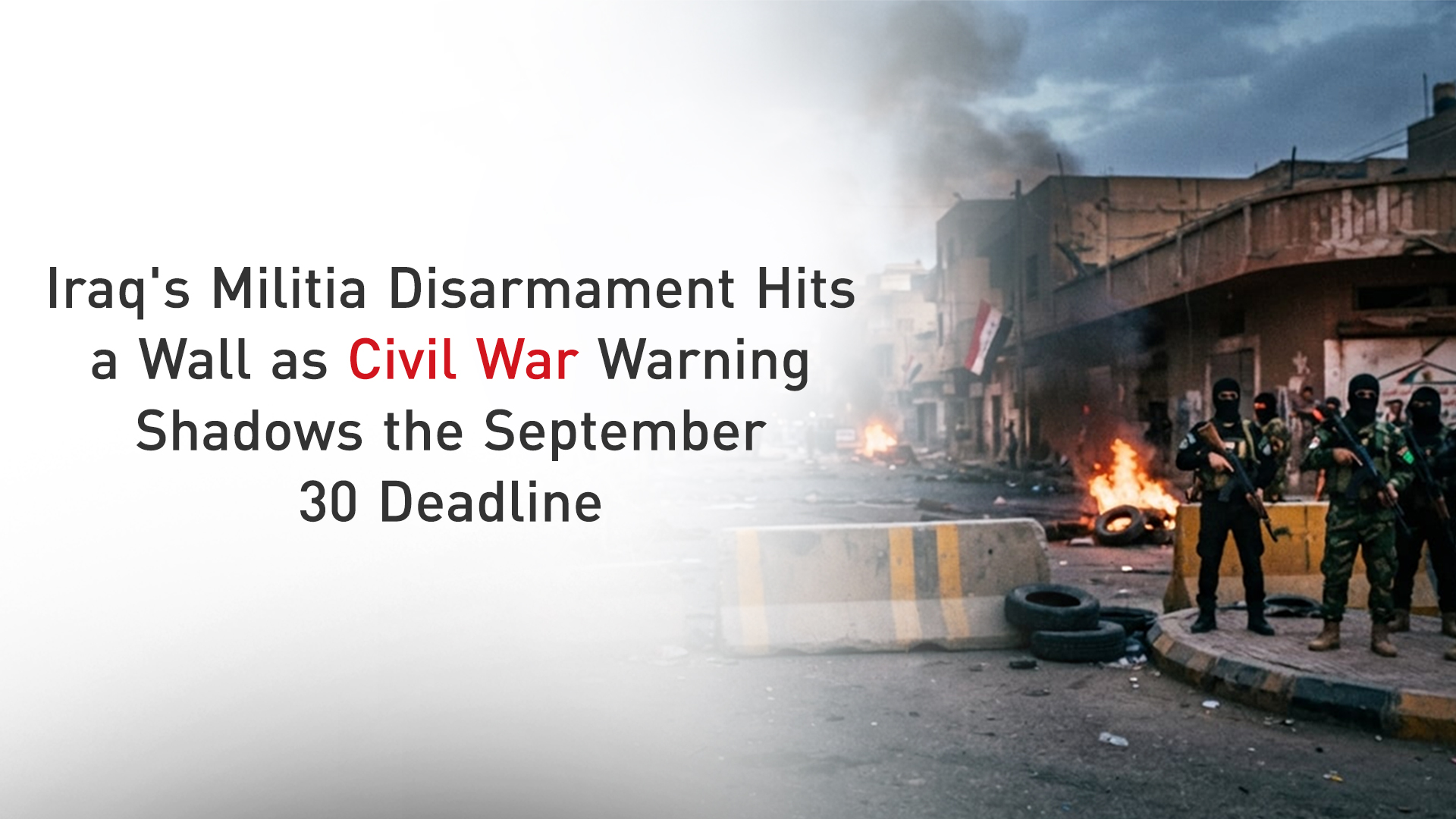
ERBIL (Kurdistan 24) - Iraq's Coordination Framework is forming a special committee to negotiate the disarmament of armed militia groups, as individual Coordination Framework leaders simultaneously pursue their own direct talks with holdout factions, two sources told Kurdistan 24 on Tuesday amid growing warnings that failure to meet the September 30 deadline could plunge Iraq into a civil conflict.
Abu Misaq al-Masari, a member of the Badr Organisation, told Kurdistan 24 that Coordination Framework leaders are working individually to build understanding with the armed groups, but no formally designated committee has yet been established. The formation of a dedicated committee represents an attempt to centralize and institutionalize a process that has until now been conducted through informal bilateral channels, as the September 30 deadline approaches with the majority of armed factions still refusing to cooperate.
The Conditions Holdout Factions Have Set
Armed groups refusing disarmament have presented a set of conditions they say must be met before any discussion of weapons handover is possible. These include the full withdrawal of American forces from Iraqi territory, economic liberation, and political decision-making free from American dominance. The conditions effectively tie disarmament to geopolitical outcomes that the Iraqi government cannot unilaterally deliver, creating a structural deadlock that individual Coordination Framework negotiations have so far been unable to break.
As The National confirmed on Friday, the Badr Organisation warned that using force to disarm armed groups before the September 30 deadline could result in internal conflict, with the head of Badr's political office stating that forced disarmament "opens the door to internal strife whose beneficiary, first and last, is the United States." The Badr Organisation set three conditions for disarmament: full US troop withdrawal, removal of strategic threats, and development of Iraq's armed forces.
A Civil War Warning From the Nasr Alliance
Aqeel al-Rudaini, spokesman for the Nasr Alliance, issued a stark warning to Kurdistan 24 on Tuesday, saying that if armed groups fail to surrender their weapons by September 30, a confrontation will erupt between the government and the militia factions, pushing the country into civil war. He added that the government is making every effort to resolve the matter through dialogue, and that failure to do so would plunge the country into an unpredictable crisis.
The warning from the Nasr Alliance, a coalition with significant Shia political weight, reflects the degree to which even factions nominally supportive of the disarmament process have begun to contemplate the worst-case scenario as the deadline approaches with no comprehensive agreement in sight.
Hadi al-Amiri: The Only Accepted Mediator
Abu Turab al-Tamimi, an Iraqi parliamentarian, told Kurdistan 24 on Tuesday that the only figure the armed groups accept as a credible interlocutor is Hadi al-Amiri, Secretary General of the Badr Organisation, because the factions respect him and he has the ability to persuade them. Al-Amiri's centrality to any eventual disarmament agreement reflects the limits of government authority over factions that have operated as a parallel military and political structure for more than a decade.
Baghdad's Enforcement Options
As Critical Threats reported on Thursday, Iraqi sources told Saudi media that the federal government has a plan to deploy Iraqi Army, Counter Terrorism Service, and other elite units around militia operation centers to restrict their freedom of movement and supplies after the September 30 deadline, a posture consistent with military isolation doctrine. Prime Minister al-Zaidi has also warned that militias refusing to disarm will face terrorism charges, with the State Administration Coalition issuing its strongest warning yet on August 7, 2026, stating that failure to comply with the September 30 deadline would result in terrorism charges, as The National confirmed.
As EdgeTheory reported in a detailed assessment published on Tuesday, al-Zaidi faces a dangerous choice after September 30: confront the militias legally or militarily, or capitulate. Confrontation carries the risk of militia retaliation against al-Zaidi personally, given that militia-linked parties are aware of the possibility of corruption prosecutions targeting their leaders. Military confrontation would be even more dangerous, as the militias are well-armed and Iran could centrally coordinate their response to any widespread government seizure attempt.
Divisions Within the Coordination Framework
The disarmament file has fractured the Coordination Framework internally, two Kurdistan 24 sources confirmed on Tuesday. Some leaders support al-Zaidi's steps fully, while others fear that a weapons confrontation could spiral beyond anyone's ability to control. Only three groups, Saraya al-Salam, Asaib Ahl al-Haq, and the Imam Ali Battalions, have so far surrendered their weapons. The Iraqi Hezbollah Battalions, the Sayyid al-Shuhada Battalions, Saraya Awliya al-Dam, Ashab al-Kahf, the Nujaba Movement, and the Karbala Battalions have all refused.
The September 30 deadline coincides with the scheduled withdrawal of the last US troops from Iraq, including from their final base in the Kurdistan Region. The departure of American forces removes the primary political pretext the holdout factions have used to justify retaining their weapons, but it also removes Washington's direct physical leverage, making the post-deadline enforcement environment substantially more uncertain than the pre-deadline negotiating period.