Lahur Jangi Lawyers Allege Sulaimani Courts Blocking Cassation Appeals
Lahur Sheikh Jangi's lawyers accuse Sulaimani courts of blocking cassation review one year after the Lalezar clashes, renewing judicial scrutiny.
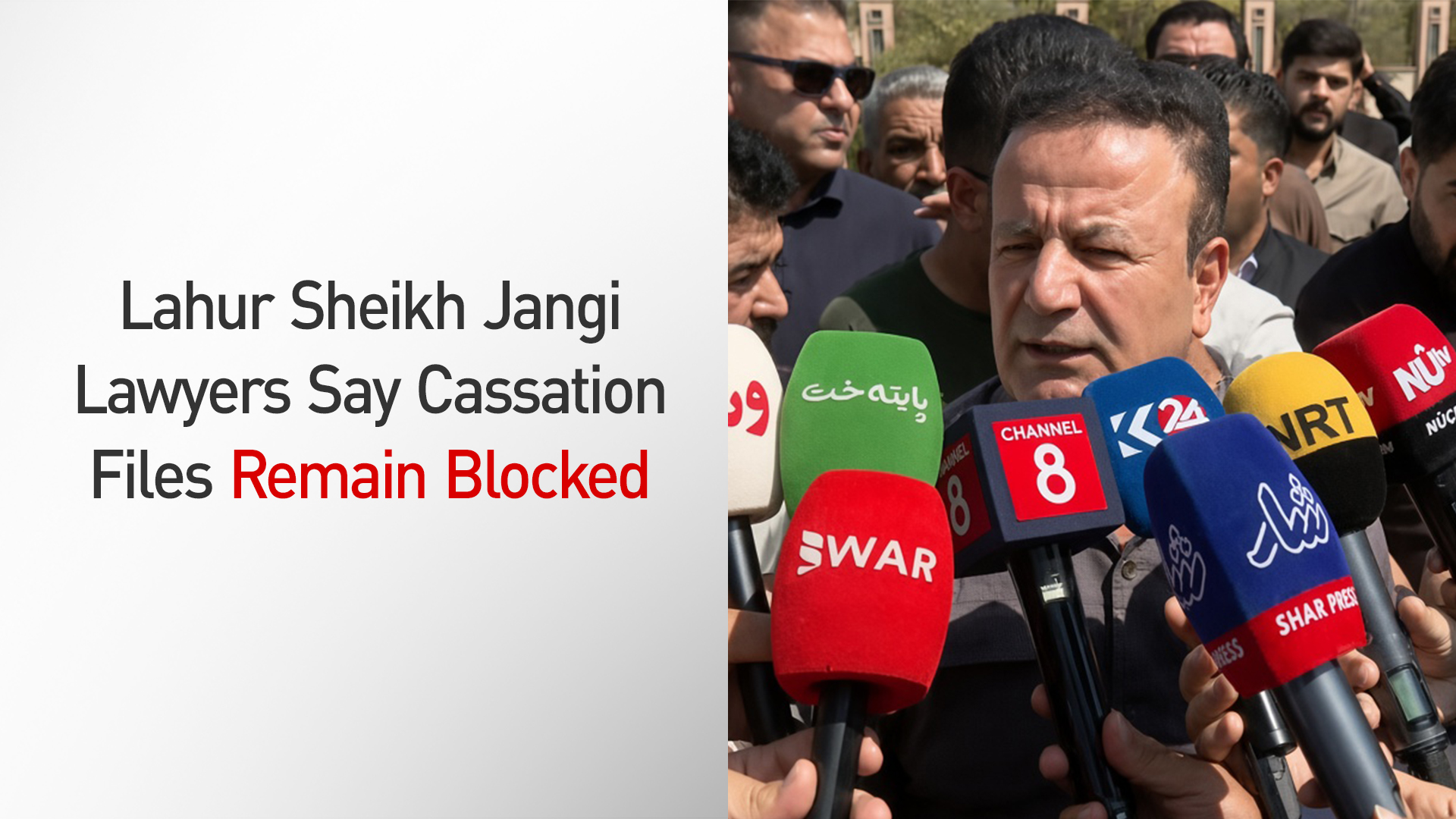
ERBIL (Kurdistan24) - The legal team representing Lahur Sheikh Jangi on Saturday accused judicial authorities in Sulaimani of blocking the transfer of case files to the Kurdistan Region's Court of Cassation, as relatives and supporters marked one year since the deadly Lalezar clashes with a protest outside the city's court.
Burhan Rashid Gulla, head of the legal team, said an appeal for cassation was submitted on Oct. 23, 2025, but alleged that the relevant courts in Sulaimani had still not forwarded the files for review.
"Today marks one year since the Lalezar tragedy, yet unfortunately, this case has remained at a standstill for the entire year," Rashid told reporters during the protest.
He described the alleged failure to transfer the files as a "major violation" of defendants' rights under criminal procedure law and argued that the delay raised questions over the fairness, legality and impartiality of the proceedings.
The case stems from armed clashes on Aug. 22, 2025, near the Lalezar Hotel in Sulaimani, where forces affiliated with the Patriotic Union of Kurdistan (PUK) confronted armed supporters of Lahur Sheikh Jangi, leader of the People's Front alliance and a former senior PUK figure.
Jangi, his brothers Polad and Aso, and dozens of guards and supporters were arrested after several hours of fighting that left people dead and wounded on both sides.
The first anniversary has renewed scrutiny of a case that has become one of the Kurdistan Region's most politically sensitive judicial disputes. The defense has repeatedly alleged political interference, procedural violations and mistreatment of detainees.
Cassation dispute returns to center of case
Rashid said the defense had reached a critical stage and expected several complaints connected to the case to be resolved within the next one to two weeks.
He called either for a reconciliation or for the case files to be allowed to proceed to the Court of Cassation. If neither happens, he said, the president of the Kurdistan Region's Judicial Council and the President of the Kurdistan Region should intervene through established legal procedures.
According to Rashid, the investigation phase is legally limited to six months and the trial phase to another six months, meaning the cases should already have been concluded under his interpretation of the law.
His remarks echoed allegations raised by Jangi's lawyers in July, when the legal team told Kurdistan24 that the Court of Cassation had requested the files on 12 occasions but that the Sulaimani court had not complied.
The lawyers argued that withholding the files deprived defendants of their right to appeal before a higher judicial authority. They cited Article 35 of the Kurdistan Region Judicial Authority Law No. 23 of 2007, which they said requires judges to remain impartial and refrain from partisan activity.
Attorney Dana Taqiaddin also alleged in July that the Sulaimani court was under "partisan domination." He said some detainees had begun hunger strikes, although the legal team advised against continuing them because of their health conditions.
Earlier, defense attorney Aryan Burhan described the proceedings as a political dispute given "a legal facade." He alleged procedural deficiencies, coerced testimony and intimidation of defense lawyers and said the defense wanted the case subjected to an impartial higher-court review.
Previous Kurdistan24 reporting also carried allegations that detainees had been tortured and that several defense lawyers were threatened by members of the Sulaimani Asayish. Those claims remain allegations and have not been independently established by the material supplied for this article.
Families warn over continued delays
Saturday's demonstration brought the legal dispute back into the public arena exactly one year after the arrests.
Awat, Lahur Sheikh Jangi's sister, warned that if the cases of the Lalezar detainees were not resolved this week, the situation could deteriorate.
"We have exercised restraint until now and kept the situation under control," she said, warning that events could "spiral out of control" beginning next week if there were no resolution.
Her remarks add a political and security dimension to a case whose origins lie in a major factional confrontation.
Previous Kurdistan24 reporting described the Aug. 22, 2025 fighting as involving forces aligned with PUK President Bafel Talabani and armed supporters of Jangi. The multi-hour confrontation became one of the most serious episodes of internal political violence in the Kurdistan Region in recent years.
Some detainees associated with the incident have since been released, but the legal status of the principal defendants remains unresolved.
Kurdistan24 previously reported that a Sulaimani judge reviewed Jangi's case on Jan. 12, 2026, but did not issue a final ruling, instead transferring the file to the Kurdistan Region Court of Appeals in Erbil for further examination.
The defense has continued to argue that meaningful appellate review of the broader proceedings has been obstructed.
Saturday's protest therefore renews pressure on the Kurdistan Region's judicial institutions to address both the length of the proceedings and the defense team's claims concerning access to cassation.
For Jangi's lawyers, the immediate demand is procedural: transfer the relevant files and permit review by the higher court. The broader dispute, however, has also raised questions over whether a case rooted in violent political rivalry can proceed in a manner regarded by all parties as independent of partisan influence.
One year after the Lalezar confrontation, the defendants' continued detention and the unresolved dispute over cassation leave the next steps largely in the hands of the Kurdistan Region's judicial authorities.