Barrack Reveals Secret Israel-Syria Talks, Warns Small Military Mistake Could Spark World War III
US Special Envoy discloses five rounds of formal US-mediated negotiations between Israel and Syria's new government, flags 9,400 ISIS detainees as a ticking regional threat, and warns against Iran's continued influence on Hezbollah disarmament
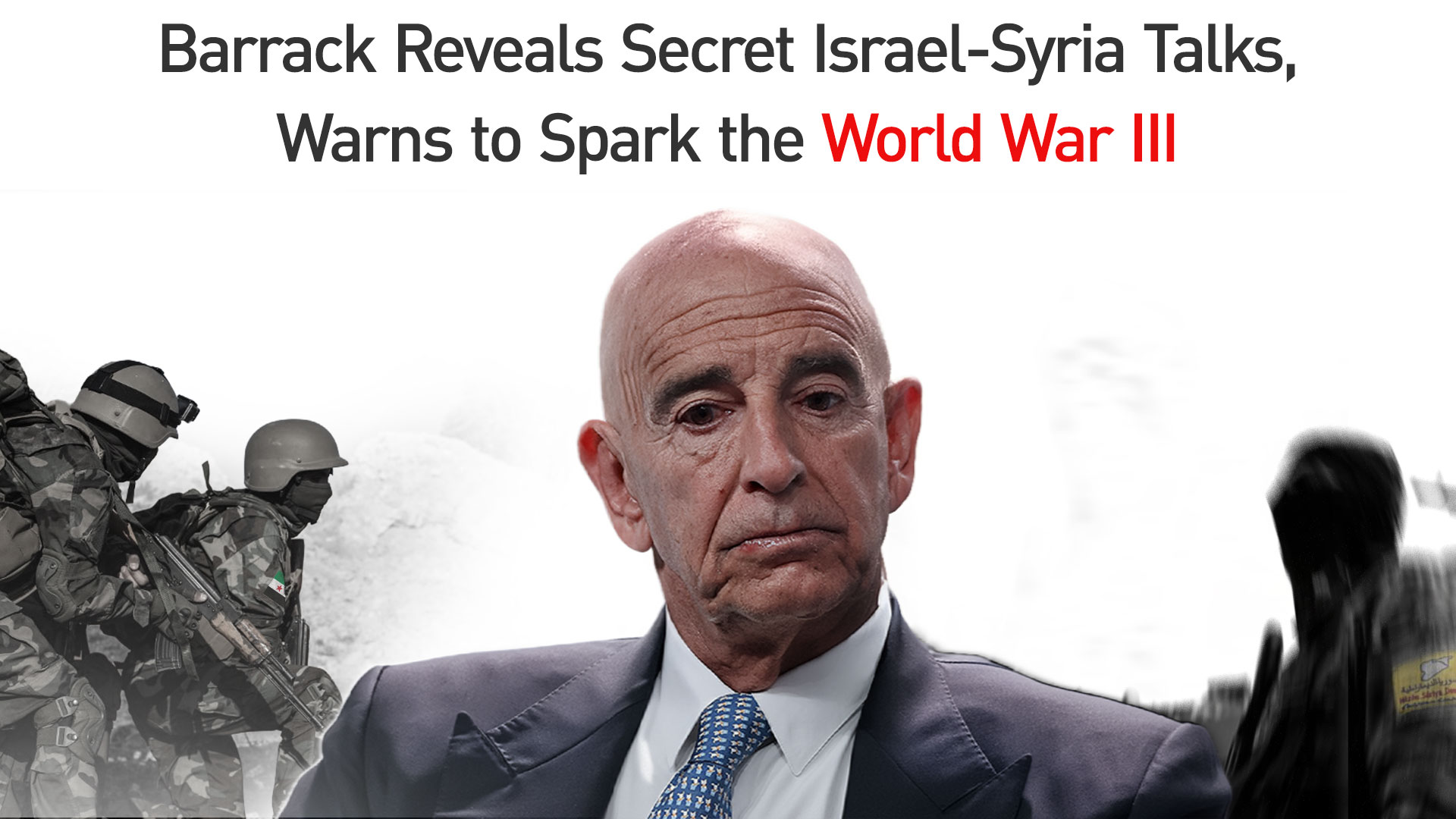
ERBIL (Kurdistan 24) - Tom Barrack, US Ambassador to Türkiye and Special Presidential Envoy for Syria and Iraq affairs, delivered one of the most comprehensive and candid public assessments yet of America's Middle East strategy on Saturday revealing secret Israel-Syria negotiations, warning that a small military miscalculation could ignite a war on the scale of World War III, and outlining the deepening complexity of the Hezbollah disarmament file in Lebanon.
Barrack made the remarks in an interview, portions of which were also delivered to PBS NewsHour, confirming that the Trump administration's primary goal in the region is to reduce the level of tensions across the Middle East, while making clear that Washington no longer intends to serve as an unlimited security umbrella for all parties. "America can no longer remain an open-ended security blanket for everyone," Barrack said. "Countries in the region, such as Türkiye, Saudi Arabia, the UAE, Qatar, and Israel, must take responsibility for their own security and political conditions."
Five Rounds of Secret Israel-Syria Talks
In one of the most significant disclosures of the interview, Barrack confirmed that the United States has supervised five formal rounds and several informal sessions of negotiations between the new Syrian government under President Ahmad al-Sharaa and Israel, with the meetings resulting in a decision to establish a "joint coordination room" in Amman, Jordan, to monitor border lines and the buffer zone whose history stretches back to the 1974 disengagement agreement.
Barrack explained that following the fall of Assad's regime on December 8 and the coming to power of the new government in Damascus, Israel adopted a strategy of eliminating threats on its borders because it did not fully trust the new Damascus administration and feared the armed groups. On December 9, Israel launched an intensive campaign that destroyed nearly all of Syria's air force and military airports to keep Syrian airspace open against Iranian threats.
He acknowledged tension over Israel's continued occupation of Syria's Golan Heights, stating directly: "Israelis are still occupying the Syrian Golan Heights, and this is a violation of United Nations resolutions and the international system that says the Golan belongs to Syrian territory."
The Near-Miss Between Israel and Türkiye
Barrack addressed the dangerous incident in which Israeli jets struck two military airports in Syria, coming within 80 kilometers of the Turkish border and bombing runways without advance warning. He presented three possible explanations for the incident: faulty intelligence about the positioning of Turkish weapons in those areas that later proved incorrect; Israel detecting a sudden or suspicious movement through intelligence and making an immediate strike decision; or a communication failure through secret channels, despite the fact that the head of Mossad and Syria's foreign minister had held lengthy talks just days before.
Barrack warned that Türkiye's military leadership exercised "maximum restraint and patience" when they saw Israeli aircraft, and that they did not allow tensions to escalate into direct conflict. He explicitly invoked the November 2015 incident when Turkish F-16s shot down a Russian Su-24 bomber on the Syrian border, bringing Moscow-Ankara relations to the brink of war until President Erdogan sent Putin a letter of apology in June 2016. "This is a very dangerous game, stationing a warplane on a border without warning and without any agreement," Barrack said.
Barrack told PBS NewsHour that Türkiye had explicitly stated it has no aggressive intentions or posture toward Israel and does not want to participate in any military operation or direct conflict. "What the Turks want is a sovereign and independent Syria, and that is what we, Israel, and all the countries of the region want," he said.
Twelve foreign ministers, including those of Türkiye, Saudi Arabia, Pakistan, and Indonesia, issued a joint statement on Friday condemning Israel's strikes on Syria, AFP reported on Saturday.
9,400 ISIS Prisoners and 75,000 in Camps: A Ticking Threat
Barrack issued a stark warning about the unresolved ISIS detainee crisis in Syria, saying approximately 9,400 ISIS prisoners are currently held in Syrian prisons without any judicial process, formal charges, or clear legal pathway. At the same time, more than 75,000 people, primarily family members of ISIS fighters, are living in dire humanitarian conditions in camps such as Hol and Roj with no clear path to repatriation.
"This remains a major threat to the region's security if not resolved quickly," Barrack said, placing the detainee file alongside the ISIS territorial remnants as one of the most urgent unresolved security challenges facing the new Syrian government and its international partners.
The SDF and Kurdish Rights
Barrack praised the role of the Syrian Democratic Forces and SDF Commander General Mazloum Abdi in the fight against ISIS, while confirming that based on Mazloum's own statements, the process of dissolving the SDF and integrating its fighters into Syria's national army on a military basis has begun. He noted that negotiations on Kurdish political and educational rights in Syria are continuing in parallel.
Barrack clarified the distinction between the YPG/SDF and the PKK, referencing Türkiye's 40-year security concerns along Syria's northern border, and noted that Türkiye has military positions along the northern Syrian border and is training forces of the new government, with efforts underway to organize those areas independently without creating confrontation.
Hezbollah's $90 Million Monthly Iranian Lifeline
On Lebanon, Barrack described the situation as one of the most complex files in the region, expressing personal opposition as a Lebanese-American Maronite Christian to the destruction of villages and killing of civilians in southern Lebanon by Israel. He revealed that Hezbollah, with monthly Iranian financial support estimated at approximately $90 million, has constructed an extensive network of tunnels and positioned tens of thousands of missiles beneath Lebanese villages.
Barrack disclosed a stark salary disparity that illustrates the structural obstacle to disarmament: a Hezbollah fighter earns approximately $2,400 per month while a Lebanese army soldier receives only around $300, making state control and disarmament of Hezbollah extraordinarily difficult.
Closing his assessment, Barrack warned that the region's problems cannot be resolved overnight and require time, funding, and daily technocratic negotiations. "A small military mistake can ignite the fire of a major war like World War III," he said, adding that the overall direction remains toward diplomacy and a regional solution rather than military escalation.