Syrian Democratic Forces Dissolve After Decade of Fighting ISIS
SDF Commander Mazloum Abdi announced the dissolution of the Syrian Democratic Forces as an independent military force, marking a shift toward peace and Kurdish rights.
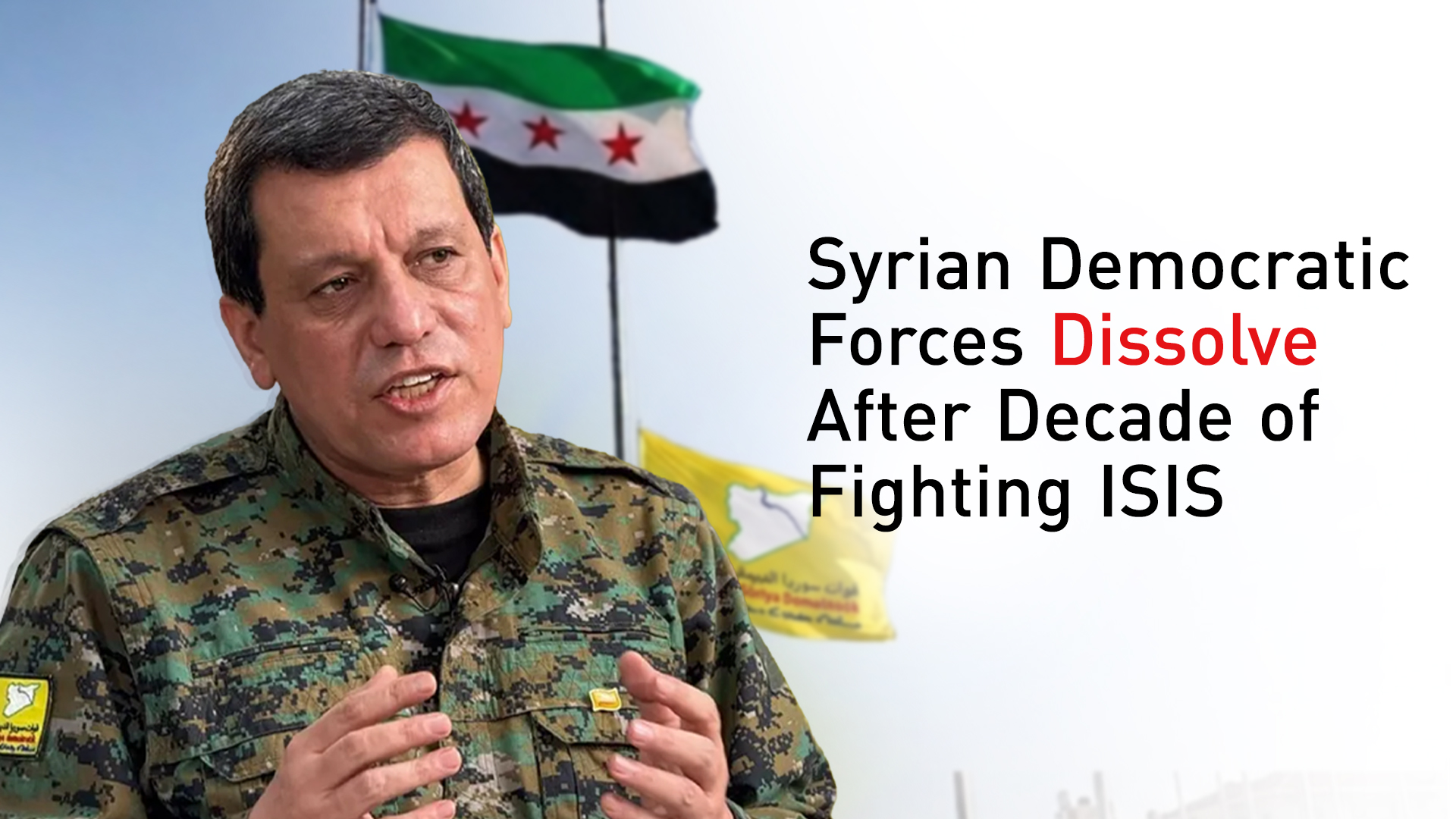
ERBIL (Kurdistan24) - Mazloum Abdi, General Commander of the Syrian Democratic Forces (SDF), formally declared on Tuesday, that his forces' mission had come to an end, announcing the dissolution of the SDF as an independent military structure and the beginning of a new phase focused on peace, reconstruction and the guarantee of national rights across Syria.
Speaking Tuesday, Abdi said the decision was made with full responsibility. He described the moment as the beginning of a genuine transition from the battlefield to nation-building, from an era of weapons to an era of peace, and from a phase of defending Syria to a phase of constructing it.
"We declare with the utmost responsibility the end of the mission of the Syrian Democratic Forces and their dissolution as an independent military force. We want today to mark the beginning of a genuine transition from the battlefield to the field of construction, from the era of arms to the era of peace, and from the phase of defending Syria to the phase of building the nation," Abdi said.
In remarks delivered in Arabic, Abdi expanded on the sacrifices behind the decision, saying the SDF would carry forward the memory of its fallen fighters. He said those fighters had not fought for the sake of war itself, but so that a day would come when Syrians no longer needed to fight at all. He said the SDF wanted that day to mark a genuine transition from battlefields to construction sites, from an age of weapons to an age of peace, and from a phase of defending Syria to a phase of building it.
Abdi also addressed the right to education in the Kurdish language, describing it as one of the most significant rights Syrian Kurds have pursued for decades. He said Syrian President Ahmed al-Sharaa had, on several occasions, publicly committed to protecting this right, and that the SDF had sought an open stance from the president regarding education in the mother tongue and the development of a decision issued Tuesday.
"We will work to implement this decision this year so that we can build upon it in the future," Abdi said.
Closing his remarks in Kurmanji, Abdi called for a new Syria to be built collectively, one that belongs to all of its components — Arabs, Kurds, Syriacs, Assyrians and Turkmen. He described his vision of an equal and free Syria that preserves the rights and dignity of all its citizens and builds a better future for coming generations. He again paid tribute to those killed in the conflict and greeted the SDF's comrades and the wider public with respect.
From the Anti-ISIS Campaign to State Integration
The SDF was established on Oct. 10, 2015, as a military coalition with a stated mission of building a secular, democratic and federalized Syria, guided by a philosophy emphasizing local administrative councils, gender equality and ethnic pluralism.
Backed by the international coalition, the SDF served as the primary ground force in breaking ISIS's territorial hold in Syria, with notable victories including the liberation of Al-Shaddadi in Hasaka and a series of border operations stretching from Baghuz through the Middle Euphrates River Valley.
The coalition's core was formed by the Kurdish People's Protection Units (YPG), which includes the all-female Women's Protection Units (YPJ), a prominent component of Kurdish military operations. To secure non-Kurdish areas, the SDF also incorporated Arab tribal militias such as Al-Sanadid, Christian and Assyrian forces including the Syriac Military Council, and regional military councils, alongside the Asayish internal security force, which managed policing and regional stability.
Tuesday's announcement follows a broader integration process launched after the collapse of the former Assad government. On Jan. 29, Abdi and al-Sharaa signed a 14-point agreement that halted hostilities and initiated the formal transfer of energy fields, border infrastructure and ISIS detention facilities to central state control.
Since then, military integration has been structured around five national military regions. Under the Eastern Region command, four SDF brigades have been fully absorbed into national defense forces and deployed across Kobani, Hasaka, Qamishli and Derik, according to Deputy Defense Minister for Eastern Region Affairs Sipan Hemo, a prominent Kurdish commander, in remarks reported by ANHA.
High-level delegations led by Abdi, Ilham Ahmed and YPJ leadership have also held regular meetings with the Interior Ministry in Damascus as part of the security integration process, including bringing the Asayish into national security operations and appointing Kurdish commanders, such as Siamand Afrin, to senior state security posts in Hasaka.
Tuesday's declaration marks the most significant step yet in that transition, formally closing the chapter of the SDF as an independent fighting force nearly 11 years after its founding.
"A new Syria will be built together," Abdi said in his closing remarks.