KRG Interior Minister Says Key Phase of Kurdistan Police Reform Is Underway
KRG Interior Minister Reber Ahmed says a new phase of police reform will focus on public trust, digitalization, leadership training and greater participation by women.
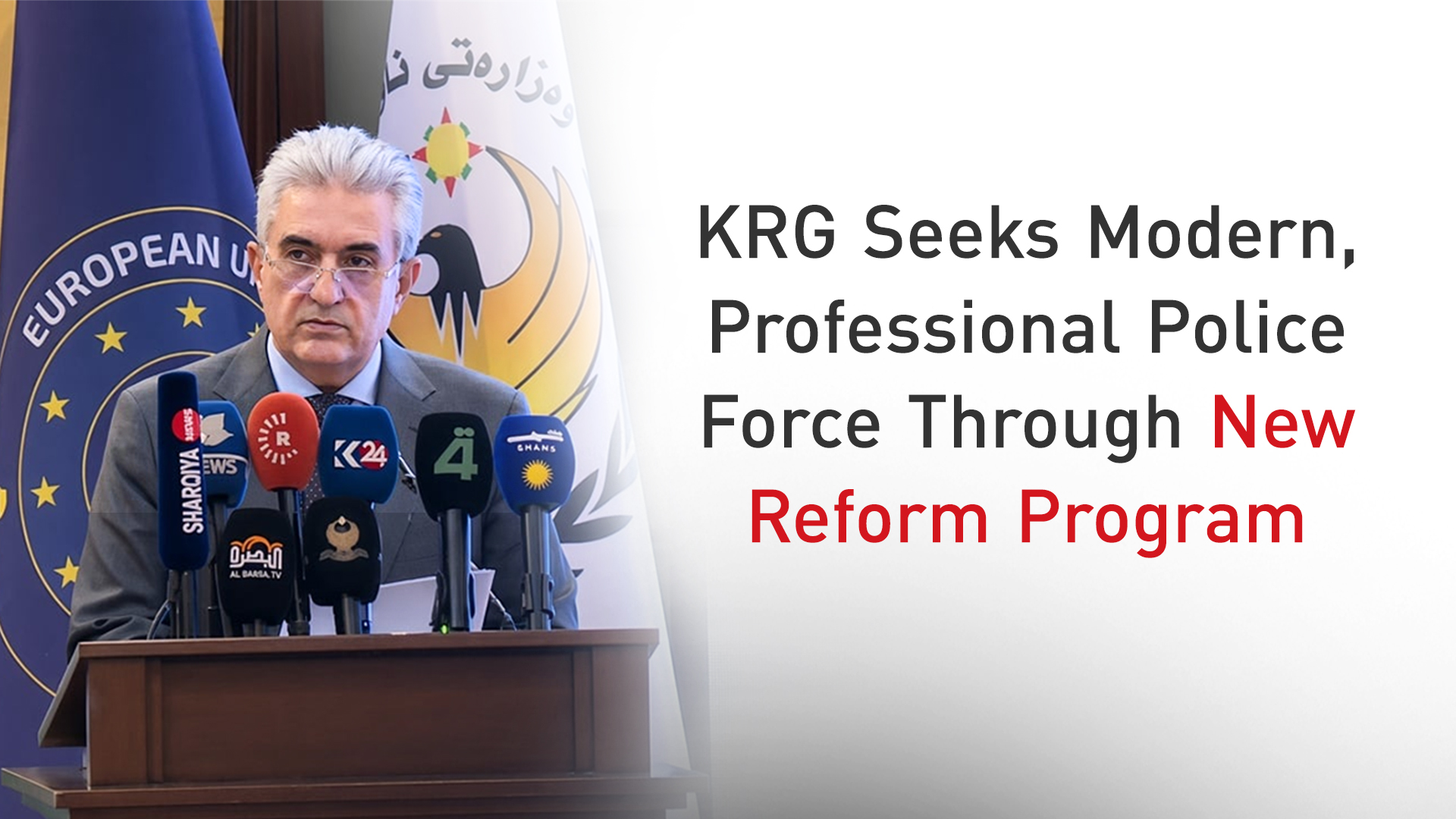
ERBIL (Kurdistan24) - Kurdistan Regional Government Interior Minister Reber Ahmed said Sunday that the Kurdistan Region has entered an important new phase of police reform centered on stronger public trust, professional conduct, digitalization and the development of a modern force capable of responding to changing security and social needs.
Ahmed outlined the reform agenda during a strategic leadership and police-reform workshop held on Aug. 30 with the participation of the European Union Advisory Mission operating in Iraq and the Kurdistan Region.
He said police reform forms a key part of the Ninth KRG Cabinet's wider reform program under Prime Minister Masrour Barzani and is intended to strengthen the institutional and professional capabilities of the police.
The objective, Ahmed said, is to build a force capable not only of addressing today's security requirements but also of adapting to future challenges and broader changes in society.
Public trust at center of reform
The interior minister stressed that reform should not be understood simply as changing administrative structures, regulations or internal procedures.
Its real measure, he said, would be whether citizens receive better services and whether police officers demonstrate higher levels of professionalism in their interactions with the public.
Ahmed identified timely enforcement of the law and greater responsiveness to citizens' needs as essential elements of the new approach.
Public confidence in the police and other internal security institutions, he said, would remain one of the most important indicators of whether the reform succeeds.
That emphasis places the relationship between police and the public at the center of the reform strategy, rather than treating modernization purely as an internal institutional exercise.
European experience, local implementation
Ahmed thanked the European Union Advisory Mission for its role in organizing the workshop and supporting discussions on international policing experience.
He said exposure to European models could broaden the perspective of police institutions in the Kurdistan Region and provide useful lessons in areas ranging from leadership to institutional management.
At the same time, he stressed that foreign experience could not simply be copied.
Any successful model, Ahmed said, must be adapted to the Kurdistan Region's own legal, social and institutional circumstances.
He also called on senior police officials to take direct ownership of the reform process.
External partners can provide advice and expertise, he said, but meaningful institutional change must ultimately be designed, accepted and implemented from within the police structure itself.
Police colleges to become leadership centers
Education and training will form another major pillar of the next reform phase.
Ahmed said police colleges need new curricula capable of preparing officers for a more complex security environment.
He argued that such institutions should move beyond conventional training and become centers for producing future police leaders capable of analysis, decision-making and institutional management.
That shift would require greater attention to strategic thinking and leadership development alongside traditional policing skills.
The minister's comments suggest that the KRG sees professional education as a long-term mechanism for changing police culture rather than simply improving individual technical capabilities.
Digitalization as a management tool
Ahmed also placed significant emphasis on digital transformation.
He described digital systems not merely as technological additions but as tools capable of changing how police institutions are managed.
Digitalization, he said, could strengthen crime prevention, improve transparency during investigations and allow authorities to provide more advanced and efficient services to citizens.
The Interior Ministry has increasingly emphasized the modernization of government and security institutions as part of the Ninth Cabinet's broader administrative reform agenda.
For police institutions, the use of digital systems could potentially improve record management, accountability and coordination while reducing dependence on slower traditional procedures.
Greater role for women
Ahmed also called for wider participation by women in both police ranks and leadership positions.
He told police commanders that reform should reflect the diversity of the society the institution serves.
People are more likely to feel secure and represented, he said, when they see different parts of society reflected within the police force itself.
Creating more opportunities for women and placing greater confidence in their capabilities therefore forms an integral part of the ministry's strategy for building a modern and effective security institution.
The call goes beyond recruitment numbers by emphasizing women's access to leadership and decision-making roles.
A broader institutional shift
Taken together, Ahmed's remarks outline a reform agenda extending across training, management, technology, public engagement and institutional representation.
The central challenge will be translating those priorities into measurable change within police institutions across the Kurdistan Region.
For the Interior Ministry, the stated objective is to move toward a force that is more professional, more transparent and more responsive to the public while remaining capable of meeting evolving security threats.
Ahmed made clear that international cooperation can support that process, but responsibility for its success rests primarily with the Kurdistan Region's own police leadership.
The new phase of reform, he said, must ultimately produce institutions that citizens trust and that are equipped to respond effectively to both present-day needs and the challenges likely to emerge in the years ahead.