Vance Blames Immigration as France Reels From Protest Violence
J.D. Vance blamed immigration and failed assimilation for unrest in France after nationwide protests left 1,200 arrested and more than 150 police injured.
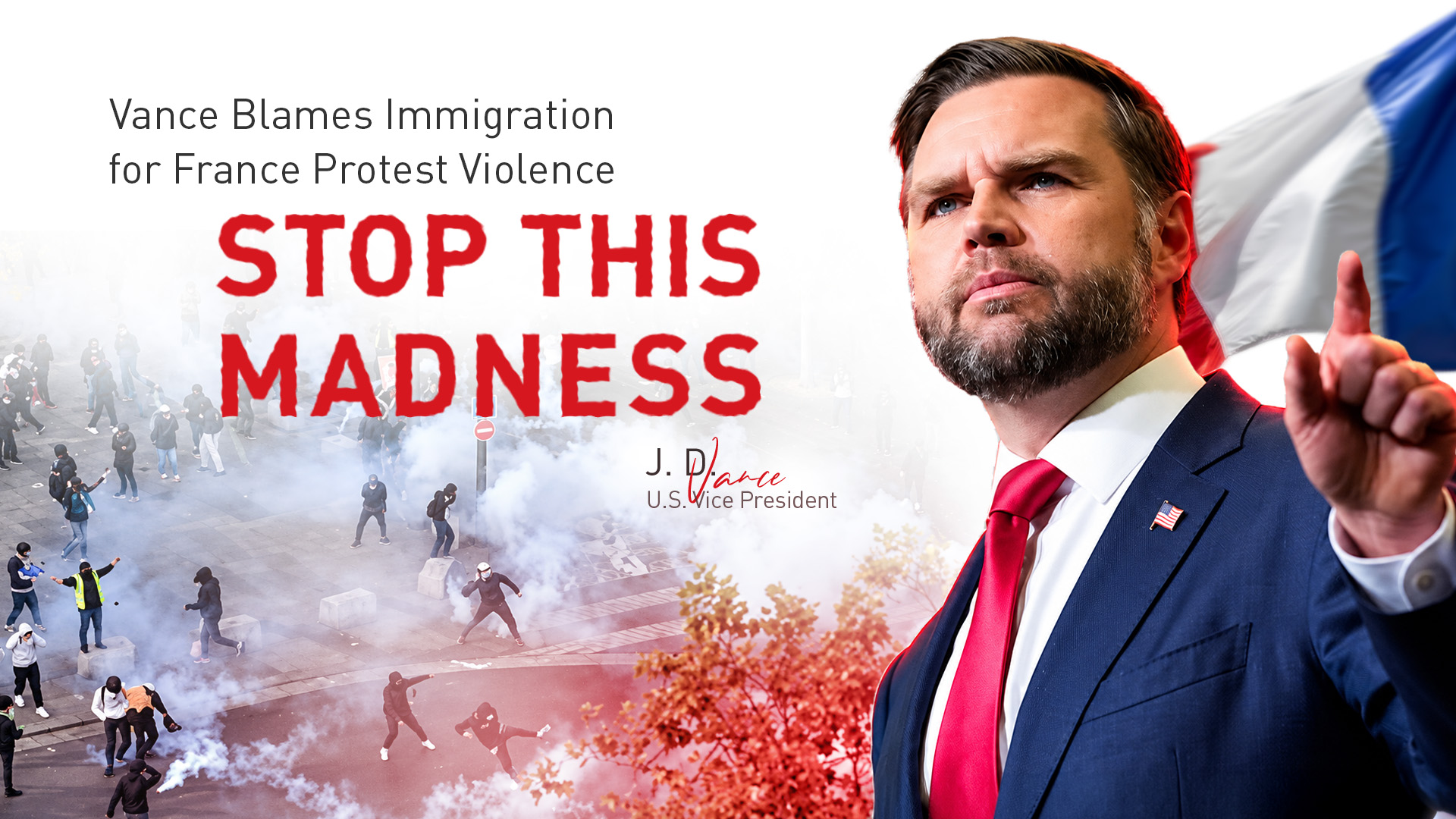
ERBIL (Kurdistan24) - U.S. Vice President J.D. Vance blamed immigration and failed assimilation for the violence that swept parts of France during nationwide protests over the cost of living and public services, turning a domestic French crisis into a wider political debate after 1,200 people were arrested and more than 150 police officers were injured.
Writing on X on Sunday, Vance argued that European governments had admitted large numbers of migrants without adequately considering integration and social compatibility, and presented the turmoil in France as a warning for the United States.
"Western liberals imported the third world into France and other countries in the name of diversity and compassion," Vance wrote, before saying he hoped France would halt what he called "this madness" before more landmarks were burned.
He also sought to connect events in France to U.S. domestic politics, saying Americans should pay attention and accusing congressional Democrats of seeking policies that could produce similar consequences.
Vance's intervention offered an immigration-centered explanation for the violence. French authorities, trade unions and demonstrators quoted in reporting on the unrest, however, have primarily described the movement in terms of rising living costs, deteriorating public services, school conditions and wider political frustration.
The source material provides no finding by French authorities establishing immigration as the cause of Saturday's rioting.
The unrest followed weeks of student mobilization and culminated in mass demonstrations across France on Saturday, Oct. 17.
Prime Minister Sébastien Lecornu said 1,200 people had been arrested and 150 police officers injured after clashes, fires, vandalism and extensive looting erupted on the margins of demonstrations in Paris and numerous other cities.
"It's a miracle the toll wasn't higher," Lecornu said, according to France24.
The Interior Ministry estimated that around 550,000 people participated in demonstrations nationwide, while the CGT trade union put the figure at 800,000.
Despite the scale of the disorder, the large majority of demonstrators marched peacefully. Violence was concentrated among groups operating around or after the main rallies, according to reporting from Agence France-Presse and other outlets.
AFP journalists Toni Cerda and Béatrice Joannis, with AFP bureaus across France, reported widespread attacks on shops and public buildings as masked groups moved through urban centers.
In Paris, parked cars were burned and stores were broken into and emptied. Supermarkets, pharmacies, clothing retailers, luxury boutiques, opticians and electronics shops were among businesses targeted in cities including Paris, Marseille, Nice, Nantes, Bordeaux, Limoges, Lille, Toulouse and Strasbourg.
AFP reporters observed small organized groups disabling security cameras before smashing their way into businesses.
The violence also struck public institutions.
A fire devastated the historic town hall in Limoges after masked protesters entered the building, while municipal buildings in Marseille and Lille were vandalized. A police facility in Bordeaux was attacked, and protesters set fire to a tourism office in Lyon.
President Emmanuel Macron said those responsible for vandalism, attacks on government buildings and businesses, and looting would face prosecution and punishment.
The disorder was accompanied by confrontations between demonstrators and police.
Security forces used tear gas and water cannon as some protesters threw projectiles and launched fireworks. A 17-year-old boy in Saint-Etienne lost his right hand after an incident involving a police crowd-control grenade, according to AFP.
The violence has also renewed scrutiny of police tactics after earlier allegations of excessive force during student demonstrations.
Kurdistan24 correspondent Sangar Akrayi, reporting from Paris earlier in the week, spoke with students who described a protest movement rooted initially in frustration with education.
Students complained of teacher shortages, inadequate equipment, deteriorating school buildings, overcrowded classrooms and insufficient public funding.
One demonstrator told Kurdistan24 that the dissatisfaction had expanded beyond schools to hospitals, town halls and other public services.
Another protester, Chloé, said students wanted authorities to listen to their demands and criticized media coverage that focused overwhelmingly on confrontation rather than the grievances driving young people into the streets.
"We are here for our rights," she told Kurdistan24.
The protests began in high schools in late September before expanding to university students, teachers, trade unions, Yellow Vest activists and other groups.
France's Education Ministry had announced plans to deploy about 3,000 substitute teachers to 114 high schools facing particularly serious staffing shortages, but student organizations said the response fell short of what was needed.
By Saturday, the demonstrations had broadened substantially.
Economic concerns were increasingly prominent, with protesters citing higher rents, wages they regarded as inadequate and the rising cost of food, energy and fuel.
Teacher Regine Monfroid told AFP in Strasbourg that people were frustrated by working for low wages while rents continued to increase.
High school student Kamil Alahyan said his reasons for protesting ranged from the approaching 2027 presidential election to distrust of politicians and concerns about growing economic inequality.
The Yellow Vest movement, which mounted major demonstrations during Macron's presidency beginning in 2018, had also called for Saturday's “yellow and youth” protests.
Some participants adopted explicitly revolutionary language, drawing comparisons with the French Revolution. But political figures across France sought to draw a line between protest and destruction.
Far-right presidential candidate Marine Le Pen condemned rioters and accused the political movement of far-left rival Jean-Luc Mélenchon of legitimizing violence.
Mélenchon, who had supported the demonstrations and earlier student mobilization, urged participants to stay away from looting and said such conduct was inconsistent with his movement's methods.
Paris Mayor Emmanuel Grégoire similarly defended the right to demonstrate while denouncing the destruction.
AFP journalist Claire Gounon, reporting separately on the looting in Paris, described scenes in which masked groups broke into shops while ordinary residents continued their Saturday routines nearby.
Some demonstrators told AFP they understood the anger behind the unrest but questioned the usefulness of damaging businesses and streets.
A civil servant named Jules said the violence appeared to reflect "deep anger" among people who felt excluded from society, but argued that looters were undermining the broader protest movement.
The French unrest also coincided with violence during demonstrations elsewhere in Europe.
In Milan, a protest against war and the rising cost of living began peacefully before masked rioters clashed with police, looted stores and started fires in the city center.
The Associated Press reported that police used tear gas and water cannon, while Italian Prime Minister Giorgia Meloni defended the right to demonstrate but said setting cities on fire was unacceptable.
Milan Mayor Giuseppe Sala, from the center-left, similarly said the grievances behind the protests were understandable but violence against police and damage to the city could not be justified.
France's unrest has therefore produced several overlapping debates.
For the government, the immediate challenge is public order after the mass arrests, injuries and attacks on businesses and municipal buildings.
For protesters, the demonstrations continue to center on living costs, education funding, public services and inequality.
For political opponents inside France, the violence is already becoming part of the contest ahead of the April and May 2027 presidential election.
Vance's comments added another dimension by interpreting the disorder through immigration and assimilation and explicitly linking France's experience to political choices facing Americans.
His remarks did not reflect the explanation advanced by the protesters interviewed by Kurdistan24, AFP or other news organizations, whose stated grievances centered overwhelmingly on economic pressures and public services.
Nor do those grievances erase the scale of Saturday's violence.
France entered Sunday confronting both realities: hundreds of thousands of people had taken to the streets with political and economic demands, while groups operating amid those demonstrations left shops looted, vehicles burning, public buildings damaged and scores of police officers injured.
The dispute now extends beyond what happened in France's streets to a political argument over why it happened, and what, if anything, other countries should learn from it.