Chinese Exports to Iran Collapse 52% in First Seven Months of 2026
New customs data show China shipped just $1.9 billion in goods to Iran between January and July, down from $4 billion in the same period of 2025, as sanctions, the naval blockade, and maritime disruption compress Iran's capacity to import foreign inputs
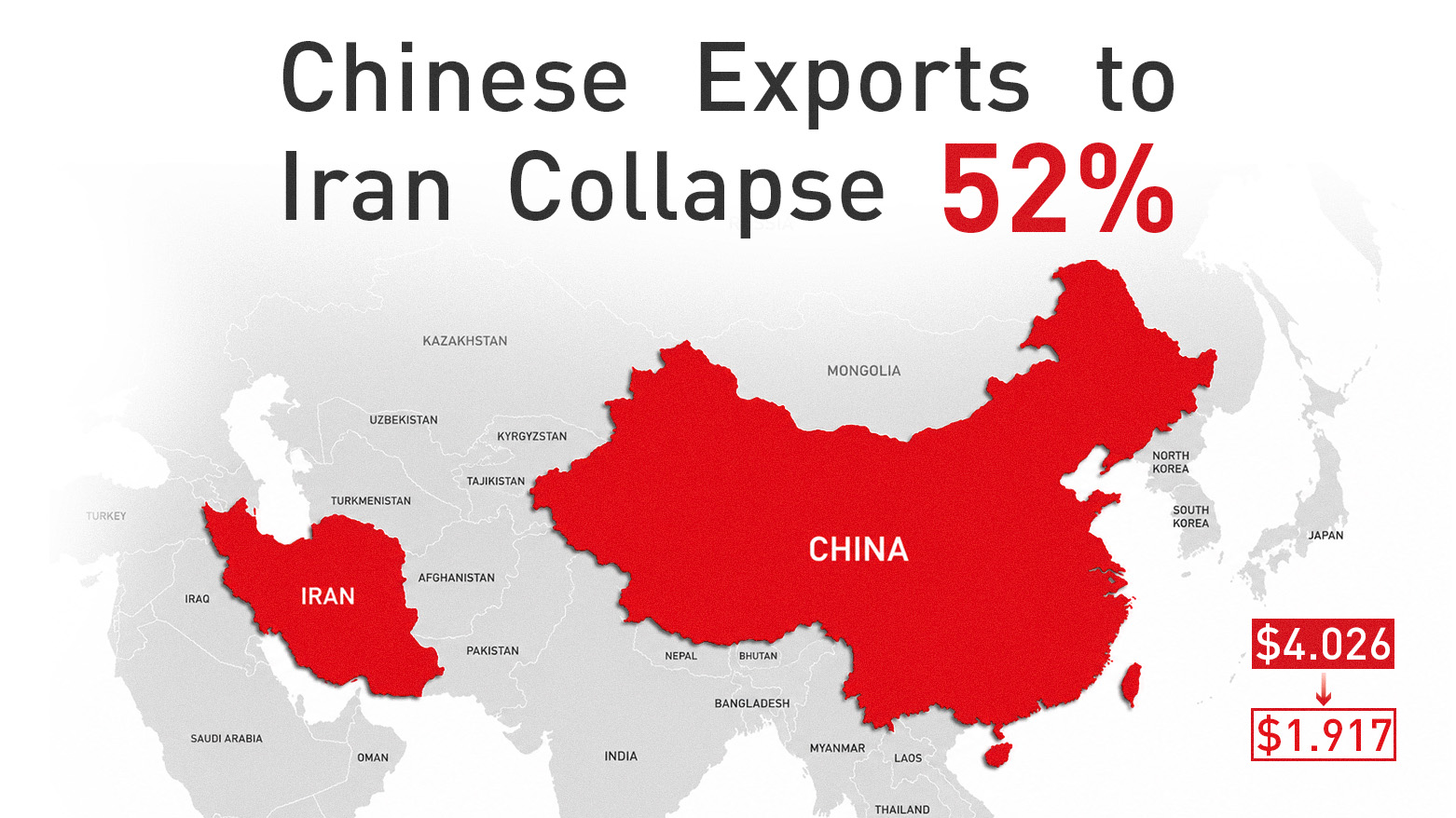
ERBIL (Kurdistan 24) - Chinese exports to Iran collapsed by approximately 52 percent in the first seven months of 2026 compared with the same period of 2025, new Chinese customs data show, with China shipping $1.917 billion in goods to Iran between January and July 2026, down from $4.026 billion in the equivalent period of 2025, a decline of more than $2.1 billion that reflects the devastating impact of the US-Iran war on one of Tehran's most critical trade relationships.
The scale of the decline is consistent with the broader collapse in China-Iran bilateral trade that has accelerated throughout the conflict. China's exports to Iran fell 90 percent from January to March 2026 at the most intense phase of the conflict, as US and Israeli airstrikes, the naval blockade, and secondary sanctions pressure simultaneously disrupted Iran's ability to receive and pay for imported goods. The 52 percent decline recorded across the full January to July period reflects a partial recovery from that extreme initial contraction as some trade routes adapted, but still represents a devastating compression of China's goods exports to Iran compared with the pre-war baseline.
China is one of Iran's most important sources of imported goods, supplying machinery and industrial equipment, electrical and electronic products, automotive components, chemicals and manufacturing inputs, and consumer goods that form the backbone of Iran's industrial and manufacturing sectors. Chinese customs data may undercount the true value of exports to Iran, as some goods transit through third countries, but the scale and direction of the decline are consistent with the general compression of Iran's imports described by Iranian officials throughout the conflict.
The practical consequences for Iran's industrial economy are severe and will continue to compound over time. Iranian manufacturers unable to obtain Chinese machinery, components, or intermediate goods face a stark set of deteriorating options: reducing capacity utilization, drawing down existing inventories, postponing maintenance and investment, substituting lower-quality or more expensive inputs from alternative sources, and ultimately cutting production and employment. The consequences of import compression of this scale typically appear with a lag in industrial output figures, meaning the full economic impact of the January to July decline may not yet be fully visible in Iran's published economic statistics.
The customs data arrive as Treasury Secretary Scott Bessent announced on Monday, August 31, 2026, that the United States plans to impose additional secondary sanctions on Iran on a weekly basis, with new measures beginning by targeting banks. Bessent also confirmed that America's blockade of Iranian ports has contributed to reducing China's oil imports from Iran, the first explicit public American claim that the naval blockade is directly affecting the volume of Chinese purchases of Iranian crude.
Since the US-Israel attacks started on February 28, Iranian production and exports collapsed amid infrastructure damage and the halt to shipping, creating an immediate shortfall of 1 to 1.4 million barrels per day in oil imports from Iran for China, as the Bruegel Institute confirmed in its analysis of the conflict's economic implications. Teapot refineries lost access to low-cost Iranian crude and faced high replacement prices in a market already strained by global tensions.
China's Foreign Ministry warned the United States on August 25, 2026, that Beijing's cooperation with Iran operates within international law and must not be disrupted, a statement that carried the confidence of a country that had prepared for the conflict with massive pre-war stockpiling. In the first two months of 2026, Chinese oil imports surged 16 percent for stockpiling, giving Beijing the buffer it needed to absorb the supply shock of the Hormuz closure without panic. But even China's strategic preparation could not fully insulate it from the collapse of bilateral trade in goods, and the 52 percent decline in Chinese exports to Iran across seven months is the clearest evidence yet that Operation Economic Outcast's secondary sanctions pressure is beginning to register in Beijing's own trade statistics.