UAE’s EDGE rides battle-tested weapons boom into European defense market
Abu Dhabi-based defense group says demand has surged after nearly 3,000 Iranian missiles and drones targeted the UAE during six months of conflict
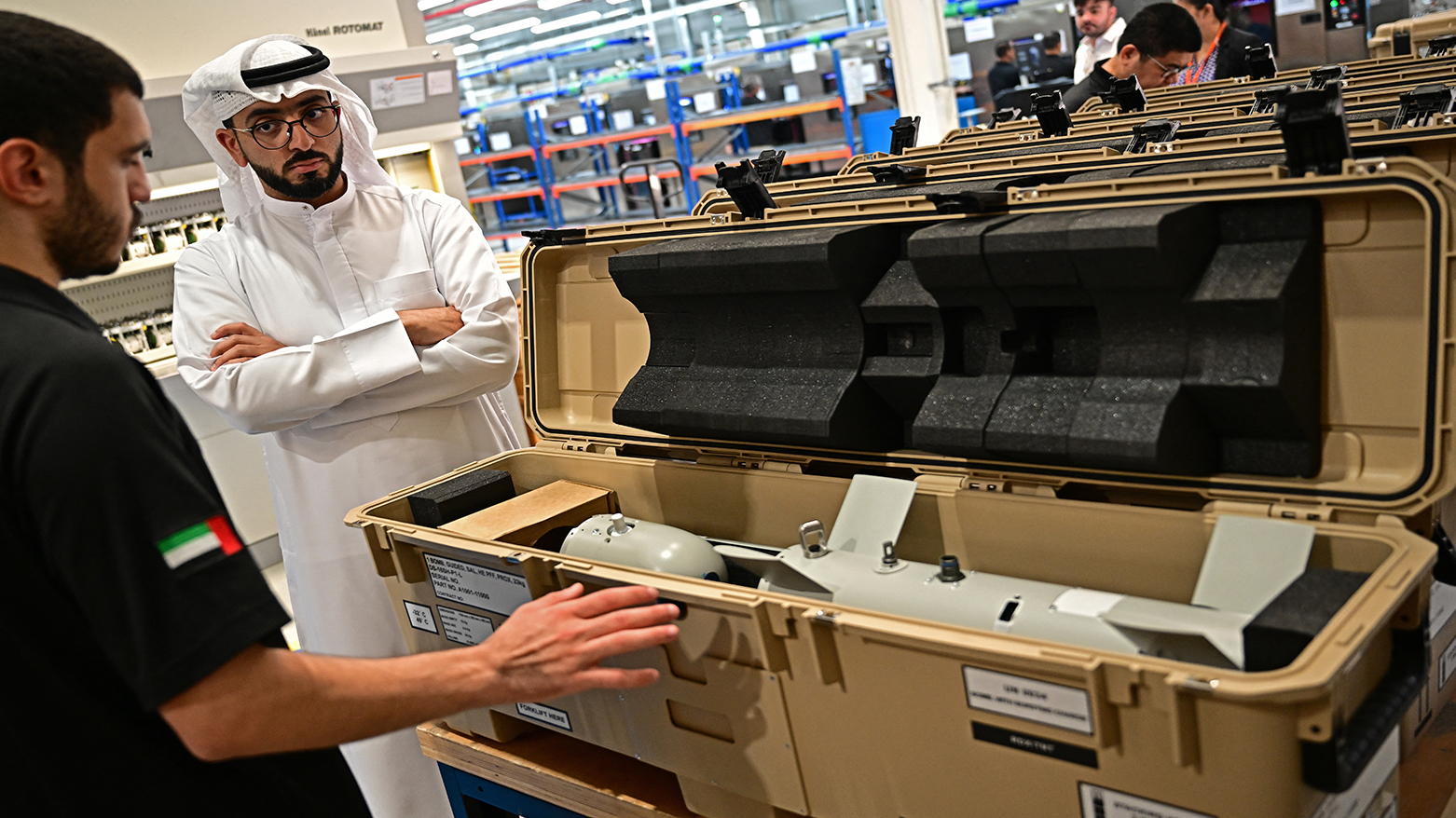
ERBIL (Kurdistan24) — The United Arab Emirates’ EDGE defense group is accelerating its push into international arms markets after weapons and technologies developed by the Abu Dhabi-based company were tested during six months of conflict between the United States and Iran, executives told AFP.
Nearly 3,000 missiles and drones targeted the UAE during the conflict, according to the company, temporarily challenging the Gulf state’s reputation as a regional safe haven while creating a surge in demand for weapons that EDGE describes as “battle-proven.”
“Before the war, we only had a handful of products that we could say were battle-proven. After the war, we can say a lot of products are now battle-proven,” Khaled Al Zaabi, president of EDGE’s platforms and systems cluster, told AFP at the company’s Abu Dhabi headquarters.
Zaabi said the battle-tested record had become “the absolute selling point” for EDGE, with demand increasing by “magnitudes” following the conflict, although he did not disclose specific sales figures.
Founded in 2019 through the consolidation of several UAE defense companies, EDGE has rapidly emerged as one of the Arab world’s largest defense manufacturers.
The group employs about 19,000 people and develops a broad range of military technologies, including drones, missiles, armored vehicles, naval vessels and artificial intelligence systems.
The company now depends largely on international exports for its revenue, with exports accounting for about 70 percent of its $5 billion in sales last year.
Air defense becomes a priority
The experience of the conflict has also sharpened the UAE’s focus on developing cheaper, locally produced systems capable of countering large-scale drone attacks.
Miles Chambers, EDGE’s senior vice president for international business, said the company was already experiencing strong demand from countries across the region.
Albert Vidal, a research associate at the International Institute for Strategic Studies, said Gulf states were likely to increase defense spending, particularly on air-defense capabilities.
Some of EDGE’s air-defense systems were still under development when the conflict began. Vidal expects “significant acquisitions” once those systems become available.
One of the most closely watched projects is SkyKnight, a short-range air-defense system currently scheduled for release in 2028. Saeed Al Shamsi, chief executive of EDGE subsidiary Halcon, said the company was seeking to accelerate development by introducing the system in phases.
“Us and EDGE are currently focused on developing air defense systems, specifically countering saturation of drone attacks,” Al Shamsi said.
The UAE continues to rely heavily on advanced US-made air-defense systems, including the Patriot and Terminal High Altitude Area Defense (THAAD) platforms. Since the start of the conflict, Abu Dhabi has spent more than $8 billion on US weapons, according to the report.
But EDGE executives argue that expensive interceptors are not always the most economical response to relatively inexpensive drones.
“You don't need to counter every threat with a Patriot missile. You can counter Shaheds and these kinds of drones with much cheaper drones,” Zaabi said.
In May, EDGE chairman and presidential adviser Faisal Al Bannai said 85 percent of drone interceptions during the conflict had been carried out using jammers produced domestically.
Vidal cautioned that the figure could not be independently verified.
The experience has nonetheless encouraged Abu Dhabi to accelerate the development of indigenous air-defense systems, drones and electronic-warfare technologies as it seeks to reduce its reliance on costly foreign systems.
Building a defense industry at home
EDGE’s ambitions are also visible at Abu Dhabi’s Tawazun Industrial Park, where the company is expanding its manufacturing capabilities.
Michael Deshaies, chief executive of EDGE subsidiary EPI, which produces components for commercial aircraft and the defense industry, said the company aimed to become “one of the largest” manufacturers of micro-jet engines.
A new 5,600-square-meter facility is being constructed near EPI’s main site to manufacture micro-jet engines for autonomous vehicles.
The facility will be more heavily focused on defense applications than EPI’s existing commercial operations, Deshaies said.
The expansion reflects a broader UAE strategy of building domestic defense manufacturing capabilities while positioning Abu Dhabi as an international hub for military technology.
EDGE targets Europe
EDGE has continued its international expansion, increasingly targeting established Western defense markets. The company has pursued a strategy centered on acquiring defense companies, taking majority stakes and gaining access to their established customer networks and markets.
After initially concentrating on markets in the Global South, including a reported $500 million investment in Brazil, EDGE established its European headquarters in Paris in June.
The move comes as European governments dramatically increase defense spending amid Russia’s war in Ukraine and mounting pressure on NATO members to strengthen their military capabilities.
EDGE has acquired stakes in and announced partnerships with defense companies across Europe. In France, it plans to establish an engine-production company and a drone manufacturing facility.
Vidal said EDGE's strategy was to manufacture weapons in Europe and market them as locally produced while taking advantage of the networks and market access of companies it has acquired.
European military spending has expanded significantly over the past decade and now exceeds the combined defense spending of Latin America, Africa and South Asia by more than three times, according to Vidal.
For EDGE, Europe represents a crucial step in its ambition to become a major global defense manufacturer.
“If EDGE wants to become a top 10 defense company globally, they will struggle to get there if they are not selling to Western/NATO countries,” Vidal said.