Saad Maan: Iraq Has 'All Options' to Disarm Militias
Lt. Gen. Saad Maan says Iraq has moved from debating whether militias can be disarmed to determining how, stressing that Baghdad has "all options" available.
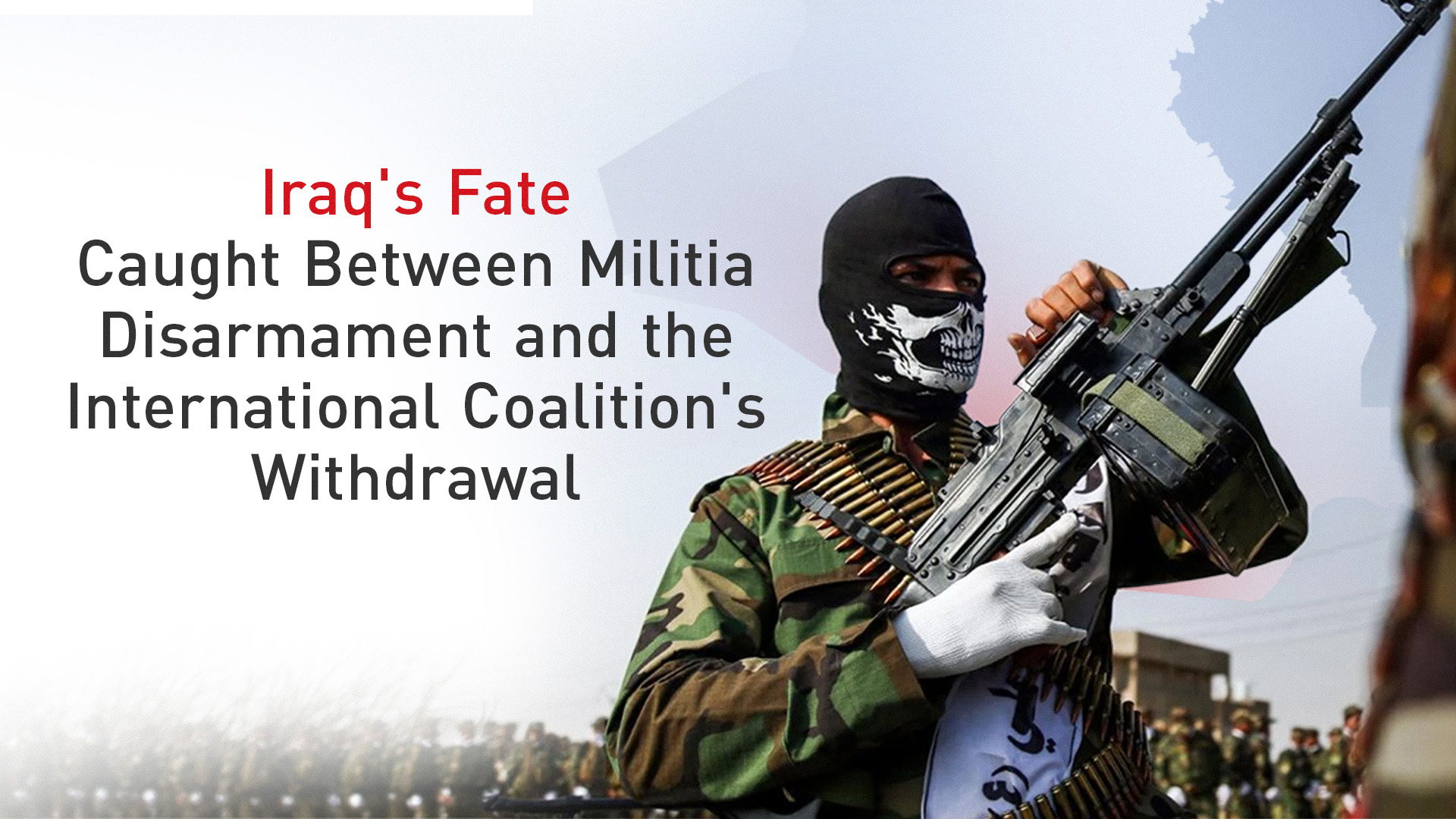
ERBIL (Kurdistan24) - Iraq's federal government has moved beyond debating whether armed factions can be disarmed and is now focused on how to bring their weapons under state control, Lt. Gen. Saad Maan said Friday, stressing that Baghdad has "all options" available as it approaches the Sept. 30 deadline for the withdrawal of U.S.-led international coalition forces.
Maan, head of Iraq's Security Media Cell, said negotiations over the future of foreign forces and weapons outside direct state control had reached an advanced stage, with what he described as "security diplomacy" helping address several sensitive issues.
"The federal government has moved beyond uncertainty over whether the issue of disarming these groups can be resolved," Maan told federal government media. "It is now focused on how to resolve it."
That shift, he said, means the government is no longer merely assessing possible outcomes but is working to identify a practical mechanism for implementing its weapons-control policy.
Maan expressed optimism despite resistance from some armed groups and said Baghdad retains all available options to achieve its objectives. He did not specify what those options include.
Sovereignty and unified security decisions
Maan framed the issue as one of sovereignty, law and unified national decision-making.
He said all armed forces operating inside Iraq should ultimately fall under federal authority and that decisions involving national security, war and peace must be made through the country's constitutional institutions.
He also defended Iraq's reliance on international dialogue and security coordination, arguing that such engagement does not diminish sovereignty.
Instead, he said, agreements and security diplomacy can help protect Iraq from becoming an arena for wider regional confrontation.
The issue has become increasingly urgent as the formal mission of U.S. and international coalition forces moves toward its scheduled conclusion on Sept. 30.
Baghdad has repeatedly presented the coalition withdrawal and the regulation of weapons as parallel elements of the same sovereignty agenda: foreign forces depart while independent armed authority inside Iraq is brought under state control.
Reported militia proposal stops short of disarmament
The government's position comes as political sources have disclosed a proposal from several armed factions that would allow them to retain their arsenals after coalition forces leave.
Three Iraqi political sources told the news outlet Al-Araby Al-Jadeed that some groups proposed suspending armed activity for two years rather than immediately surrendering their weapons.
According to an unnamed Iraqi lawmaker cited in that reporting, Kataib Hezbollah was among the factions proposing that its weapons remain under its own control during the two-year period.
The groups also reportedly sought guarantees concerning the safety of their senior leaders.
Those details come from anonymous political sources and have not been publicly confirmed by the factions or the prime minister's office.
According to the same sources, the government rejected the proposal because freezing the use of weapons would not satisfy its stated objective of ending armed structures outside official state control.
Talks conducted through intermediaries
The reported negotiations have so far been indirect.
Al-Araby Al-Jadeed's sources said Prime Minister Ali Falih al-Zaidi has not personally met militia leaders or their representatives over the proposal.
Instead, messages are reportedly being exchanged through prominent intermediaries, including Badr Organization leader Hadi al-Amiri, National Security Adviser Qasim al-Araji and Popular Mobilization Commission chief Falih al-Fayyadh.
That format reflects the sensitivity of the negotiations.
Baghdad is attempting to establish exclusive state control over weapons without triggering a direct military confrontation with powerful armed factions, several of which maintain political influence and longstanding links with Iran.
Maan's emphasis on security diplomacy suggests the government continues to prioritize negotiated mechanisms even while keeping other options open.
Factions divided over disarmament
The armed groups themselves do not appear to have a unified position.
According to the source material, Asaib Ahl al-Haq and Kataib Imam Ali have indicated willingness to surrender their weapons.
Saraya al-Salam, affiliated with influential Shiite cleric Muqtada al-Sadr, had previously dissolved its armed formation with members to be incorporated into state institutions.
Other groups are described as continuing to resist full disarmament.
Kataib Hezbollah, Harakat al-Nujaba and Kataib Sayyid al-Shuhada are identified in the reporting as the most prominent factions unwilling to relinquish their arsenals.
A former Iraqi government adviser cited in the report estimated that those three groups together have nearly 30,000 members, possibly more.
That figure is unofficial and has not been independently verified.
PMF status complicates the file
One of the most difficult aspects of the dispute is the institutional status of the Popular Mobilization Forces.
The Popular Mobilization Commission is legally part of Iraq's security and military establishment following legislation approved by parliament.
Yet several factions operating within or alongside that framework are widely understood to retain their own leadership structures, internal chains of command and weapons.
That creates a distinction between the PMF as a legally recognized state institution and individual factions whose effective control over personnel or weapons may not rest entirely with the federal government.
This distinction is central to Baghdad's current challenge.
Simply recording weapons as belonging to the Popular Mobilization Forces may not satisfy the government's objective if individual armed groups continue to exercise practical control over their arsenals and make independent operational decisions.
Baghdad lacks full inventory of weapons
The government also faces a basic information problem.
According to a former government adviser cited in the source material, federal authorities do not possess a complete and accurate database detailing the quantity, location and types of weapons held by all armed factions.
That lack of information could complicate any eventual handover.
Even if a faction formally agrees to disarm, Baghdad would need a reliable inventory to determine whether the full arsenal had actually been surrendered.
The secrecy surrounding weapons depots and stockpiles therefore creates both a practical enforcement problem and a potential source of mistrust.
Sept. 30 raises stakes
The approaching coalition withdrawal is likely to intensify pressure on all sides.
Some armed factions have long justified maintaining independent weapons by pointing to the presence of U.S. and other foreign forces.
The government's position is that the end of the coalition mission removes that argument and strengthens the case for consolidating all armed authority within constitutional institutions.
For Maan, the central question is no longer whether that objective should be pursued.
It is how the government can implement it.
His assertion that Baghdad has "all options" available marks one of the clearest indications yet that the federal government wants the process to move from political commitments and indirect negotiations toward an enforceable mechanism for placing weapons under state control.
The unresolved issue is whether that transition can be achieved through security diplomacy, or whether resistance from the most heavily armed factions will force Baghdad to consider more coercive measures.