Yemen Fighting Kills More Than 60 as Houthi Offensive Threatens Bab al-Mandab
Renewed clashes around Taiz mark some of Yemen’s deadliest fighting in years, with government forces backed by Saudi Arabia battling an Iranian-supported Houthi advance toward the Red Sea coast
ERBIL (Kurdistan24) — Fighting between Yemen’s internationally recognized government forces and Iran-backed Houthi forces killed more than 60 people on Saturday, including civilians, as intense clashes continued in the country’s southwest and the Houthis pushed toward strategic areas overlooking the Red Sea, according to medical and military sources cited by AFP.
Three Yemeni military sources told AFP that 26 government troops were killed during several hours of fighting in the southwest, while medical and military sources from the Houthis reported that 31 of their fighters were killed.
In the government-held city of Taiz, a missile strike also killed six civilians traveling by bus and wounded seven others, according to a medical source. A government official blamed the attack on the Houthis.
The latest casualties came a day after some of the deadliest fighting in Yemen in years. AFP reported that 129 people were killed on Friday, highlighting the rapid escalation since a fragile ceasefire that had largely held since 2022 collapsed in July.
The fighting has concentrated around western Taiz and neighboring areas of Hodeidah, as Houthi forces seek to advance toward the government-held port city of Mokha and positions near the Bab al-Mandab Strait.
The strategic waterway links the Red Sea with the Gulf of Aden and is a critical route for international maritime trade and energy shipments.
A military officer in Taiz said the “coming hours will be decisive” after Houthi forces captured positions near the city a day earlier. The officer said reinforcements had been arriving from Aden as government forces sought to prevent further advances toward Mokha and the Bab al-Mandab area.
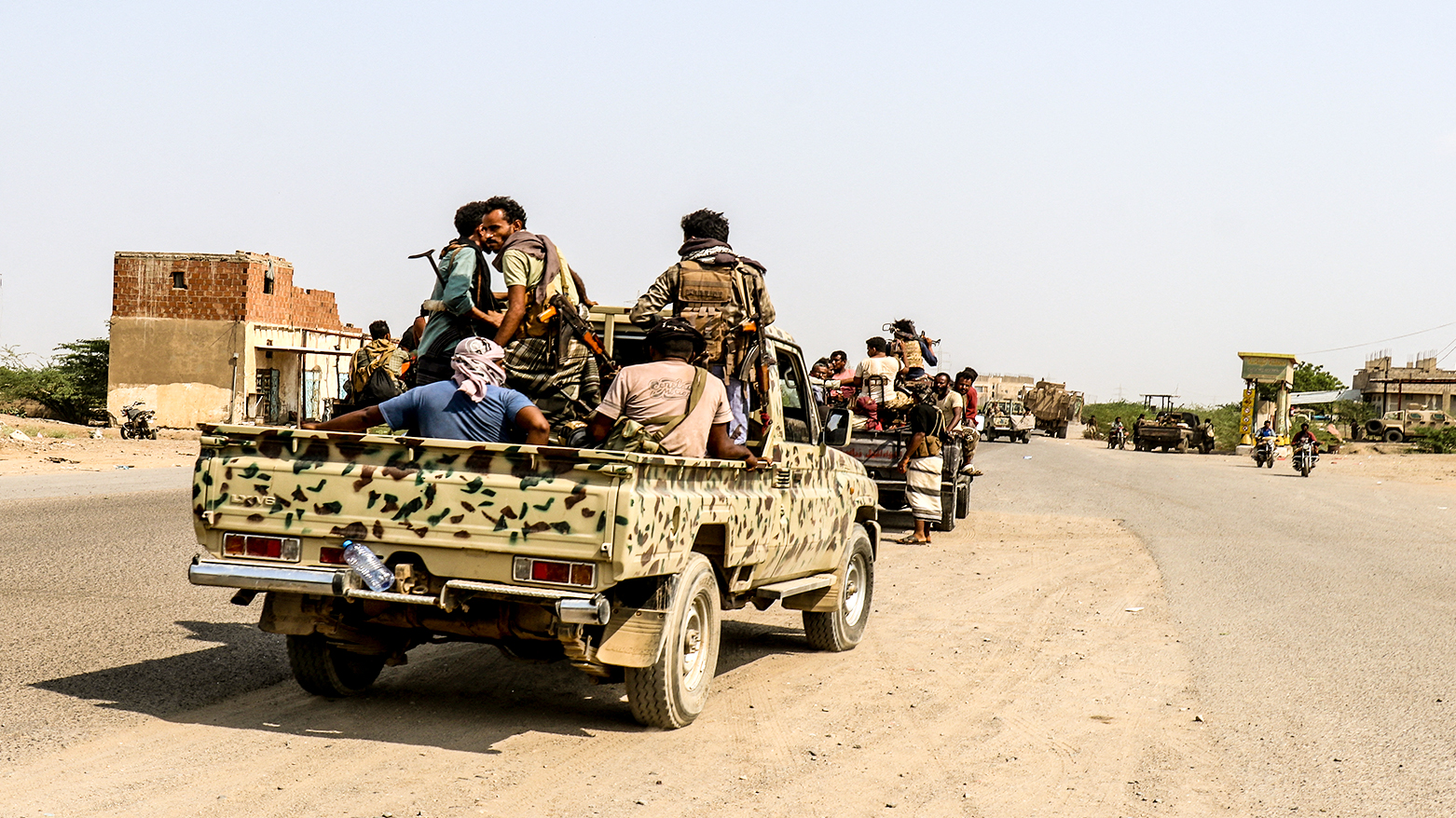
In Hays district, about 68 kilometers northwest of Taiz toward the Red Sea coast, AFP journalists saw government forces being transported toward front lines in pickup trucks. Some fighters carried assault rifles, while others had rocket-propelled grenades over their shoulders.
“There has been heavy Houthi shelling on Hays and its residents, but the district is tough,” Hays resident Rashed Maghari told AFP, saying the area would be difficult for the Houthis to capture.
The escalation has also brought increased air support for government forces. Yemeni warplanes carried out more than 15 strikes against Houthi positions in Taiz and Hodeidah on Friday, according to the Yemeni army, marking a significant expansion of the government’s direct use of air power since the latest escalation began.
Saudi Arabia, a key backer of Yemen’s internationally recognized government, has also carried out airstrikes against Houthi positions, according to a Yemeni military official cited by AFP.
The renewed fighting comes as the Houthis have sought to expand their control along Yemen’s western coast and have declared a maritime blockade targeting Saudi Arabia.
Any further Houthi advance toward Bab al-Mandab could increase the risks to commercial shipping through the Red Sea, particularly as the wider Middle East conflict has disrupted traffic through the Strait of Hormuz.
The strategic importance of Bab al-Mandab has increased further amid the disruption of shipping through Hormuz, making the Red Sea route an increasingly important alternative corridor for international trade and energy shipments.
The latest escalation also represents a potentially significant new front in the wider Middle East war that began with US-Israeli strikes on Iran in late February.
The Houthis, who have maintained close ties with Tehran, have increasingly linked their military actions in Yemen to the broader regional confrontation.
Yemen’s conflict began escalating sharply in 2014, when Houthi forces seized the capital, Sanaa, and large parts of the country. Saudi Arabia and its allies intervened militarily in 2015 to support the internationally recognized government.
A Saudi-led coalition has backed government forces, while Iran has supported the Houthis. The two sides reached a UN-brokered truce in 2022 that significantly reduced large-scale fighting, but the ceasefire formally expired without a comprehensive peace agreement.
The renewed battles around Taiz and the Red Sea coast now threaten to push Yemen back toward a broader conflict, while control of territory near Bab al-Mandab could give the Houthis greater leverage over one of the region’s most strategically important maritime chokepoints.