Baghdad, Erbil Expand Intelligence and Border Coordination
Senior Iraqi and Kurdistan Region security officials met Sunday to strengthen coordination on borders, intelligence sharing, counter-narcotics operations and joint military training.
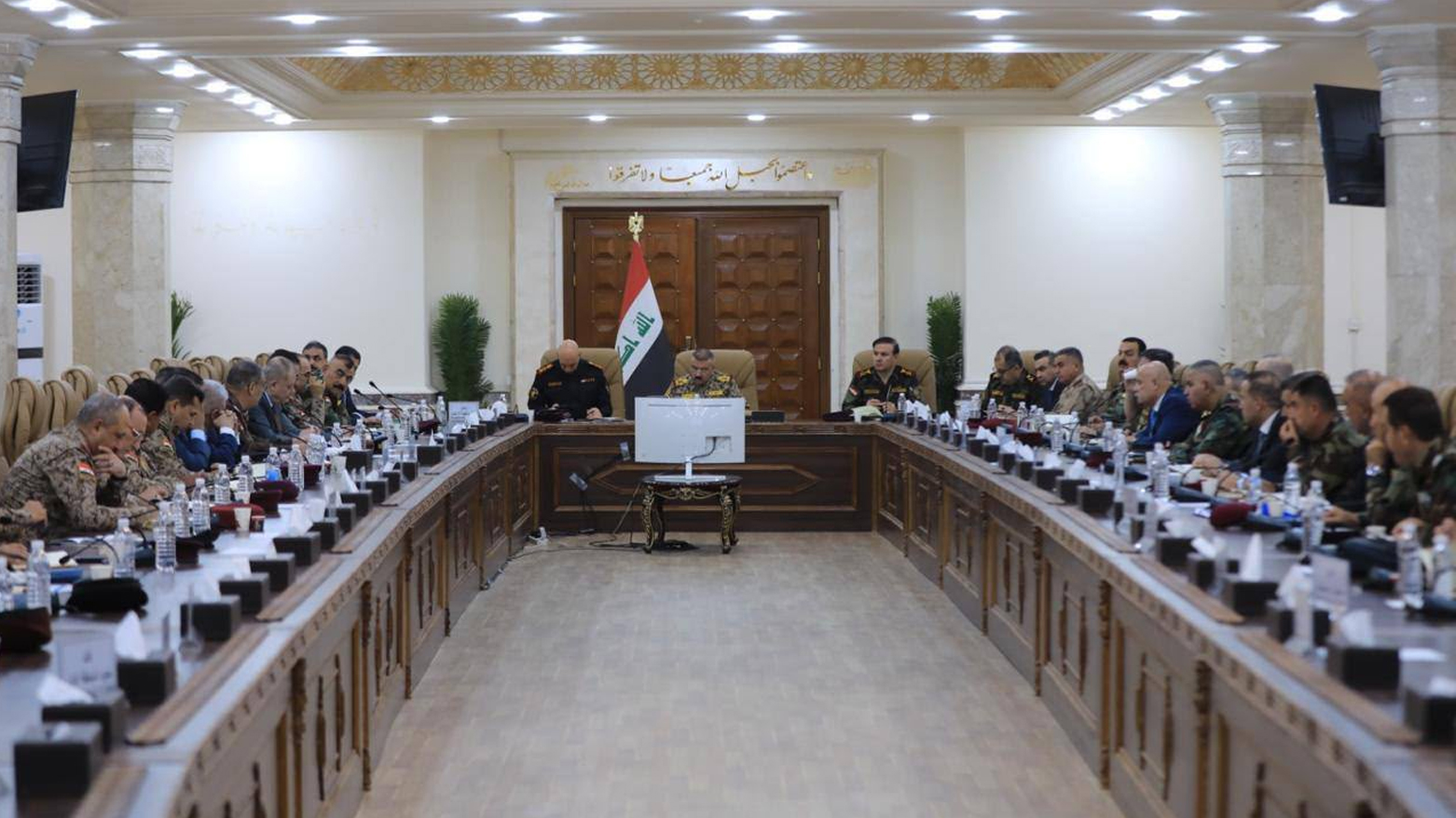
ERBIL (Kurdistan24) - Senior federal Iraqi and Kurdistan Region security officials met on Sunday to strengthen field coordination, intelligence sharing and military cooperation, with discussions focusing on border security, counter-narcotics operations and joint mechanisms for confronting shared threats.
Abdul Amir al-Shammari, director of the Office of the Commander-in-Chief of the Armed Forces, chaired the Sunday meeting, which brought together some of Iraq's most senior security and military officials.
Federal participants included the head of the Counter-Terrorism Service, the head of the Border Ports Authority, the Interior Ministry's undersecretary for intelligence, deputy heads of the National Security and Intelligence services and the Iraqi Army's assistant chief of staff for operations, alongside several military commanders.
The Peshmerga chief of staff attended with a Kurdistan Region delegation comprising senior commanders, officers, directors and heads of regional security agencies.
The meeting examined mechanisms for improving coordination between federal forces and Kurdistan Region forces at both operational and military levels.
Participants received a detailed briefing on areas of shared security concern and discussed conditions at border crossings, including the work of Kurdistan Region border units.
A central focus was strengthening control along borders to prevent smuggling and infiltration.
Officials also discussed expanding cooperation against narcotics trafficking and dismantling networks involved in the movement and distribution of illegal drugs.
The meeting emphasized improving the work of joint coordination centers so that intelligence can be exchanged more rapidly between Baghdad and Erbil.
Such centers are intended to provide a permanent mechanism for responding to threats that cross administrative or security boundaries and require cooperation between federal and Kurdistan Region institutions.
Shammari stressed the need to establish clear priorities for future cooperation.
These include securing Iraq's international borders, organizing joint military exercises and training programs, strengthening intelligence coordination and ensuring that wanted individuals are transferred to the judiciary.
The Peshmerga chief of staff also presented observations concerning the practical implementation of field plans and coordination mechanisms.
The meeting concluded with a series of recommendations aimed at strengthening security integration between Baghdad and Erbil and unifying efforts to preserve stability.
The discussions reflect continuing efforts by federal and Kurdistan Region authorities to institutionalize security cooperation in areas where responsibilities and threats overlap.
Border security, organized smuggling, narcotics trafficking and intelligence-sharing increasingly require coordinated responses involving multiple security institutions.
The emphasis on joint exercises and intelligence exchange also points toward deeper operational cooperation rather than coordination limited to periodic high-level meetings.
For Baghdad and Erbil, improving those mechanisms is particularly important in areas where federal and Peshmerga forces operate in proximity and where security gaps could be exploited by criminal or militant networks.
Sunday's meeting therefore focused not only on immediate security concerns, but also on building more systematic structures for cooperation between the two sides.