EU Says Canada Partnership Is Not Aimed at US as Trump Threatens Tariffs
Brussels defends proposal for Canada to become the bloc’s first associate member as Ottawa seeks closer economic and security ties with Europe
ERBIL (Kurdistan24) — The European Commission said Thursday that its proposal to make Canada the European Union’s first “associate member” is intended to strengthen ties between Brussels and Ottawa, not to target the United States, after President Donald Trump threatened new tariffs and potentially a halt in trade with the bloc.
European Commission trade spokesperson Olof Gill said the proposed partnership was “not against anyone else, but for our common strength,” responding to Trump’s warning that he could impose “very serious tariffs” on the EU if the initiative were deemed hostile to US interests.
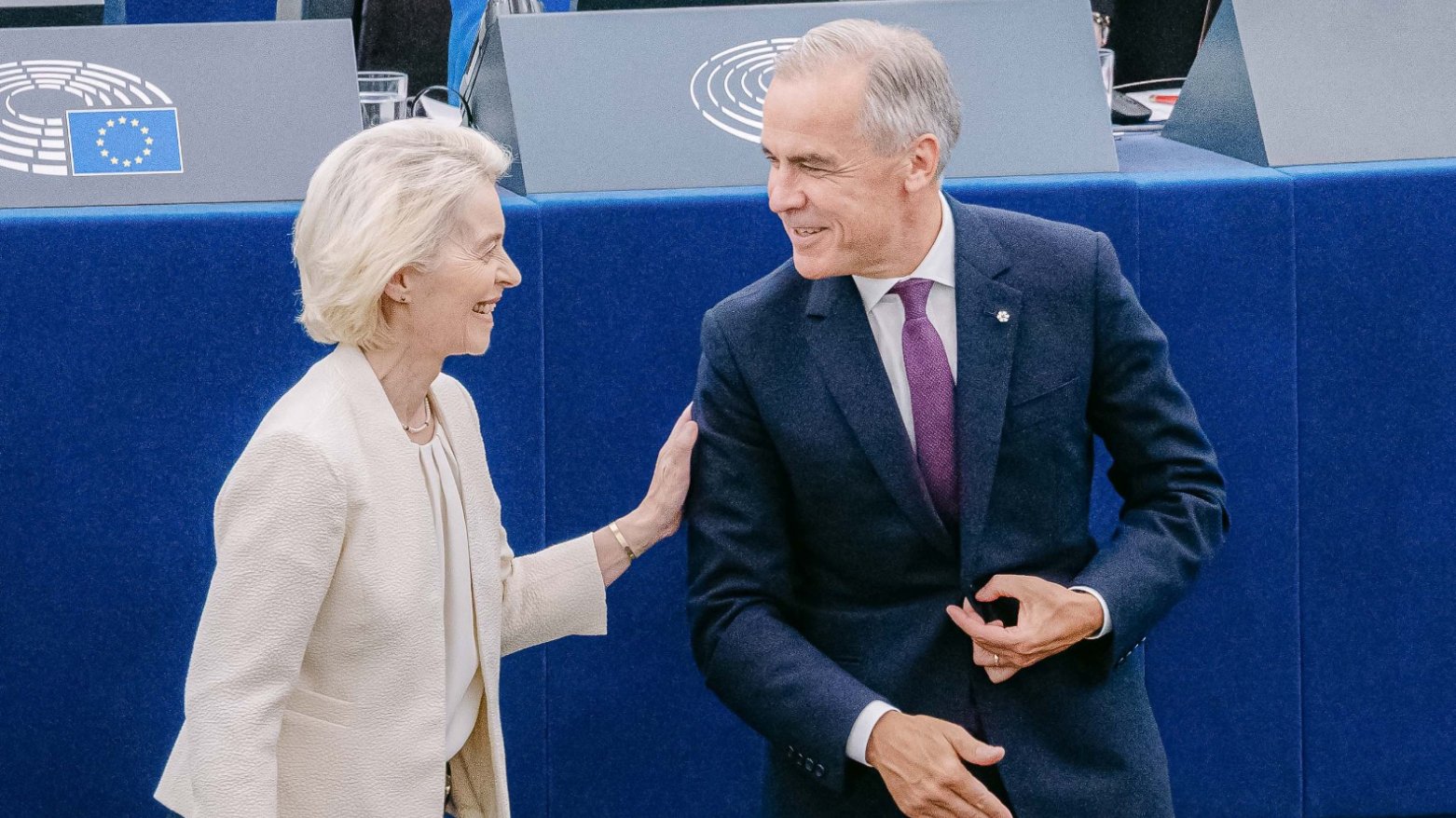
European Commission President Ursula von der Leyen proposed the new status on Wednesday during her annual address to the European Parliament in Strasbourg, with Canadian Prime Minister Mark Carney attending.
She called for closer cooperation with Canada in critical minerals, artificial intelligence, advanced manufacturing, energy and defense.
“We will create a tech alliance. We will integrate defense industrial bases. We will make the Arctic a flagship joint project,” von der Leyen said.
Carney was scheduled to address European lawmakers on Thursday as part of a broader push by Ottawa to deepen relations with Europe. His visit is also expected to build momentum ahead of an EU-Canada summit in Montreal next month.
Unprecedented proposal
The proposed “associate membership” would represent a new form of relationship between the EU and a non-member country. EU treaties do not currently establish an associate-membership category, meaning the precise rights, obligations and level of access associated with the proposed status would have to be negotiated.
The proposal does not amount to Canadian EU membership. Instead, it envisages a substantially deeper relationship while Canada remains outside the bloc’s institutional structure.
The idea has previously been discussed in European political circles. German Chancellor Friedrich Merz floated a similar concept earlier this year in relation to Ukraine, although no such status currently exists within the EU.
The proposal would also require the support of EU member states. French Europe Minister Benjamin Haddad said Paris supports closer ties with Canada but that the proposal would need to be debated and examined before France takes a definitive position.
Canada seeks to diversify strategic ties
The initiative comes as Canada seeks to reduce its economic and strategic dependence on the United States amid increasingly strained bilateral relations under the Trump administration.
The United States remains Canada's overwhelmingly largest export market, accounting for about 70 percent of Canadian exports, making diversification a major economic and strategic priority for Ottawa.
Carney has increasingly promoted deeper relationships with European and other international partners as Canada faces US tariff pressure and broader uncertainty over its traditional economic relationship with Washington.
At the same time, the EU is seeking to strengthen its economic and strategic partnerships amid trade tensions with Washington and increasing competition with China, while Russia's war in Ukraine has accelerated European efforts to expand defense production and secure critical supply chains.
Canada already has substantial economic ties with the EU through the Comprehensive Economic and Trade Agreement (CETA), which has eliminated almost all tariffs on bilateral goods trade.
The two sides have also expanded cooperation beyond trade into security and defense.
In June, the EU formally concluded an agreement allowing Canadian companies and products to participate in procurement under the bloc's Security Action for Europe (SAFE) program.
Canada became the first non-European country to participate in the initiative, which supports large-scale European defense procurement.
Canadian officials say the arrangement gives Canadian defense companies access to SAFE procurement opportunities and allows Canadian industry to contribute up to 80 percent of the value of eligible contracts.
The EU and Canada also signed a Security and Defense Partnership in 2025 covering areas including military mobility, interoperability, maritime and space security, and defense-industrial cooperation.
Trump threatens response
Trump reacted sharply to the proposed arrangement, calling it “laughable” and warning that Washington could impose “very serious tariffs” or potentially halt trade with Europe if the initiative amounted to a hostile act.
“If it's a good intention, that's fine. If it's a bad intention, we'll put very heavy tariffs on Europe,” Trump said.
The European Commission has rejected the suggestion that the proposal is directed against Washington, framing it instead as part of a broader effort to strengthen cooperation among like-minded partners.
The dispute nevertheless highlights the increasingly complex economic and geopolitical relationships among the US, EU and Canada, as traditional transatlantic partners seek greater resilience in trade, defense, technology, energy and critical-mineral supply chains.
For Brussels, the Canadian initiative could provide a framework for deeper cooperation with a major G7 economy and NATO ally. For Ottawa, closer European ties could offer additional markets and strategic partnerships at a time when its dependence on the US has become a source of economic and political vulnerability.
The proposal's future remains uncertain, however, with its legal framework still undefined and requiring further negotiations among Canada, the European Commission and EU member states.