KRG Council of Ministers Hails Peshmerga Forces Unification
Minister of Peshmerga Affairs Shoresh Ismail presented a report detailing the reorganization process, including steps already taken and future requirements.
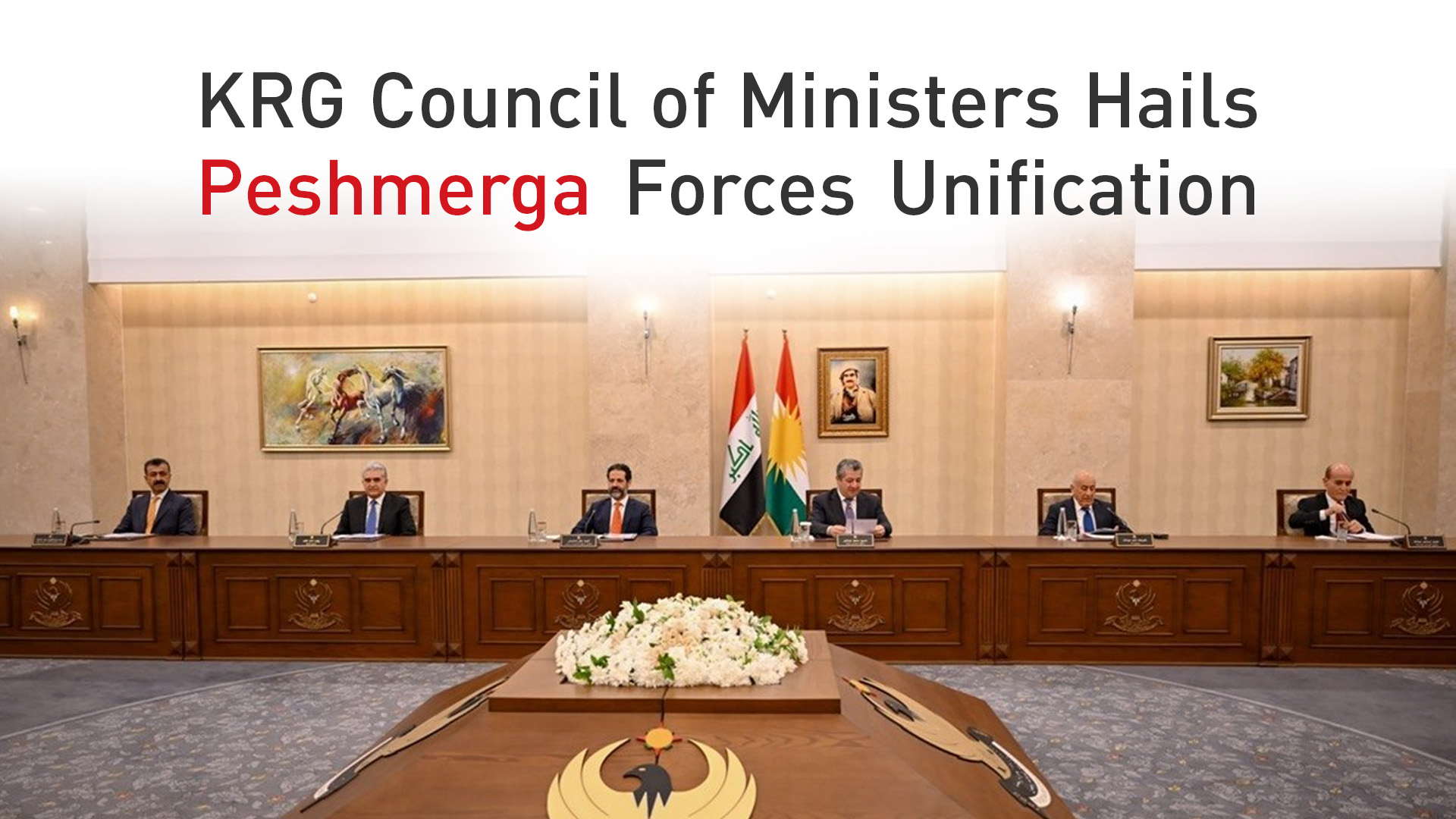
ERBIL (Kurdistan24) — The Kurdistan Region Council of Ministers on Wednesday, convened under Prime Minister Masrour Barzani, with Deputy Prime Minister Qubad Talabani in attendance, and discussed the unification of Peshmerga forces, electricity debt reductions, and the regulation of economic and commercial activities, according to a statement from Kurdistan Regional Government (KRG).
The meeting’s first agenda item focused on the ongoing unification of the Peshmerga forces under the Ministry of Peshmerga Affairs.
Minister of Peshmerga Affairs Shoresh Ismail presented a report detailing the reorganization process, including steps already taken and future requirements. The report said all Peshmerga personnel have undergone biometric registration, their salaries have been transferred to bank accounts, and their information has been reviewed by relevant Iraqi federal institutions.
The KRG also continues to seek parity between Peshmerga personnel and members of Iraq’s federal defense institutions in terms of salaries, ranks, allowances, and financial entitlements.
The Council of Ministers said the Peshmerga should be treated as an integral part of Iraq’s defense system, with the Ministry of Peshmerga Affairs’ salaries, operational costs, training, armament, and projects incorporated into federal sovereign expenditures.
Prime Minister Barzani described the unification as a “historic and national achievement,” emphasizing that the process goes beyond reorganizing military units and aims to establish a unified command and institutional decision-making structure under the Ministry of Peshmerga Affairs.
He also stressed the need to protect the rights and financial entitlements of Peshmerga personnel and ensure parity with their counterparts in the Iraqi Army.
Talabani also welcomed the unification, describing it as a national and institutional achievement, while stressing the need for continued reform and professionalization within the Ministry of Peshmerga Affairs.
The Council instructed the KRG’s Top Negotiation Delegation to continue efforts during negotiations over Iraq’s 2027 federal budget to secure funding for Peshmerga salaries, allowances, financial entitlements, operations, and other requirements through sovereign expenditures. It also called on Kurdish representatives and parliamentary blocs in Baghdad to advocate for the demands during the budget process.
The Council thanked the United States, coalition forces, and other partners for their role in supporting the reorganization and reform of the Peshmerga forces, and called on all political parties to support the process.
Electricity debt discounts extended
The Council also reviewed the implementation of Decision No. 299, issued on July 22, concerning discounts on accumulated electricity debts owed by subscribers to the national grid.
Following a report by the Minister of Electricity Kamal Mohammad on public response and debt payments, the Council unanimously decided to extend the deadline for benefiting from the discounts from September 24 to October 18, under the same terms and conditions.
The KRG said the measure aims to ease the financial burden on citizens while increasing revenues available to the Ministry of Electricity to purchase natural gas and maintain and improve electricity services.
KRG to implement amended federal public companies law
The final agenda item addressed legal and administrative preparations for implementing Iraq’s amended Public Companies Law No. 22 of 1997 in the Kurdistan Region, alongside the amended Companies Law No. 21 of 1997.
The Minister of Trade and Industry Kamal Muslim said harmonizing the legal framework would help improve the operation of public institutions and strengthen oversight, transparency, and protection of public assets.
The Director General of the Companies Registration Department also stressed the importance of reducing legal and procedural differences in areas including companies, trade, investment, and economic activity.
The Council ultimately approved implementing the amended Public Companies Law No. 22 of 1997 alongside the amended Companies Law No. 21 of 1997, taking into account the Kurdistan Region’s constitutional powers and specific circumstances.
The move is intended to strengthen public institutions, improve the Region’s business and economic environment, and bring its legal framework closer to relevant federal legislation.