Qamishlo Lawyers Call for Kurdish to Gain Official-Language Status
Lawyers in Qamishlo, Western Kurdistan, are calling for Kurdish to receive official-language status and constitutional protection beyond Decree No. 13.
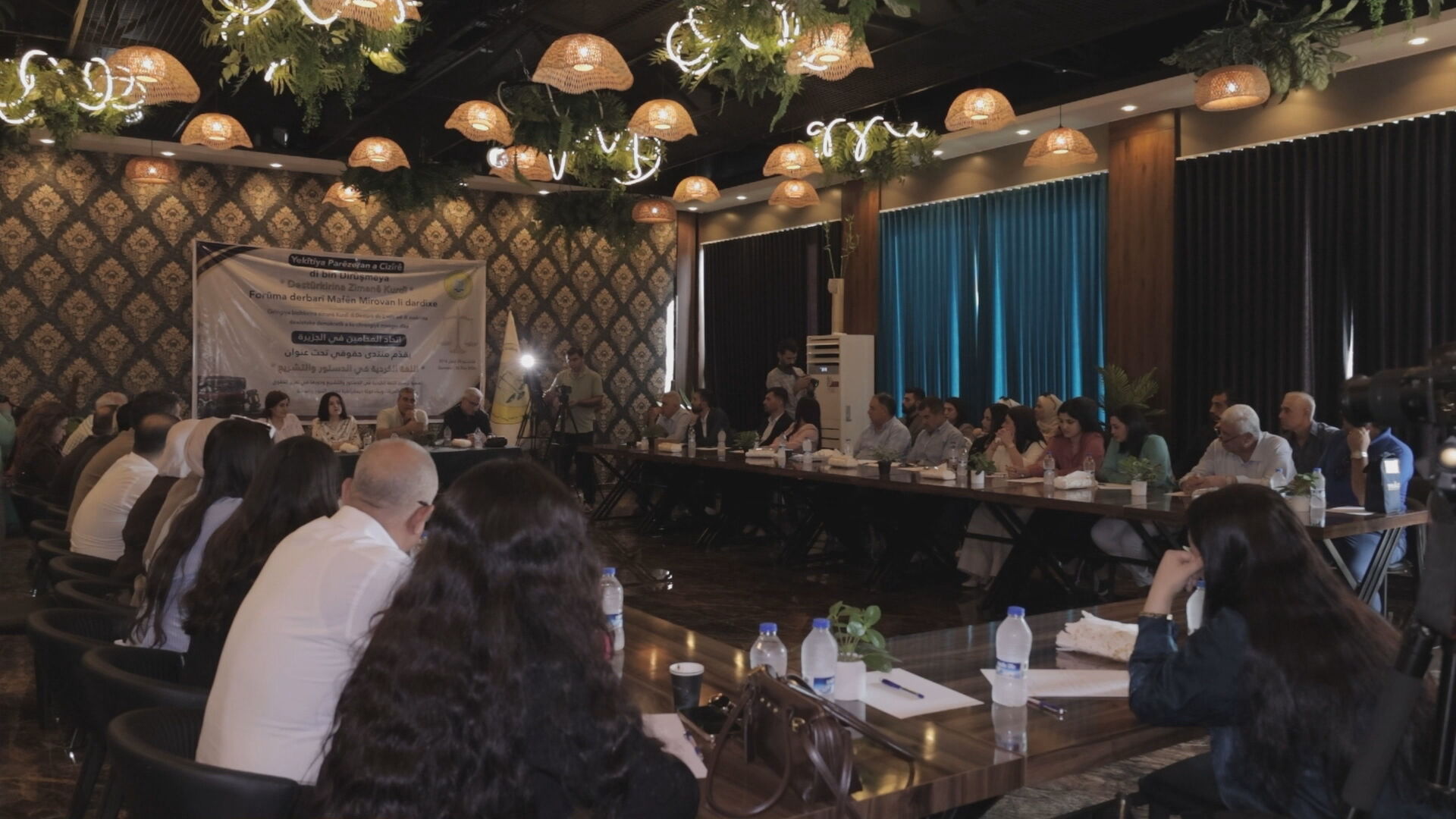
ERBIL (Kurdistan24) - Lawyers in Qamishlo, Western Kurdistan (Northeastern Syria), are calling for Kurdish to be recognized as an official language and constitutionally protected, arguing that recent moves by Damascus to recognize Kurdish as a national language and introduce it into schools do not go far enough.
The Jazira Lawyers Union organized a panel discussion in the city to examine Kurdish linguistic rights and Decree No. 13, with participants focusing on how those rights should be incorporated into Syria's future constitutional framework.
Kurdistan24 correspondent Ekerem Salih, reporting from Qamishlo, Western Kurdistan, said lawyers at the gathering argued that Kurds should have the right to speak, study and conduct public life in their mother tongue.
One lawyer said the historical presence of Kurds in their homeland provided the basis for Kurdish to receive official status alongside Arabic in areas where Kurdish communities live.
"Kurdish [should] be recognized not merely as a national language, but as an official language of the Syrian state in the areas where Kurds live, alongside Arabic," the lawyer said.
The demand goes beyond the language provisions introduced by Damascus earlier this year.
President Ahmed al-Sharaa issued Decree No. 13 in January, recognizing Kurds as an integral component of the Syrian population and acknowledging their cultural and linguistic identity. The decree recognizes Kurdish as a national language and permits its teaching in public and private schools in areas with significant Kurdish populations.
The Education Ministry expanded those provisions in August through Decision No. 2068/943, allowing Kurdish to be incorporated into curricula at all educational levels in areas with significant Kurdish populations. The ministry said the policy was intended to protect linguistic and cultural rights while supporting national unity.
Under the current arrangements, students receive Kurdish-language instruction and, during the transitional period, may study subjects including social studies, history, geography and philosophy in Kurdish or Arabic.
For the lawyers meeting in Qamishlo, Western Kurdistan, however, the central question is whether those measures will become permanent constitutional rights rather than remain dependent on decrees and administrative decisions issued during the political transition.
"We need to determine what is necessary and ensure that this right is guaranteed so that it cannot be manipulated in the future," one lawyer said.
The lawyer stressed that linguistic rights should be written directly into the constitution, giving them protection beyond temporary executive measures.
That position reflects a broader Kurdish campaign over language and education.
Hundreds of Kurdish students and family members demonstrated in Qamishlo, Western Kurdistan, on Sept. 22, demanding comprehensive mother-tongue education and official recognition of Kurdish. Protesters argued that teaching Kurdish for several classes a week falls short of allowing children to receive their full education in their native language.
Students and parents said they were not opposing Arabic but wanted Kurdish to remain the principal language of instruction for children who had already studied in it for years.
One mother told Kurdistan24 that Kurdish children had the right to study in their mother tongue, while another called for the language to be recognized in the new constitution.
The issue has also entered wider political discussions over Syria's future.
Mazloum Abdi, an adviser to the Syrian presidency, said during a Sept. 18 meeting in Kobani that Kurdish should become both a language of education and an official language, while discussions over its status continue.
Former senior U.S. official Brett McGurk also addressed Decree No. 13 during an interview with Kurdistan24's Issa Hassan in New York.
McGurk welcomed President al-Sharaa's reference to the decree and said its provisions should become part of Syria's constitutional framework.
"I thought it was important that the president mentioned Decree 13, and this will now be part of the constitutional fabric in Syria," McGurk said.
He linked the issue to the wider process of determining Kurdish rights and the future relationship between Kurdish-led institutions and Damascus, while also stressing the need to recognize the Syrian Democratic Forces' role in the fight against ISIS.
The language debate therefore centers increasingly on the difference between administrative recognition and constitutional status.
Damascus has formally opened the way for Kurdish-language education and describes Kurdish as a national language. Lawyers, students and Kurdish political figures are pressing for a broader settlement in which the language would receive official status and mother-tongue education would be protected through the constitution.
In Qamishlo, Western Kurdistan, lawyers said their activities would continue alongside those of teachers, students and other sections of society until what they regard as legitimate linguistic rights are secured.
For them, the immediate question is no longer whether Kurdish can enter classrooms, but whether its place in education and public life will be guaranteed permanently in Syria's emerging constitutional order.