Rubio Says Cuba Has 'Already Fallen,' Calls for Change
Marco Rubio says Cuba has "already fallen," calling its economy and government dysfunctional while advocating a diplomatic transition toward political and economic freedoms.
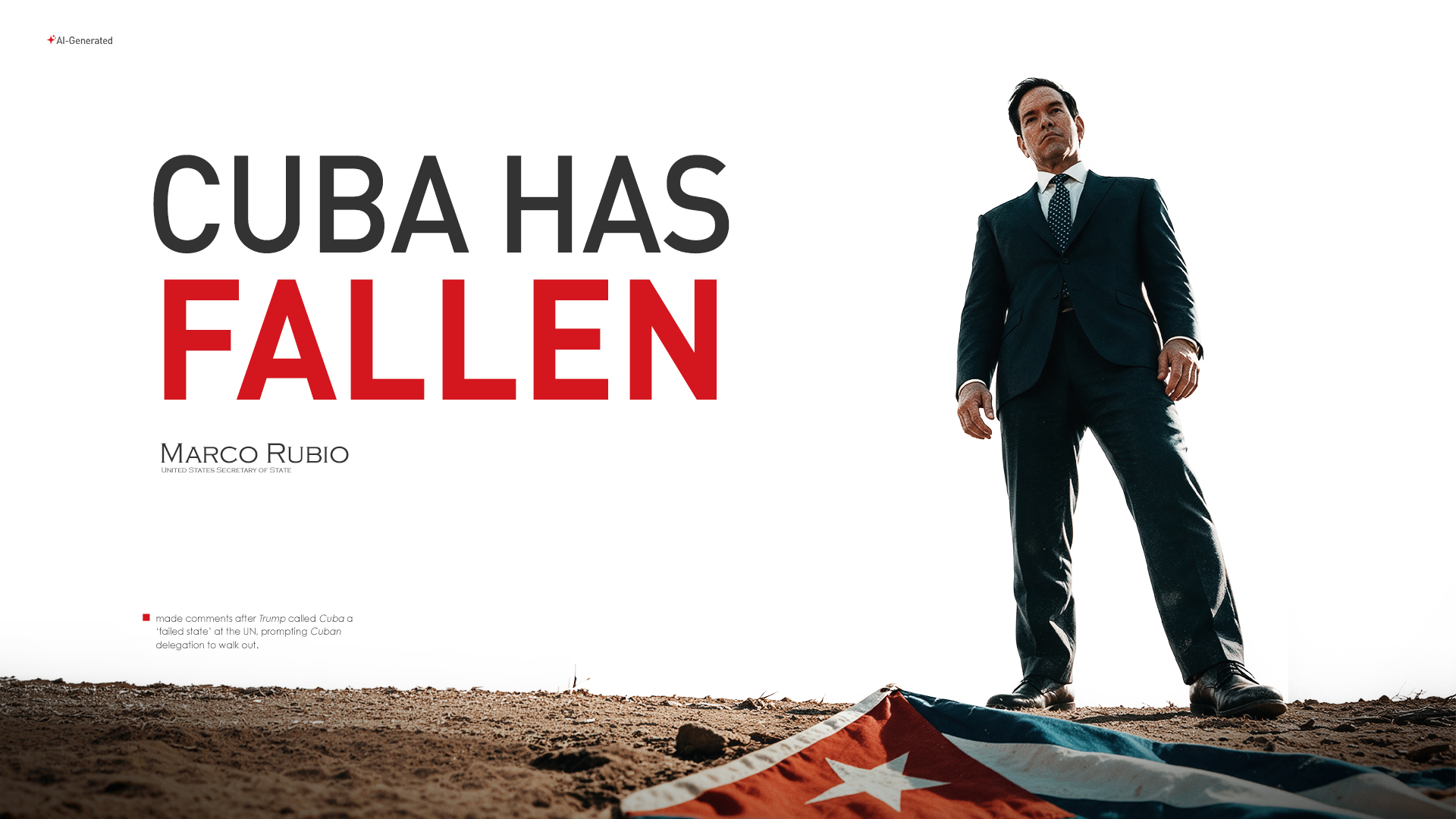
ERBIL (Kurdistan24) - U.S. Secretary of State Marco Rubio said Cuba has "already fallen," describing its economy and system of government as dysfunctional while arguing that the country needs a transition combining political and economic freedoms.
Speaking with Sean Hannity on Fox News, Rubio delivered a sweeping criticism of Cuba's political and economic system and said the Trump administration hoped change could be achieved diplomatically.
"The truth is Cuba's already fallen," Rubio said. "It doesn't have a functional economy."
He described Cuba as a "failed state in every sense of the word," arguing that although the government retains the capacity to imprison and kill people, it has failed to provide what he considers functional governance or a viable economy.
Those assessments represented Rubio's characterization of conditions in Cuba. The interview segment did not include a response from the Cuban government.
Rubio accused Cuba's political and economic system of being driven by "corruption, graft, and theft" and claimed that profitable sectors had been placed under the control of the Cuban military and Communist Party.
He argued that income-generating economic activity had benefited a limited number of officials rather than the broader population.
Rubio also pointed to outward migration as evidence of the depth of Cuba's difficulties, saying close to 20% of the country's population had left since 2021.
He portrayed that movement as a consequence of what he called the failure of the existing system.
Despite his sharp criticism, Rubio said Washington hoped Cuba would choose a different course.
He expressed hope that individuals within the country's existing power structure, including those controlling the security apparatus, would recognize the seriousness of Cuba's circumstances and support change.
Rubio said the Trump administration would seek to prevent Cuban officials from continuing what he described as profiting "off the backs of the Cuban people."
He also tied Washington's Cuba policy directly to U.S. national security.
Rubio said the United States would not allow Cuban territory to become a base for operations against American interests or develop into what Washington considers a threat to its security.
At the same time, he emphasized that President Donald Trump's preference was to resolve disputes through diplomacy and negotiated agreements.
Rubio said that approach applied not only to Cuba but to international disputes more broadly.
For Cuba, he said Washington wanted an "irreversible positive change" involving both political and economic freedoms.
Rubio argued that economic liberalization alone would not be sufficient.
"You cannot have economic freedom in Cuba if you don't have political freedom first," he said, adding that both forms of change would need to occur at least simultaneously.
Such a transformation, Rubio acknowledged, would require a period of transition.
His comments indicate that Washington's stated objective goes beyond short-term economic reform and extends to changes in Cuba's political system.
Rubio ended his remarks with a warning to Cuban officials who, in his view, believe they can avoid significant reforms by waiting for the Trump administration to leave office.
He said those continuing to defend the revolutionary system were mistaken if they believed they could simply wait without changing course.
"They are wrong," Rubio said, warning that they would "learn the lesson the hard way" if they did not change their approach.
The Cuba remarks came during a wider Fox News interview in which Rubio also discussed Iran, Greenland, China, European migration and Venezuela.
But on Cuba, his message combined intense criticism of the current political system with a stated preference for a diplomatic transition — one that Washington believes must include political freedoms alongside changes to the economy.