Ali Al-Zaidi: End Of Coalition Mission Does Not Mean End Of Terrorism Fight
Iraqi Prime Minister said the conclusion of the International Coalition’s mission marks Iraq’s transition to full responsibility for its security and stability, while stressing that the fight against terrorism is not over.
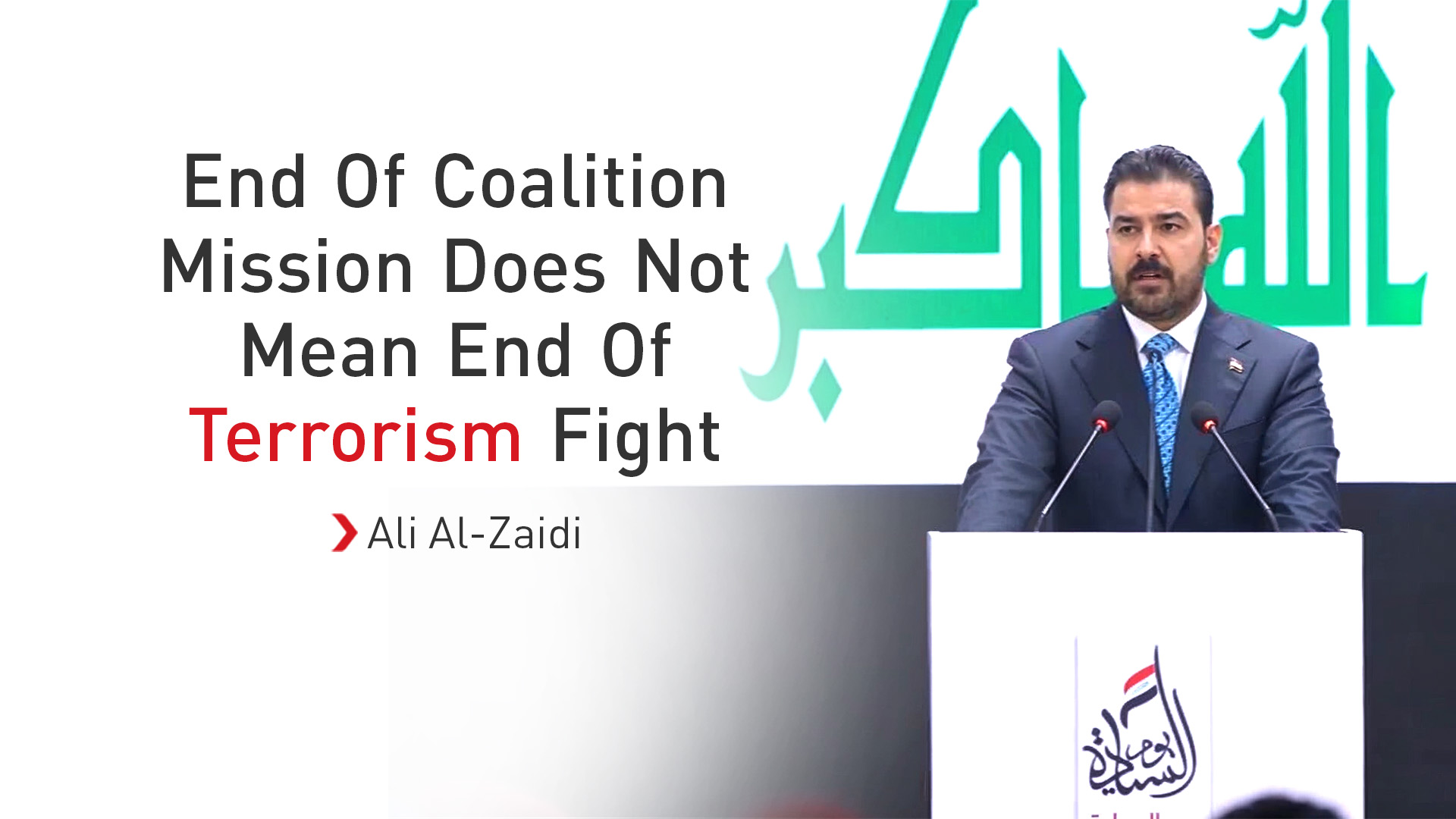
ERBIL (Kurdistan24) - Iraq on Wednesday, formally marked the conclusion of the International Coalition’s mission to fight ISIS, with the Iraqi Prime Minister Ali Zaidi declaring that the end of the coalition’s mission does not mean the end of the threat posed by terrorism.
Speaking at a ceremony marking the conclusion of the coalition forces’ mission in Iraq, Zaidi said the cooperation between Iraq and friendly countries had produced a significant victory against what he described as one of the darkest chapters of extremism and brutality in history.
“With this, the mission of the International Coalition to fight Daesh (ISIS) officially concludes, proving that cooperation between friendly forces and friendly nations has yielded a remarkable victory over one of the darkest chapters of extremism and brutality in history,” Zaidi said.
Zaidi said Sept. 30 would remain a significant date in Iraq’s collective memory, recalling the period when Iraqi people defended their cities and towns against ISIS attacks.
He said the mobilization of the Iraqi people alongside the country’s armed forces marked the beginning of a phase in which Iraqi forces reorganized their command structures, mobilized resources, unified their efforts, and took the initiative in the fight against terrorism.
“On September 30, 2026, we recall an image that will forever remain in our memory: the image of our people defending their land, cities, and towns that were desecrated by terrorists,” he said.
Zaidi credited friendly countries with extending assistance to Iraq during the confrontation, while Iraqi forces reorganized and re-equipped their ranks.
He also highlighted the role of the Joint Operations Command throughout the war against terrorism, describing it as the central point for coordination, intelligence gathering, planning, and directing operations during what he called a major national battle.
The Iraqi prime minister expressed gratitude to the countries that participated in the Global Coalition, as well as its commanders, officers, trainers, and advisers who worked alongside Iraqi security forces.
“We extend our sincere thanks and appreciation to all friendly countries that participated in the Global Coalition, and to its commanders, officers, trainers, and advisors who worked alongside our security forces,” Zaidi said.
He stressed, however, that the conclusion of the coalition mission should not be interpreted as the conclusion of Iraq’s fight against terrorism.
“The conclusion of the International Coalition's mission does not mean the end of our battle against terrorism; rather, it marks Iraq’s transition into a phase where it assumes full responsibility for its own security and stability,” he said.
According to Zaidi, the transfer of the Joint Operations Command’s duties to the Office of the Commander-in-Chief of the Armed Forces establishes an institutional framework for managing security efforts under the authority and supreme command of the state.
Zaidi said the end of the coalition mission opens what he described as a new era defined by Iraq’s sovereignty, the strength of its institutions, the readiness of its armed forces, and balanced partnerships with its allies.
He told the Iraqi people that while the mission had concluded with victory, responsibility for protecting that victory now rests with the country as a whole.
“The mission has concluded with your victory, but the responsibility to protect this victory remains, and today it rests upon all our shoulders,” Zaidi said.
As Iraq assumes full sovereignty over its territory, he reaffirmed the government’s position on the role of weapons and armed forces within the country.
“There shall be no weapons outside the framework of the law, and no force outside the institutions of the State,” Zaidi said.
He added that this principle is dictated by the Constitution, supported by Iraq’s religious authority, and desired by the Iraqi people.