Khalilzad Warns US Withdrawal Could Test Iraq As Kurdistan-US Ties Remain Strong
Former US ambassador to Iraq said the end of the Coalition mission marks an important milestone in US-Iraqi relations but warned that Iraq’s ability to confront future threats, militia disarmament, and the regional balance of power remain key challenges.
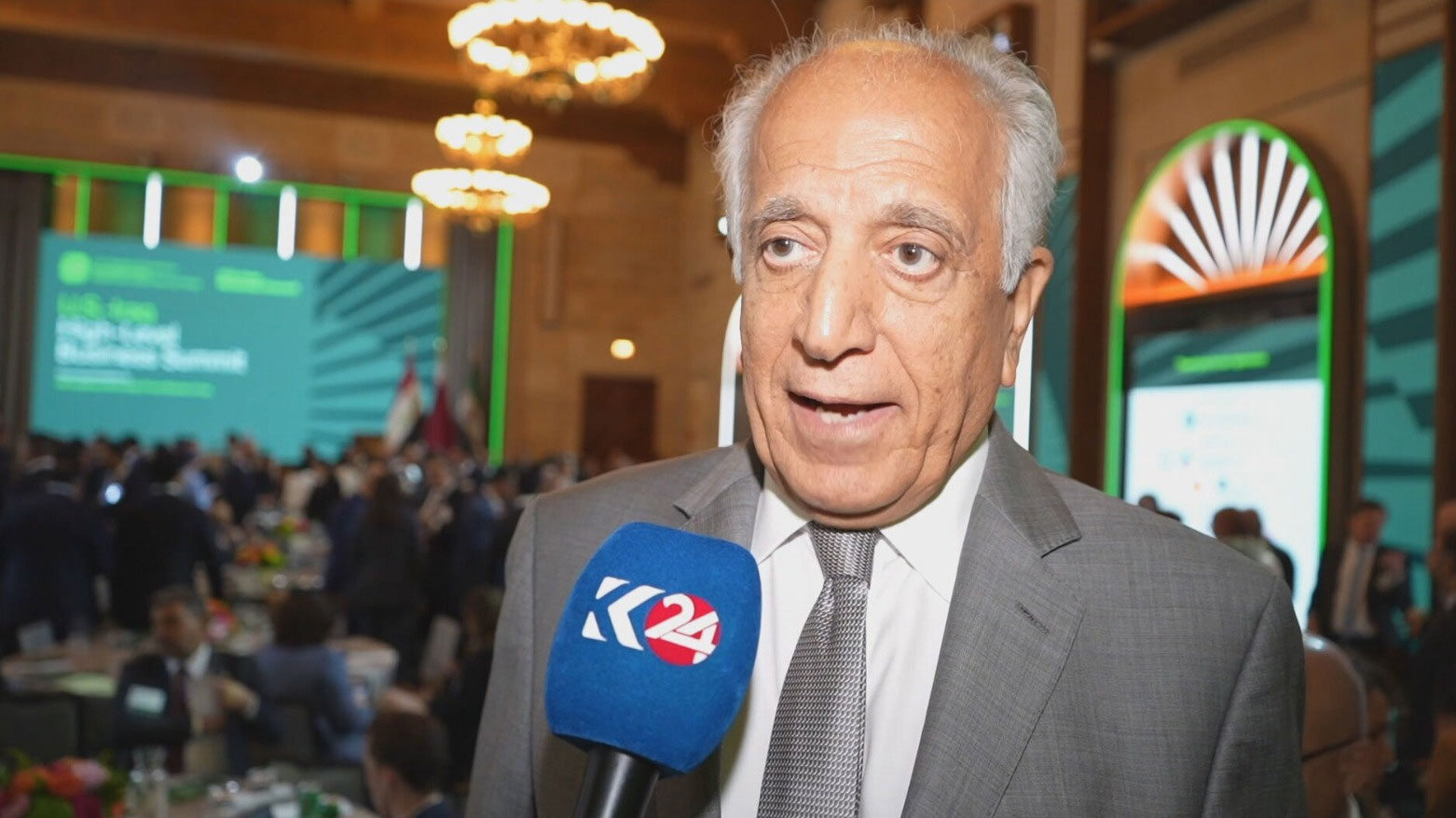
ERBIL (Kurdistan24) - The completion of the US-led Coalition withdrawal from Iraq marks a new phase in Washington-Baghdad relations, but former US Ambassador to Iraq Zalmay Khalilzad has warned that the consequences will depend on whether Iraqi forces can independently manage emerging security threats and whether the strategic relationship between Washington, Baghdad, and the Kurdistan Region remains strong.
Speaking Wednesday on Kurdistan24’s Basi Roj program hosted by Zheno Mohammed, Khalilzad described the withdrawal as an important milestone in US-Iraqi relations, while stressing that its ultimate impact—positive, neutral, or negative—could only be judged retrospectively.
“I believe that there are concerns that I have,” Khalilzad said, pointing to the readiness of Iraqi forces and recalling the previous US withdrawal under President Barack Obama.
He said that during the earlier withdrawal, Iraqi forces were unable to handle the threat posed by ISIS, which later emerged as a major security crisis.
Khalilzad said the departure of US forces from Erbil was particularly significant because of the longstanding relationship between Kurdistan and the United States.
He pointed to the history of US military involvement with the Kurdistan Region dating back to Operation Provide Comfort, describing the relationship as both strategic and rooted in longstanding ties.
“There is a long, strong relationship between Kurdistan and the United States, especially with the U.S. military dating back to Provide Comfort,” Khalilzad said.
He added that the Kurdistan Region has strategic importance for the United States and that longstanding relations had created a strong connection between the two sides.
“So, there is strategic importance of Kurdistan, and there is sentimental attachment and relations that have been built over time,” he said, adding that he was sure it had not been easy for the US military to depart Erbil and the Kurdistan Region.
Khalilzad said the military presence had been a key instrument connecting Washington and Baghdad, but its end did not necessarily mean the end of the broader security relationship.
“We will continue to have a security relationship with Iraq and, I hope, a security relationship also with the Kurdish region of Iraq,” he said, while noting that the future of that relationship remained to be seen.
Khalilzad also highlighted the relationship between the US withdrawal and the issue of armed groups operating outside state control.
He said the initial Iraqi proposal had linked the withdrawal of US forces with militias coming under state control, including a requirement that armed groups outside the state apparatus surrender their weapons.
That process, he said, has now been delayed.
“The initial proposal, which was made more than two years ago by Prime Minister Sudani, was a clear linkage of U.S. withdrawal and the disarming of the militias,” Khalilzad said. “Now that U.S. withdrawal has been completed, the disarmament of the militias has been delayed.”
He also pointed to Iran’s position, saying Tehran had sought the withdrawal of US forces from Iraq and was not supportive of militia disarmament.
Khalilzad said the question of how Iran would respond to the US withdrawal was among the issues that needed to be closely monitored, particularly whether Tehran would perceive the withdrawal as shifting the balance of power in its favor inside Iraq.
“There are issues to be concerned about, and to be monitoring, and be watching,” he said.
The former ambassador said another major challenge was whether Iraqi security forces were strong enough to deal with different contingencies, including the possible return of terrorist threats.
He recalled that after the previous US withdrawal, ISIS emerged and Iraqi forces were unable to contain the threat, ultimately leading to the return of US forces in 2014.
Khalilzad said the current withdrawal therefore required careful attention to the possibility that history could repeat itself.
“I hope, certainly, that Iraq is in a position to handle threats such as what happened before—re-emerging ISIS, let's say, threat or a different terrorist threat—that Iraq would be able to handle it, Kurdistan and Iraq together, Kurdistan would be able to handle it,” he said.
He stressed that confidence in Iraqi forces should be accompanied by preparations for possible scenarios in which those forces might not be able to manage a renewed threat.
“Hope is good. Having confidence in your forces is good, but also you have to be mindful of what if history repeat itself, and what should we be prepared for in case that happens?” Khalilzad said.
Khalilzad said the existing strategic framework between Iraq and the United States should be tested through exercises and preparations designed to ensure that Washington could provide assistance if requested.
“We have, obviously, as I say, the security framework, a Strategic Cooperation Agreement. We need to test them, those elements,” he said. “Do exercises to make sure that we are able to assist if the U.S. assistance is needed.”
He acknowledged that the timing of the withdrawal was particularly sensitive because of the ongoing war between Iran and the United States.
Khalilzad said Iran could perceive the withdrawal as a victory because Tehran had sought the full withdrawal of US forces from Iraq for many years.
He called for contingency plans that would allow the United States to respond in cooperation with partners in Iraq and the Kurdistan Region if different scenarios emerged.
Khalilzad said it was too early to determine whether the withdrawal would ultimately prove successful.
“If Iraq holds together, the security forces are able to handle the situations that they face, the relationship between Washington [and] Iraq, including the Kurdish region, continues to be strong, security exercises, military exercises take place, the relationship remains robust, then this will be regarded as a success,” he said.
He added that a different assessment would be necessary if those conditions failed to materialize.
“At this point, I believe it to be, as I said before, premature to come to a conclusion,” Khalilzad said.
Khalilzad said the strategic relationship between Washington and Iraq should remain strong and that the United States should be prepared to respond if Iraq requests assistance against a threat it cannot handle alone.
He argued that US engagement with Iraq and the Kurdistan Region is not simply a matter of goodwill, but also reflects their strategic importance to the regional balance of power.
“Strategically, Kurdistan and Iraq are very important for the balance of power in the Middle East,” Khalilzad said.
He also pointed to what he described as more than 1,000 attacks on the Kurdistan Region by Iran or Iranian-backed groups in recent months.
“There are other challenges, of course, to the region as well, and we can't just turn our back on Iraq and on Kurdistan,” he said. “This is a new phase that we are in, but the fundamentals remain the same.”
Khalilzad said that although the US-China rivalry was widely viewed as the central global strategic competition, its effects were also felt in regions such as Iraq and the Middle East.
“It would be a strategic error, in my view, if we turn our back on Iraq and on Kurdistan,” he said.
Khalilzad also addressed relations between Baghdad and Erbil, arguing that Iraq’s constitution should remain the fundamental framework for resolving disputes between the federal government and the Kurdistan Region.
He said he had helped with the drafting of the Iraqi constitution and had worked with Iraqi and Kurdish leaders, including President Masoud Barzani and former President Jalal Talabani.
“The fundamental document, until it changes, the path—it outlines how Iraq should be organized, how issues should be dealt with. That is the best way to move forward,” Khalilzad said.
He acknowledged that agreements reached during government formation had sometimes not been honored, but said constitutional implementation remained fundamental.
“Implementing the constitution is the most important,” he said. “Obviously, respect and personal good relations, they are important. But implementing the law—which the constitution is the law—is fundamental, and therefore, that has to be what must happen.”
Khalilzad said some people in Iraq might prefer a strong centralized government without federalism or decentralization, but argued that such preferences did not override the existing constitutional framework.
“They have to implement it, because that's the law,” he said, adding that constitutional changes should be pursued through the mechanisms provided by the constitution itself.
Khalilzad also welcomed efforts to unify the Peshmerga, describing the force as having a historic role for the Kurdish people and the Kurdistan Region.
“I've been advocating for unification of the Peshmerga for a long time,” he said.
He said the Peshmerga has an important role in protecting the security of the Kurdistan Region and cooperating with Iraqi security forces against shared national threats.
“So, I regard this as positive, the unification that has taken place, and I wish this effort well,” Khalilzad said. “It's very important.”