Kurdistan24 Exclusive: Troop Withdrawal doesn't Mean End of Cooperation Between Germany & Kurdistan Region
Berlin confirms to Kurdistan24 that engagement will continue in an "adapted form" covering security sector support, civilian stabilization, and development.
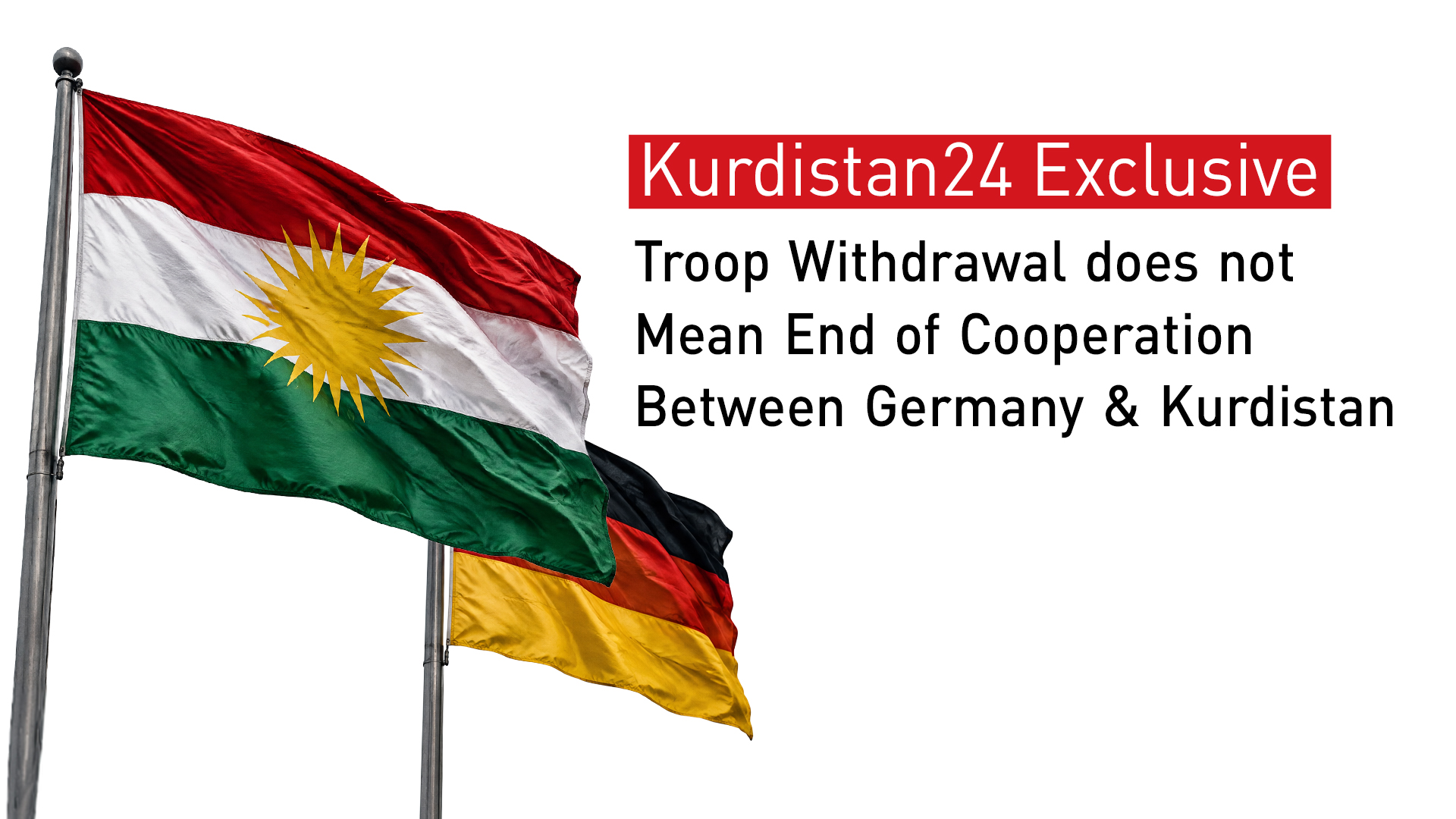
ERBIL (Kurdistan24) - Germany respects Baghdad's desire for the withdrawal of coalition forces, but the move does not signal an end to Berlin's long-standing partnership with Iraq and the Kurdistan Region, sources at the German Federal Foreign Office told Kurdistan24.
The office indicated that Berlin remains committed to continuing its engagement through an adapted framework focused on security assistance, stabilization, and development cooperation.
"We respect the Iraqi desire for the withdrawal of all international forces. However, this does not mean the end of our cooperation with Iraq," the sources said.
"It is our mutual interest to continue Germany's engagement in Iraq, including in the Kurdistan Region of Iraq, in an adapted form – including support for the security sector, continued civilian stabilization efforts, and development cooperation," the sources added.
The future structure of Germany's role was a key agenda item during official talks in Berlin on Sept. 15, when Iraqi Prime Minister Ali al-Zaidi visited the German capital at the invitation of Chancellor Friedrich Merz. German officials confirmed that consultations are ongoing with Iraqi partners to outline the concrete details of this future engagement.
On security, the German Federal Foreign Office assessed that the Islamic State (ISIS) has been "sustainably weakened," noting that the extremist group no longer holds territory and its operational capacity continues to dwindle.
"At the same time, our Kurdish and central Iraqi partners are increasingly capable of independently continuing the fight against the remaining ISIS structures," the sources emphasized.
Berlin cautioned that continued vigilance is required to prevent any resurgence, stressing that "notwithstanding this positive development, there remains, of course, a continued need to secure the successes achieved."
The coalition's departure was formalized in September 2024, when Baghdad and Washington signed a bilateral agreement setting the timeline to end the mission, following months of negotiations by the joint Higher Military Commission (HMC). Under the roadmap, the drawdown was carried out in phases, with troop reductions and base handovers across Iraq beginning in 2025.
The process concluded on schedule on Sept. 30, 2026, when coalition forces vacated their final position at Erbil Air Base. At a ceremony in Baghdad, Coalition Commander Liam Hollen confirmed the completion of the final withdrawal of personnel and equipment, ending Operation Inherent Resolve, the decade-long multinational mission launched in 2014 to advise, train, and support Iraqi security forces and the Peshmerga.
Germany has been a central pillar of the coalition effort in Erbil and Baghdad since 2014. The Bundestag authorized the Bundeswehr to deploy up to 500 personnel, though deployment levels generally ranged between 100 and 200 soldiers. Most were stationed at Camp Stephan, adjacent to Erbil International Airport, with a smaller advisory group in Baghdad.
German forces helped equip and train the Peshmerga, supplying MILAN anti-tank guided missile systems that proved critical in halting ISIS armored vehicle attacks, and providing training in combat engineering, mine clearance, explosive ordnance disposal (EOD), and battlefield trauma care.