Iraq’s al-Zaidi Declares New Sovereignty Phase, Praises Factions Committing to Arms Control
Prime minister outlines six pillars of sovereignty, including Coalition withdrawal, Peshmerga unification, weapons control and a national air-defense system
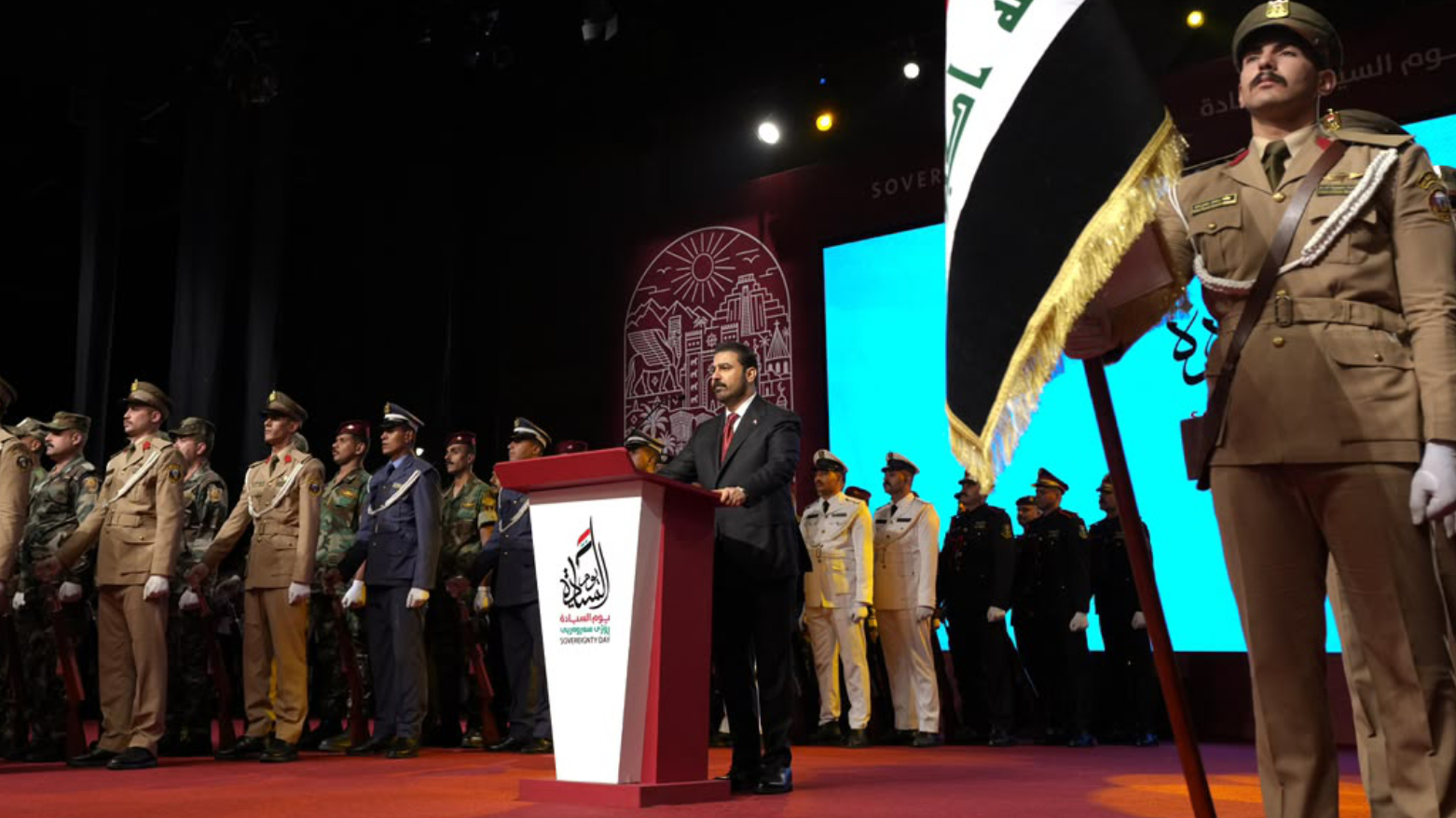
ERBIL (Kurdistan24) — Iraqi Prime Minister Ali Faleh al-Zaidi on Thursday praised armed factions that have declared their commitment to resolving the issue of weapons in accordance with the Constitution, as he declared the launch of a new phase of Iraqi sovereignty following the end of the international Coalition’s military mission in the country.
Al-Zaidi made the remarks while presiding over a Sovereignty Day conference attended by Iraqi Parliament Speaker Haybat al-Halbousi, Kurdistan Region President Nechirvan Barzani, senior officials, political leaders, heads of diplomatic missions in Iraq, and representatives of Iraqi society.
In his speech, al-Zaidi said Iraq was consolidating the foundations of political, economic, and security sovereignty, with the rule of law extending across the country and national wealth remaining under Iraqi control in accordance with the Constitution.
“Sovereignty represents the decision of the people and their determination to preserve the existence and prestige of the state,” al-Zaidi said, describing it as a fundamental element of Iraq’s national identity.
He said Iraqis had overcome major challenges over the past two decades, including terrorism and political instability, and had now reached a point where the country could renew its commitment to protecting the state and its institutions.
Six pillars of sovereignty
Al-Zaidi said the sovereignty Iraq was celebrating was reflected in six developments that he described as having been achieved or set in motion.
First, he pointed to the withdrawal of foreign forces and the complete conclusion of the international Coalition’s mission in Iraq. The Iraqi government formally marked the end of the Coalition’s mission on Sept. 30, with the departure of Coalition forces and equipment from Iraq marking the conclusion of its military mission against ISIS.
Second, al-Zaidi cited an agreement concerning the withdrawal of Turkish forces and Kurdistan Workers’ Party (PKK) elements, as well as an end to the presence of foreign armed groups on Iraqi territory.
Third, he identified the unification of the Peshmerga forces as a step toward strengthening unity in security and military decision-making.
Fourth, he said Iraq would end the presence of any foreign armed opposition groups on its territory and would not allow Iraqi territory to be used as a launching point for attacks against neighboring countries.
Fifth, al-Zaidi emphasized the need to regulate weapons in accordance with the Constitution and law, based on the timetable established by his government for addressing the status of armed factions and integrating them into state institutions.
Sixth, he announced the beginning of work to establish an integrated national air-defense system to strengthen Iraq’s ability to protect its airspace and sovereignty.
Praise for factions accepting weapons roadmap
Al-Zaidi specifically praised factions that have announced their commitment to addressing the weapons issue in accordance with the Constitution and the timetable established by the government.
“We commend the positions of the factions that have announced their commitment to addressing the issue of weapons according to the Constitution and according to the timetable set by the government,” he said.
He called on other armed groups to make the same commitment, saying the move would serve the interests of Iraqis and strengthen the authority and prestige of the state.
The issue of weapons outside state control has become a central part of Baghdad’s post-Coalition security agenda. In remarks marking the formal conclusion of the Coalition mission on Sept. 30, al-Zaidi said there should be no weapons outside the framework of the law and no force outside state institutions.
Economic sovereignty
The prime minister also linked national sovereignty to economic strength, saying Iraq needed an economy capable of responding to global changes while engaging with the international economy through equal partnerships.
He said his government was pursuing economic diversification, expanding international partnerships, and investing in young people rather than maintaining economic structures whose role had diminished.
Al-Zaidi also highlighted oil as Iraq’s principal national resource, saying the government was committed to protecting the country’s wealth and maximizing its revenues for the benefit of Iraqis.
“We have reached the moment to fulfill our commitment to safeguard Iraq’s security and provide protection for every inch of its territory,” he said.
The prime minister concluded by praising Iraq’s armed forces and security institutions, describing them as a symbol of the country’s sovereignty and guardians of its territory and people.
His remarks came as Iraq marked its first Sovereignty Day following the formal conclusion of the international Coalition’s military mission against ISIS.
The Iraqi government had designated Oct. 1 as Sovereignty Day and instructed state institutions across the country to organize commemorative events marking the occasion.