Trump Threatens Iran if Linked to flydubai Cockpit Attack
Donald Trump warned Iran of a "very hard" response if it is found to be linked to the attack aboard a flydubai flight to Israel, as investigators examine the motive.
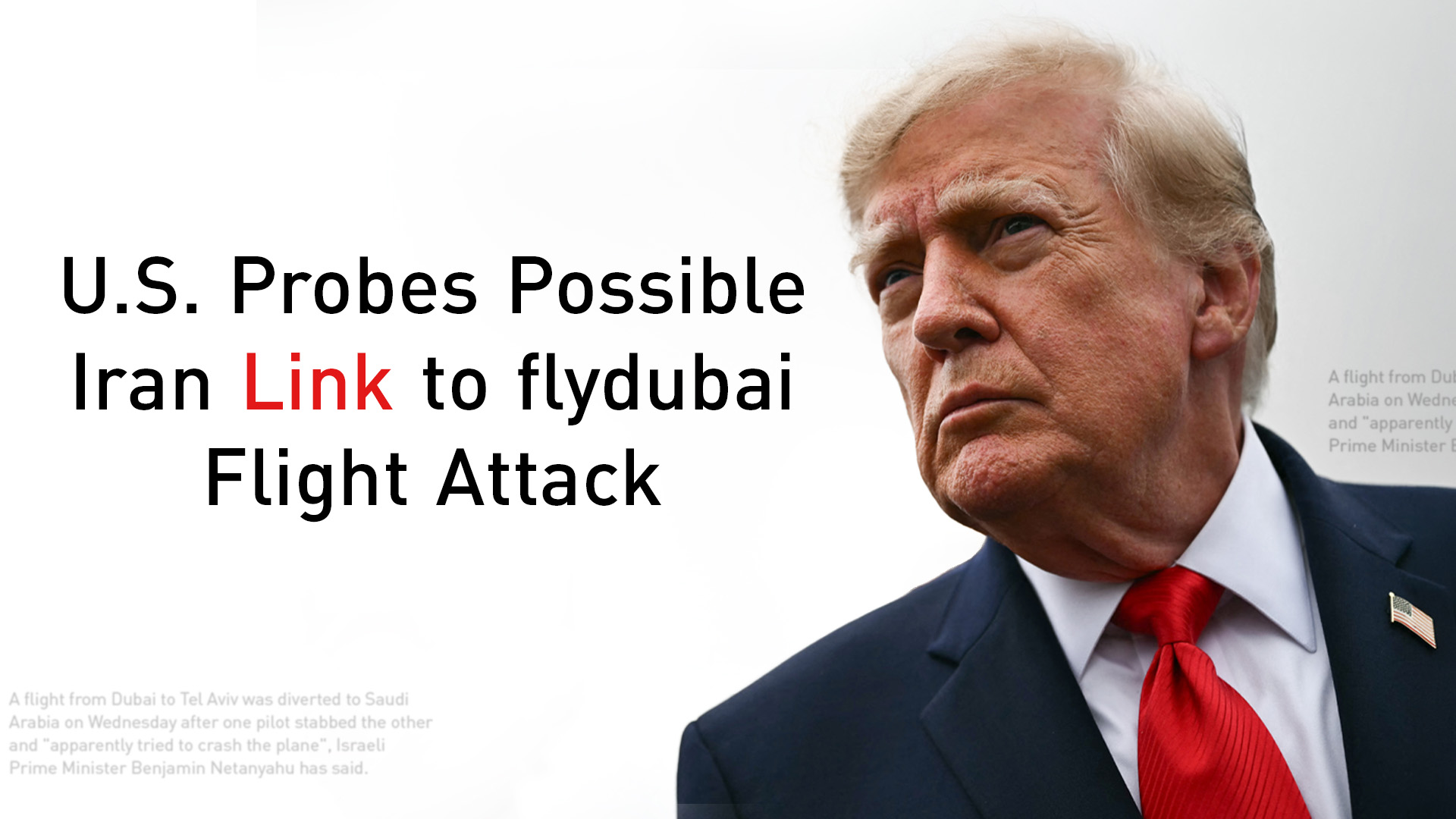
ERBIL (Kurdistan24) - U.S. President Donald Trump warned that Iran would be "hit very hard" if investigators determine Tehran was involved in the attack aboard a flydubai flight to Israel, as authorities in the United Arab Emirates, Saudi Arabia and Israel work to establish the motive behind the mid-air assault.
Asked at the White House on Thursday whether Iran was connected to Wednesday's incident, Trump said information reaching him suggested there could be a link, but stressed that the matter was still being investigated.
"I would say the answer, based on what I'm hearing, is yes but we're working on it right now," Trump said.
When asked whether the United States would retaliate if Iranian involvement was established, he replied: "Oh, they'll be hit very hard, don't worry."
No public evidence establishing Iranian involvement has yet been released, and the investigations into the incident remain ongoing.
The warning followed a dramatic sequence aboard flydubai Flight FZ1073, which was traveling from Dubai to Tel Aviv on Wednesday with 182 people aboard, including eight crew members.
According to Agence France-Presse reporting by Sabine El Hajj, with AFP teams in Israel and Saudi Arabia, the copilot allegedly attacked the captain during the flight, leading to a struggle for control of the aircraft.
Saudi authorities said their initial investigation indicated that the copilot had assaulted the captain. The suspect was transferred to the UAE on Thursday accompanied by an Emirati security team.
Passengers and other crew members intervened as the aircraft rapidly lost altitude.
Flight-tracking data cited by AFP showed the plane losing roughly 17,000 feet within about a minute. Reuters separately reported a drop of around 14,000 feet in less than 30 seconds.
The aircraft eventually made an emergency landing at Prince Sultan bin Abdulaziz International Airport in Tabuk, Saudi Arabia.
Flydubai said another on-duty crew traveling aboard the flight ultimately landed the aircraft safely. The airline subsequently suspended flights to Israel while the investigation continues.
Israeli Prime Minister Benjamin Netanyahu described the incident as an attempted terrorist attack and said investigators believe the Omani copilot had undergone what he called "Islamist radical indoctrination."
"We know that he underwent Islamist radical indoctrination," Netanyahu told Fox News, without providing supporting evidence publicly.
He also said the suspect had urged crew members to kill him during the incident and described his behavior as suicidal.
Earlier, however, Netanyahu had not ruled out the possibility that mental health could have been a factor.
The UAE's chief prosecutor said investigators would examine whether the incident involved terrorist activity or intent.
That inquiry remains important because neither the precise motive nor any connection to a foreign government has yet been established.
Netanyahu said the UAE would lead the investigation, with Israel participating.
He also raised questions about how the copilot, identified as an Omani national, had been assigned to an Israel-bound flight despite Israeli arrangements intended to restrict pilots from countries without diplomatic relations with Israel.
"Obviously, there was a loophole here," Netanyahu said in a separate Fox News interview.
The injured captain, Indian national Smit Machchhar, was praised by both Netanyahu and Indian Prime Minister Narendra Modi for his actions during the attack.
Netanyahu credited Machchhar with resisting the copilot long enough for the cockpit to be opened, allowing others to intervene.
India's embassy said the captain was recovering well, while Modi publicly described him as a "HERO."
Passengers also described joining the effort to restrain the suspect.
Passenger Miryam Shira Ohayon said the aircraft appeared to be almost out of control during the incident and credited those who intervened with preventing a crash.
The episode is now raising wider questions about aviation security, particularly the threat posed when the danger originates inside the cockpit rather than among passengers.
Associated Press reporters Sam Metz, Rio Yamat and Philip Marcelo reported that aviation experts expect authorities to examine pilot vetting, crew screening and whether warning signs involving the copilot had been identified before the flight.
Eyal Hulata, Israel's former national security adviser, told the AP that aviation security had traditionally concentrated much more heavily on passengers and baggage than on the possibility of a threat from a pilot or other crew member.
He said that approach could now change.
Experts also noted that cockpit doors were strengthened and locked after the Sept. 11, 2001, attacks to stop outside intruders, but that the same protection can become a problem when the threat is already inside the flight deck.
Investigators are also expected to examine the emergency response after the aircraft began transmitting distress signals.
A person familiar with air-traffic communications told the AP that the crew reported a hijacking and requested ambulances. Saudi Arabia and Jordan initially did not clear the aircraft to land before Saudi authorities ultimately allowed it to divert to Tabuk.
International aviation specialists cited by AP said serious emergencies normally require getting an aircraft onto a suitable runway as quickly as possible, while acknowledging that national authorities also make security decisions concerning their own airspace.
The incident comes as Washington is expanding its military presence in the Middle East.
AFP cited Axios as reporting that additional U.S. Patriot missile batteries had recently been deployed to Saudi Arabia and Qatar to protect important energy infrastructure against possible Iranian retaliation.
Axios also reported that the USS Theodore Roosevelt carrier strike group was heading toward the Middle East, where two other U.S. carrier groups were already operating.
The deployments form the backdrop to Trump's warning to Tehran, but investigators have not publicly established that Iran directed, supported or had prior knowledge of the flydubai incident.
For now, authorities are examining several distinct questions: why the copilot allegedly attacked the captain, whether the act was terrorism, whether he acted alone, how he passed security and operational checks for an Israel-bound flight, and whether any outside actor was involved.
Until those investigations are completed, Trump's warning to Iran remains conditional on a connection that has yet to be publicly proven.