Akre Beekeeper Produces Royal Jelly Worth 10 Million Dinars
Akre beekeeper Abduljabbar Sa'adi says his rare royal jelly sells for 10,000 Iraqi dinars per gram, highlighting a growing beekeeping sector across Kurdistan.
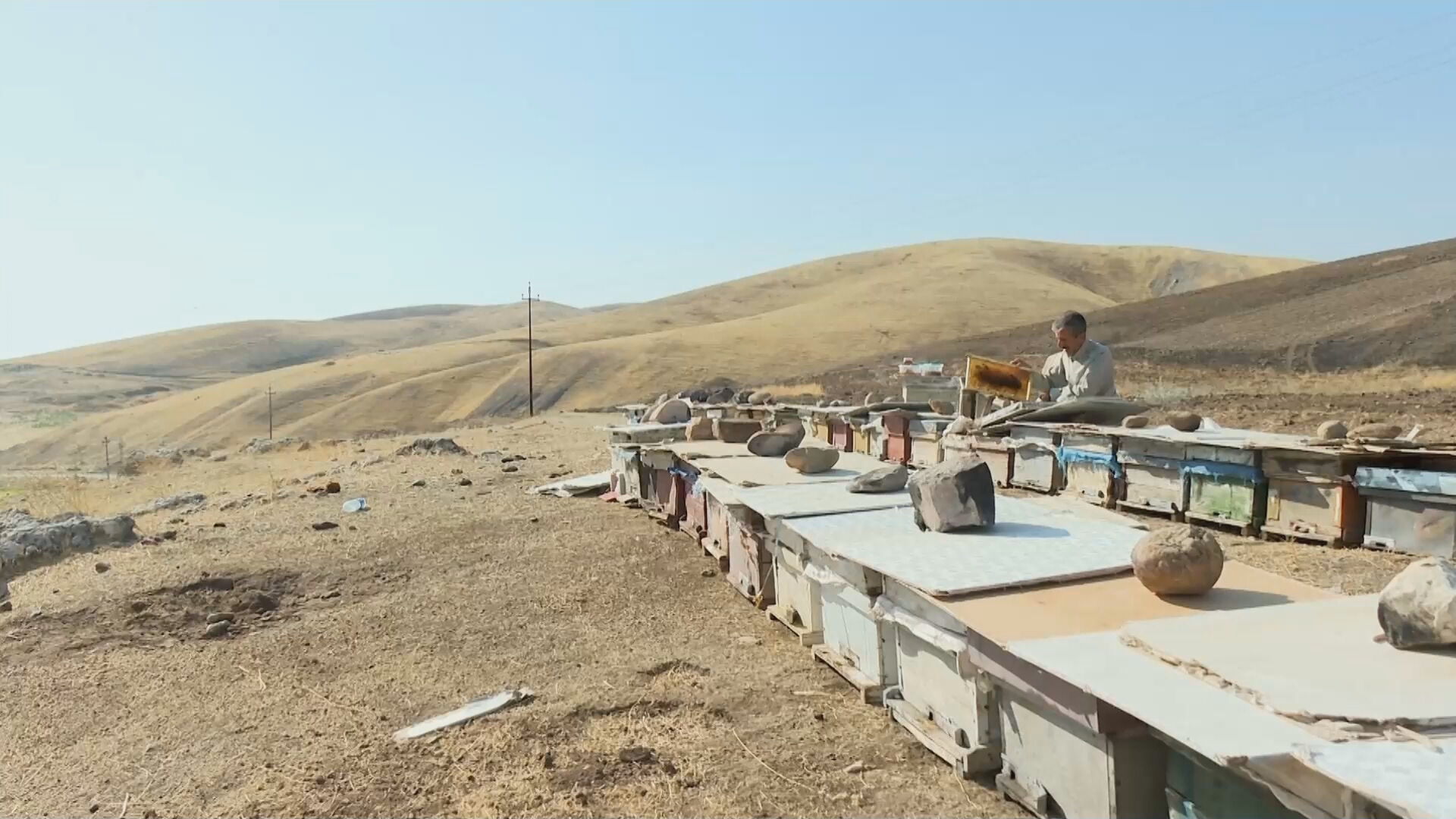
ERBIL (Kurdistan24) - In the hills around Akre, where beekeeping has long been tied to village life and the surrounding landscape, Abduljabbar Sa'adi tends a product far scarcer than ordinary honey. Measured by the gram rather than the jar, the royal jelly he produces can sell for 10,000 Iraqi dinars per gram, putting the value of a kilogram at roughly 10 million dinars.
Sa'adi, from Gundki village in the Akre area, told Kurdistan24's correspondent Ari Hussein that his family has been involved in beekeeping since 1998.
After years of producing honey, he began working with royal jelly in 2015.
"We began producing royal jelly," Sa'adi said. "It is not available every year; it is scarce."
Royal jelly is produced in very small quantities compared with honey, and Sa'adi said availability can vary considerably from one year to another.
"Some years there is none at all, while in other years it is available," he said. "This year, there was a large amount."
That scarcity helps explain its price.

Sa'adi said one gram sells for around 10,000 Iraqi dinars, meaning a kilogram would be valued at approximately 10 million dinars if produced in that quantity.
But royal jelly is not something he recommends consuming by itself.
Showing Kurdistan24 six grams of the substance, Sa'adi explained that he mixes that amount with 125 grams of honey.
According to his own practice, he recommends taking a spoonful of the mixture each morning on an empty stomach for 21 days and then waiting three hours before eating.
Sa'adi also attributes a wide range of health benefits to royal jelly. Those claims reflect his experience and traditional use of the product and should not be understood as independent medical guidance.
For him, however, royal jelly represents another specialized branch of a craft he has practiced for nearly three decades.
His story comes at a time when beekeeping is expanding across the Kurdistan Region.

The Kurdistan Regional Government's Ministry of Agriculture and Water Resources said in August that honey production was expected to reach between 550 and 600 tons in 2026, compared with 450 to 500 tons the previous year.
Qaraman Qadir, spokesperson for the ministry, attributed the expected increase of 15 to 20 percent to improved mountain pastures and favorable weather for bees.
More than 1,300 beekeepers are officially registered with the ministry, collectively managing nearly 500,000 beehives.
Read More: Kurdistan Region Honey Production Expected to Rise 20% This Year
Among the main honey-producing areas identified by the ministry are Choman, Balakayati, Sidakan and Rawanduz, as well as Penjwen, Mawat, Qaradagh, Sharazur, Amedi, Dinarta and Zakho.
Akre, where Sa'adi works, forms part of a wider mountainous environment in which beekeeping remains closely connected to natural vegetation and rural livelihoods.
The government has also been looking beyond domestic consumption.
Kurdistan Region honey was first exported to Qatar in November 2023, followed by shipments to other markets, while the Agriculture Ministry says it is working to create further export opportunities.
Scientific and educational interest in beekeeping is growing as well.

Mergasor Technical Institute recently announced that it will open a dedicated beekeeping department for 40 students in the new academic year.
Dr. Talib Sherwan, dean of the institute, said the program will provide scientific training in beekeeping and bee raising while connecting technical education with local production and natural resources.
The department will become the institute's fourth academic program alongside Nursing, Herbal Medicine and Business Administration.
Read More: Kurdistan Technical Institute Launches Beekeeping Department
That move reflects a broader effort to turn a traditional rural occupation into a field combining experience, science and vocational training.
Sa'adi's work provides a small-scale example of that transition.
His knowledge comes from years spent with bees, learning how weather, flowering seasons and hive conditions affect what can be produced.

Honey may remain the best-known product, but royal jelly represents the more delicate and unpredictable side of the craft.
For Sa'adi, that unpredictability is part of what gives it value.
A productive season may yield enough to sell by the gram. Another year may produce almost nothing.
After nearly three decades among the hives, he continues to work within those natural limits, producing honey when the bees allow it and, in the better years, harvesting a substance so scarce that six grams can be presented as something valuable in its own right.