Tom Barrack Says Financial Connectivity Key to Syria’s Economic Recovery
U.S. envoy highlights banking roundtable with Syrian financial officials and American institutions as Washington backs reforms to reconnect Syria to the global financial system
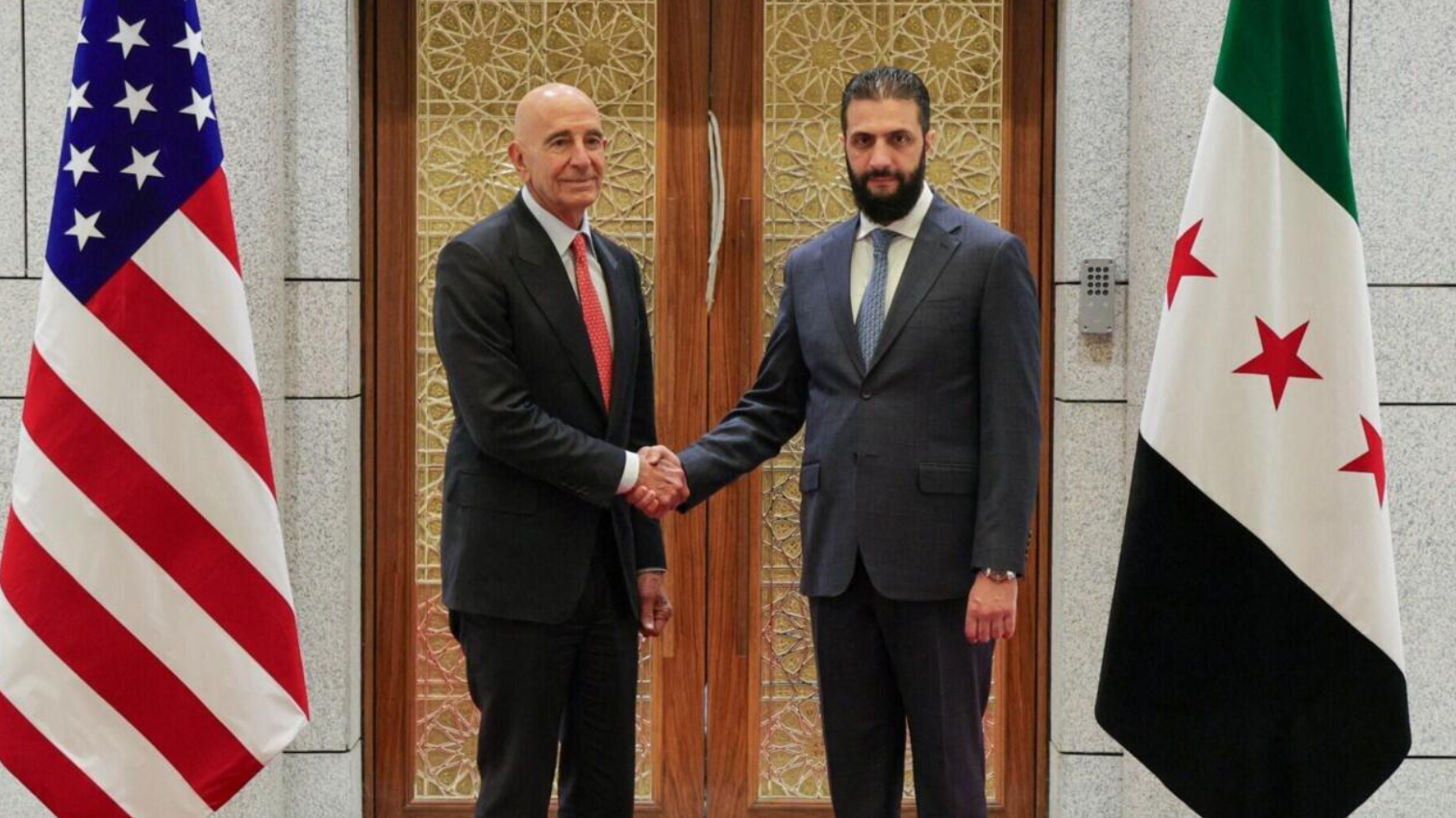
ERBIL (Kurdistan24) — Tom Barrack, U.S. Ambassador to the Republic of Türkiye and Special Presidential Envoy for Syria and Iraq, said Saturday that restoring Syria’s financial connectivity is essential to turning the country’s economic recovery into lasting prosperity.
“President Trump opened the door to Syria’s recovery. Restoring financial connectivity is how we help turn that opportunity into lasting prosperity,” Barrack said in a post on X, referring to his participation in a Treasury-hosted banking roundtable with Syrian financial officials, U.S. banks and payment service providers.
Barrack said the discussions focused on combating illicit finance, advancing credible financial reforms and rebuilding confidence as Syria seeks to reconnect with the international financial system.
He described the meeting as “another foundation stone” in President Donald Trump’s approach toward giving Syria an opportunity for economic recovery.
The roundtable was held in New York on Thursday, Oct. 1, and was co-hosted by U.S. Treasury Assistant Secretary for Terrorist Financing and Financial Crimes Jonathan Burke and Syrian Minister of Finance Yisr Barnieh, with participation from Central Bank of Syria Governor Safwat Raslan.
Barrack provided remarks virtually, according to the Treasury Department’s readout.
During the full-day discussions, representatives of U.S. financial institutions and payment service providers were briefed on Syria’s current anti-money laundering and countering the financing of terrorism (AML/CFT) framework.
The participants also received information on gaps identified by an independent third party and the Syrian government’s efforts to address them.
The U.S. Treasury said financial connectivity is essential to combating illicit finance and supporting Syria’s reintegration into the global financial system.
It said Washington would continue working with Syrian counterparts on measures to counter illicit finance and implement key financial reforms. The discussions come as the Trump administration has moved to ease broad U.S. economic restrictions on Syria.
The Treasury readout described President Trump’s decision to lift virtually all sanctions on Syria as “historic,” linking the restoration of financial connectivity to the country’s wider reintegration into the global economy.
The financial measures are part of a broader effort to establish channels through which Syrian banks and businesses can interact with international financial institutions while meeting international compliance requirements.
Earlier policy discussions have also focused on correspondent banking, money-laundering controls and other safeguards needed to restore confidence among international financial institutions.
For Washington, the effort involves balancing economic reintegration with safeguards against illicit financial activity.
The Treasury has emphasized that greater access to the global financial system must be accompanied by stronger AML/CFT controls and credible reforms to reduce risks for U.S. and international financial institutions.
Barrack’s remarks underscore the financial dimension of the U.S. administration’s broader Syria policy, with the envoy presenting renewed banking connectivity as a mechanism for translating sanctions relief into economic activity, investment and longer-term recovery.
The renewed financial engagement also reflects the broader diplomatic opening that President Ahmed al-Sharaa has secured with Washington and other international actors since taking office.
President Donald Trump has publicly praised al-Sharaa’s leadership and backed measures to remove major obstacles to Syria’s economic recovery, while the Trump administration has progressively expanded its engagement with Damascus.
Barrack has played a prominent role in that process, maintaining close contact with al-Sharaa and helping advance Washington’s engagement with the Syrian government.
Their meetings, including high-level contacts during the UN General Assembly in New York, have underscored the deepening relationship between Damascus and Washington.
During remarks in September, Barrack praised the Syrian leadership for what he described as “great leadership and great cooperation,” adding that he was “happy to be a small part of this journey.”