Iraqi Forces Begin First Phase of Jurf al-Sakhar Security Operation
Iraqi Federal Police begin moving toward Jurf al-Sakhar as Baghdad launches its security operation following delays, with Kataib Hezbollah remaining on alert.
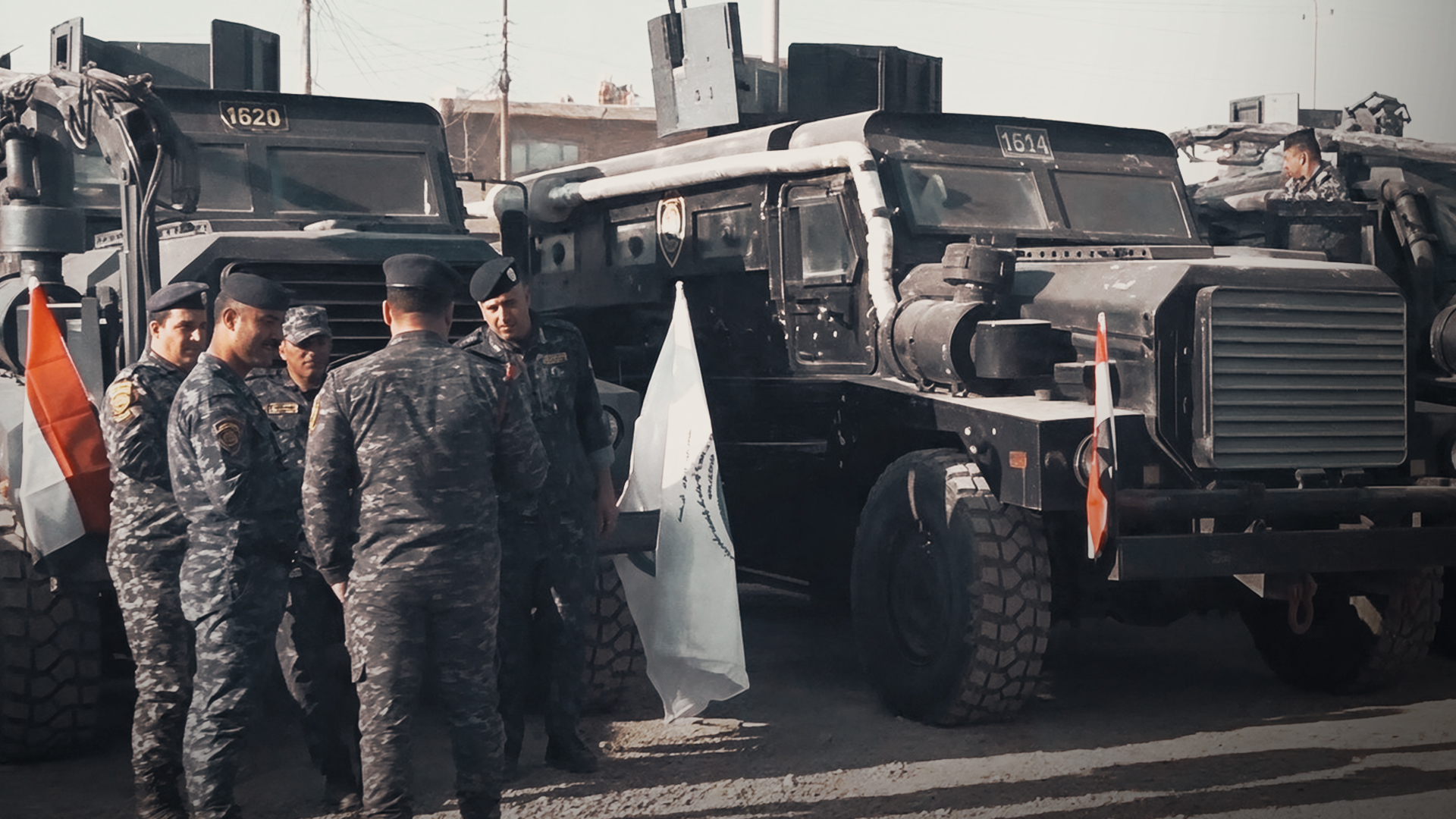
ERBIL (Kurdistan24) - Iraqi Federal Police forces began moving toward the entrance of Jurf al-Sakhar on Friday morning, marking the beginning of the first phase of a government security operation in the heavily restricted area southwest of Baghdad, Kurdistan24 correspondent Dilan Barzan reported.
Barzan said the movement began only minutes before his latest report on Nov. 20. His account confirms that the operation has started, but does not establish that government forces have completed their entry or assumed control of positions inside the subdistrict.
The development followed a two-hour delay, the assembly of six military and security formations near Jurf al-Sakhar, and continued uncertainty over whether Kataib Hezbollah (KH), the armed group long established in the area, had agreed to the new arrangements.
Kurdistan24 correspondent Shivan Jabari, reporting from Musayyib district in Babil province, said units gathered near one entrance included an Iraqi Army brigade, a Federal Police brigade, two Popular Mobilization Forces (PMF) brigades, a Counter-Terrorism battalion and a battalion responsible for protecting oil pipelines.
The government had set 6:00 a.m. Friday as the deadline for the operation, but the movement was postponed until 8:00 a.m., Jabari reported. Iraqi Prime Minister Ali Falih Zaidi and security official Saad Maan nevertheless maintained that the deployment decision had not been reversed.
Barzan's subsequent report of Federal Police forces advancing toward the entrance marked a change from the earlier situation, when the assembled units remained stationary despite the expiry of the initial deadline.
Forces Gather
Jabari described military vehicles, buses and minibuses carrying security personnel along the Baghdad-Musayyib road and around Jurf al-Sakhar. He said he had not observed tanks or missile systems among the forces he could see.
In his assessment, the visible preparations suggested an operation designed to reposition units in stages rather than launch an immediate battle. That interpretation, however, did not eliminate the possibility of confrontation.
The correspondents said the anticipated first phase involved transferring designated positions previously held by KH to government-assigned forces, with some locations expected to be administered jointly.
Further movements were planned over the following days toward locations connected to investigated oil-smuggling activity or suspected unauthorized oil extraction, Jabari reported. The aim, he said, was to establish a security perimeter and bring all three principal entrances under control.
No completed transfer of those positions had been independently established when Barzan reported the operation's initial movement.
No Confirmed Agreement With KH
The central uncertainty remained the position of KH. Jabari said Iraqi authorities and the armed group had not reached an agreement at the time of his report, although both sides had indicated that they did not want a military confrontation.
He said government security units in Musayyib, Jurf al-Sakhar, Babil and Anbar, as well as elsewhere in Iraq, had been placed on alert. KH fighters inside the subdistrict were also on high alert and remained armed.
The group had indicated that its fighters would respond if an unwanted confrontation occurred, raising concerns about how an attempted handover might unfold.
In an earlier account from near Jurf al-Sakhar, Barzan observed that the area remained calm after the 6:00 a.m. deadline, with few military vehicles moving toward it.
He suggested that a limited-entry arrangement might be emerging under which some government forces would enter while KH members remained in place. That was an assessment based on conditions on the ground, not confirmation of a final agreement.
Barzan also reported that Esmail Qaani, commander of Iran's Quds Force, had been in Iraq since Monday, holding talks with Shiite political leaders and Zaidi intended to avert fighting. The outcome of those discussions was not established in the latest field reports.
Phased Security Reorganization
The movement is part of a security reorganization approved by Iraq's government, bringing together the Army, Federal Police, PMF and Energy Police under a plan for sector-by-sector deployment.
On Thursday, Zaidi met ministers and senior security commanders to review preparations and the rotation of military units. His office said the government wanted the operation conducted professionally, with security personnel observing military orders and protecting citizens and their property.
The PMF separately announced that repositioning would begin Friday under instructions from the Commander-in-Chief of the Armed Forces.
Maan, head of Iraq's Security Media Cell, said further information would be presented at a press conference in the area assigned to the Federal Police's 16th Brigade. He indicated that Federal Police and PMF representatives would explain how the operation was being carried out.
The plan involves not only replacing forces at designated positions but also protecting oil infrastructure amid continuing scrutiny of suspected smuggling in and around the subdistrict.
Jurf al-Sakhar has become a focal point of Baghdad's effort to establish direct oversight of territory and security positions long held by armed groups.
For now, the reported movement of Federal Police toward the entrance is the first concrete step after the delayed deadline. Whether the units can proceed to their assigned locations without confrontation, and whether any accommodation with KH will govern that process, remains unresolved.