Iraqi PM Al-Zaidi Orders Investigation Into U.S. Flag Incident
Prime Minister Ali Faleh al-Zaidi ordered an investigation and legal action over disrespect toward the U.S. flag during Iraq's Sovereignty Day events.
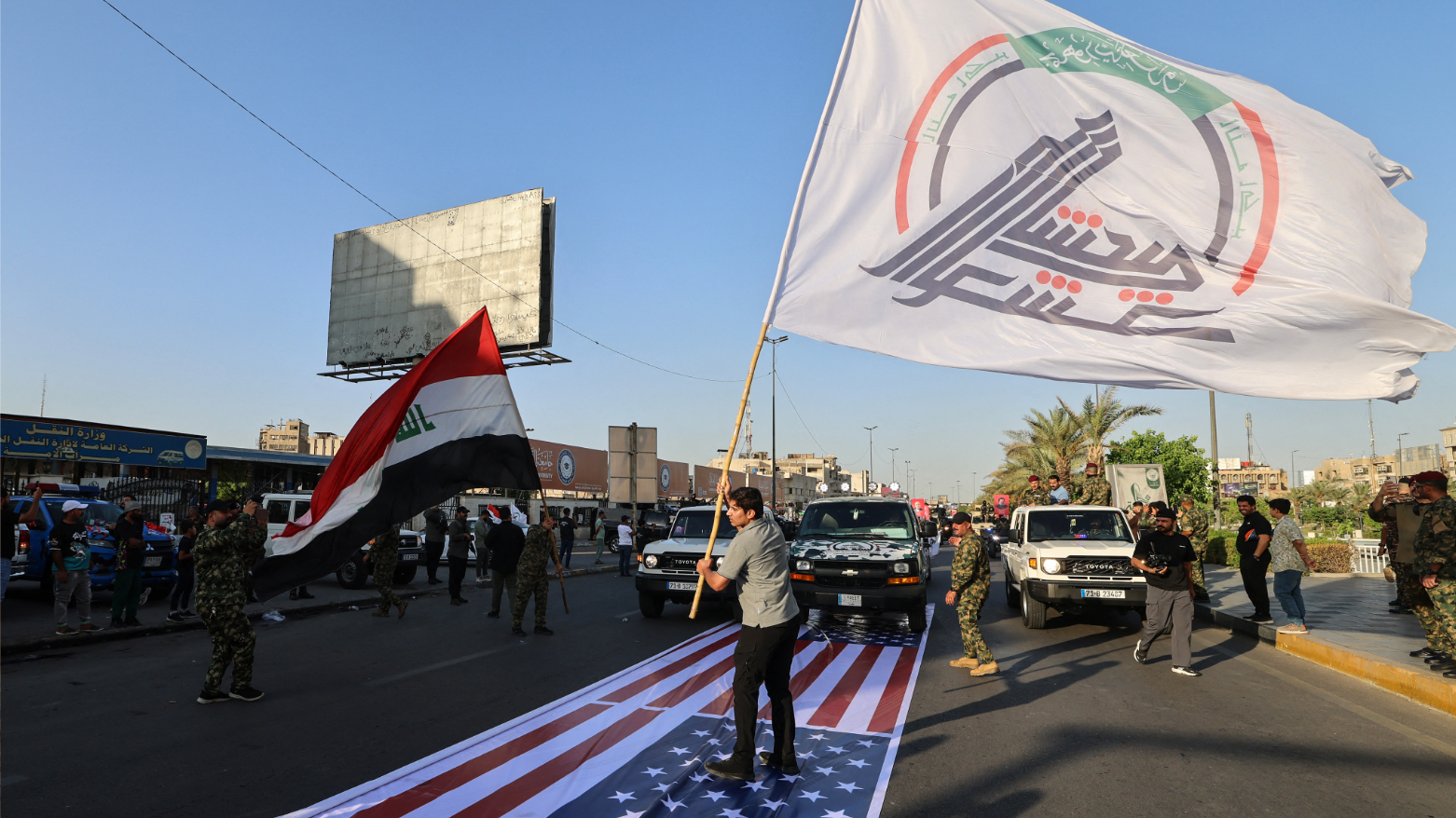
ERBIL (Kurdistan24) - Iraqi Prime Minister Ali Faleh al-Zaidi has ordered an investigation into an incident in which the U.S. flag was disrespected during Sovereignty Day activities, directing authorities to take legal action against those responsible as Baghdad seeks to reinforce state authority in the first days after the international Coalition's military mission ended.
Sabah Numan, spokesperson for the Commander-in-Chief of the Iraqi Armed Forces, said Sunday that Al-Zaidi, in his capacity as commander-in-chief, had ordered the formation of an investigative committee to establish the circumstances surrounding the incident.
The episode occurred during one of the displays organized as part of Sovereignty Day events marking the end of the U.S.-led international Coalition's military mission in Iraq.
According to the report, a number of Popular Mobilization Forces fighters and supporters disrespected the U.S. flag during the celebrations and drove a military vehicle over it.
The supplied material does not identify the individuals involved, specify their organizational affiliations within the PMF structure, or indicate that the action represented an official decision by the Popular Mobilization Forces as an institution.
Numan said the commander-in-chief condemned the incident and stressed the need to respect Iraqi law and diplomatic norms.
Al-Zaidi instructed the committee to complete its investigation as quickly as possible and submit its findings to the relevant senior authorities.
He also ordered the necessary legal measures to be taken against those found responsible.
The decision comes only days after Iraq formally ended the international Coalition's military mission on Sept. 30, a development the government has presented as the beginning of a new phase of Iraqi sovereignty and full responsibility for national security.
Al-Zaidi has repeatedly tied that new phase not only to the withdrawal of foreign forces, but also to the state's ability to control weapons, armed activity and decisions affecting Iraq's territory.
In his National Day address on Saturday, the prime minister said Iraq had entered a period in which the state possesses its own decision, protects its territory and airspace, and places weapons under the authority of the commander-in-chief.
His government has also said that the end of the Coalition mission does not mean the end of security relations with partner countries. Cooperation is expected to continue through areas including intelligence sharing, training, expertise and technology.
The investigation into the U.S. flag incident therefore comes against a wider debate over what Iraqi sovereignty should mean after the departure of Coalition forces.
For Baghdad, one of the most pressing questions is the future of weapons held by armed factions outside the regular chain of state authority.
The Shiite Coordination Framework, Iraq's principal Shiite political alliance, reaffirmed on Friday that June 30, 2027 remains the deadline for resolving the issue.
Meeting at the Government Palace at Al-Zaidi's invitation, the Framework called for nationwide de-escalation, stronger state institutions and adherence to the rule of law.
It also backed the continued work of a four-member committee engaged in negotiations over weapons and praised armed groups that had committed to arrangements reached through the political and security process.
The Framework presented those efforts as part of the responsibilities emerging after Sovereignty Day.
Al-Zaidi has similarly said there should be no weapons outside the framework of law and no armed force operating outside state institutions.
That issue has taken on greater importance with the Coalition no longer maintaining its previous military presence in Iraq.
During the years of the anti-ISIS campaign, debate over armed factions frequently intersected with arguments about the presence of foreign forces. With the Coalition mission now formally concluded, Baghdad is placing greater emphasis on consolidating domestic security authority.
The government's stated objective is therefore twofold: asserting independence from an international military presence while demonstrating that the Iraqi state itself can regulate armed activity inside the country.
The flag incident presents an early, highly visible test of that approach.
Sovereignty Day was intended to mark the transfer of primary security responsibility to Iraqi institutions. The government's response now signals that celebrations of the Coalition's departure are not, in its view, a license to disregard laws or diplomatic conventions involving states with which Iraq continues to maintain relations.
At the same time, the investigation remains at an initial stage. No findings have yet been announced, and the supplied statement does not identify individuals who could face legal proceedings.
The broader effort over weapons is also unfinished.
The Coordination Framework's June 2027 deadline means negotiations with armed factions will continue for months, even as the government publicly insists that ultimate authority over weapons and security decisions belongs to the state.
In the first days of post-Coalition Iraq, that principle is moving from political speeches into practical questions of enforcement.
The investigation ordered Sunday concerns one episode involving the U.S. flag. But it comes as Baghdad confronts a much larger issue: whether the sovereignty celebrated after Sept. 30 can be matched by effective state authority over armed actors, public security and the rule of law.