Al-Zaidi: Five Factions Agree to Hand Over Weapons as Iraq Seeks to Strengthen State Authority
Prime minister says three factions have already surrendered their weapons, while Baghdad pursues foreign troop withdrawals, economic reform and measures to shield Iraq from regional conflicts
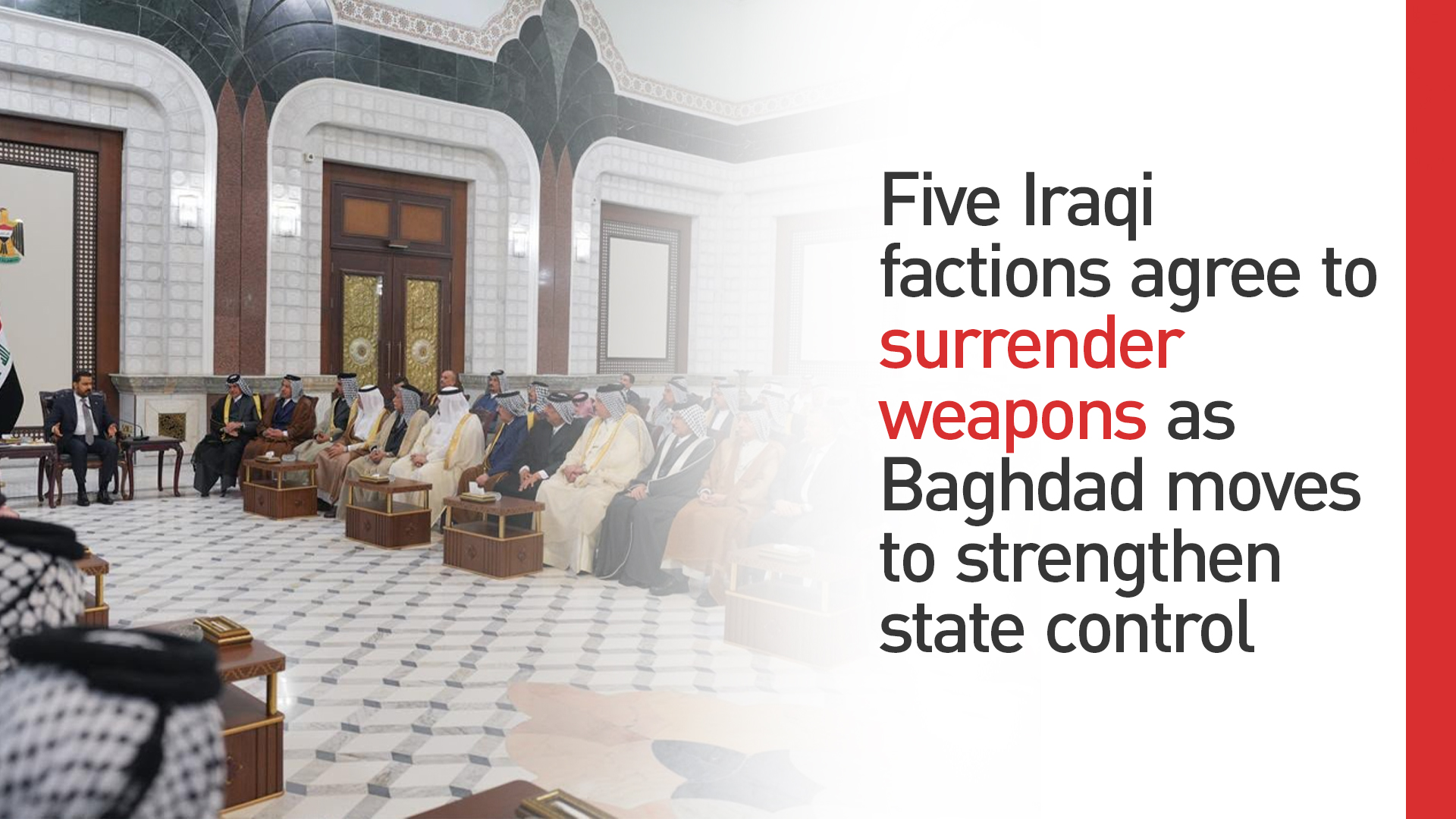
ERBIL (Kurdistan24) — Iraqi Prime Minister Ali Faleh al-Zaidi said Monday that five armed factions had agreed to hand over their weapons to the state, with three having already completed the process, as his government pushes to consolidate state authority and keep Iraq out of the repercussions of regional conflicts.
Al-Zaidi made the remarks while receiving tribal sheikhs and dignitaries, praising the tribes for supporting the state and helping maintain order during difficult periods. He stressed that the government would not allow anyone to weaken the state or threaten its existence.
"Five factions have agreed to surrender their weapons, and three of them have already surrendered their weapons," al-Zaidi said, adding that dialogue was continuing with the remaining groups.
He said the government was seeking to strengthen state institutions and ensure that national decisions remained in Iraqi hands, stressing that "Iraqi blood is our responsibility" and that the government had a duty to prevent further bloodshed.
Political backing for weapons control
Several political and parliamentary figures welcomed the announcement, describing the transfer of weapons to state control as a step toward strengthening sovereignty and unifying the country's security decision-making.
MP Murtada al-Ibrahimī told Iraq's State-owned news Agency (INA) that Iraqi sovereignty must be unified "in both decision-making and presence," arguing that the response of some factions and their surrender of weapons demonstrated seriousness in addressing the requirements of the current phase.
MP Murad Ismail, head of the Ezidi Force Alliance bloc, told INA that restricting weapons to the state was a "national" step that would strengthen institutions and ensure that security forces operated exclusively under the authority of the commander-in-chief of the armed forces.
Meanwhile, Badr bloc MP Shakir al-Tamimi told INA that the government's security, military and economic vision was aimed at building a strong state in which the government held decision-making authority over agreements with other countries.
Sadikoun bloc MP Wafaa al-Tai also told INA that placing weapons under state control would strengthen the rule of law, unify security decisions and contribute to a more stable environment for investment and economic activity.
The government’s weapons-control effort comes as Iraq enters a new security phase following the completion of the US-led international Coalition's military mission in the country.
Baghdad has linked the next phase to strengthening state institutions and ensuring that armed forces operate within the constitutional framework.
Baghdad seeks to avoid regional fallout
Al-Zaidi also said his government had worked to prevent Iraq from being subjected to international isolation and had sought partnerships with the international community.
He said Iraq needed beneficial international partnerships, particularly with major and economically advanced countries, while arguing that economic reform required attracting foreign investment and the withdrawal of foreign forces from the country.
"We seek to keep Iraq away from any repercussions of the conflicts in the region," al-Zaidi said, adding that the stability of Iraqi society and the population was the government's objective.
The prime minister also said Baghdad had held talks with Türkiye over several issues, including the presence of Turkish forces inside Iraq, and that there had been a withdrawal from some positions controlled by the Turkish military.
He added that talks with Kuwait were aimed at resolving outstanding bilateral issues.
Iraq projects higher oil output
On the economic front, al-Zaidi said Iraq was working to establish a stronger economic identity through program-based budgeting and investment in infrastructure, particularly electricity.
He said the current economic crisis had significantly affected the Iraqi economy but maintained that the government was working to establish longer-term economic foundations.
Al-Zaidi said Iraq's oil production would reach 10 million barrels per day by 2031, reiterating a target the government has previously outlined for substantially increasing crude production capacity.
He also announced the establishment of a Future Generations Fund, with 1.5 trillion Iraqi dinars allocated to it. Funds recovered through anti-corruption operations will also be added to the fund, he said.
The prime minister further said the government would allocate 500 billion dinars monthly to settle outstanding payments to farmers and continue work on a project providing one million residential plots with full services.
Coordination Framework discusses economic stability
Separately, Iraq's Coordination Framework held its regular meeting Monday in Baghdad in the presence of al-Zaidi and Finance Minister Faleh Sari, focusing on the country's financial and economic situation and the government's services plan.
According to a statement, the meeting emphasized the need for monetary and development policies that support economic stability, improve living standards and strengthen basic services.
The meeting also addressed regional and international developments, stressing the importance of preserving Iraq's stability and national interests amid mounting challenges in the surrounding region.
Al-Zaidi's remarks come as Baghdad seeks to balance a push for greater state control over security with efforts to strengthen the economy and manage Iraq's relationships with neighboring countries and international partners.
