Serbia Raises Terror Alert After Attacker Killed Outside Israeli Embassy
Belgrade says suspected ISIS supporter targeted a police guard, renewing security concerns after a similar attack on the diplomatic mission in 2024
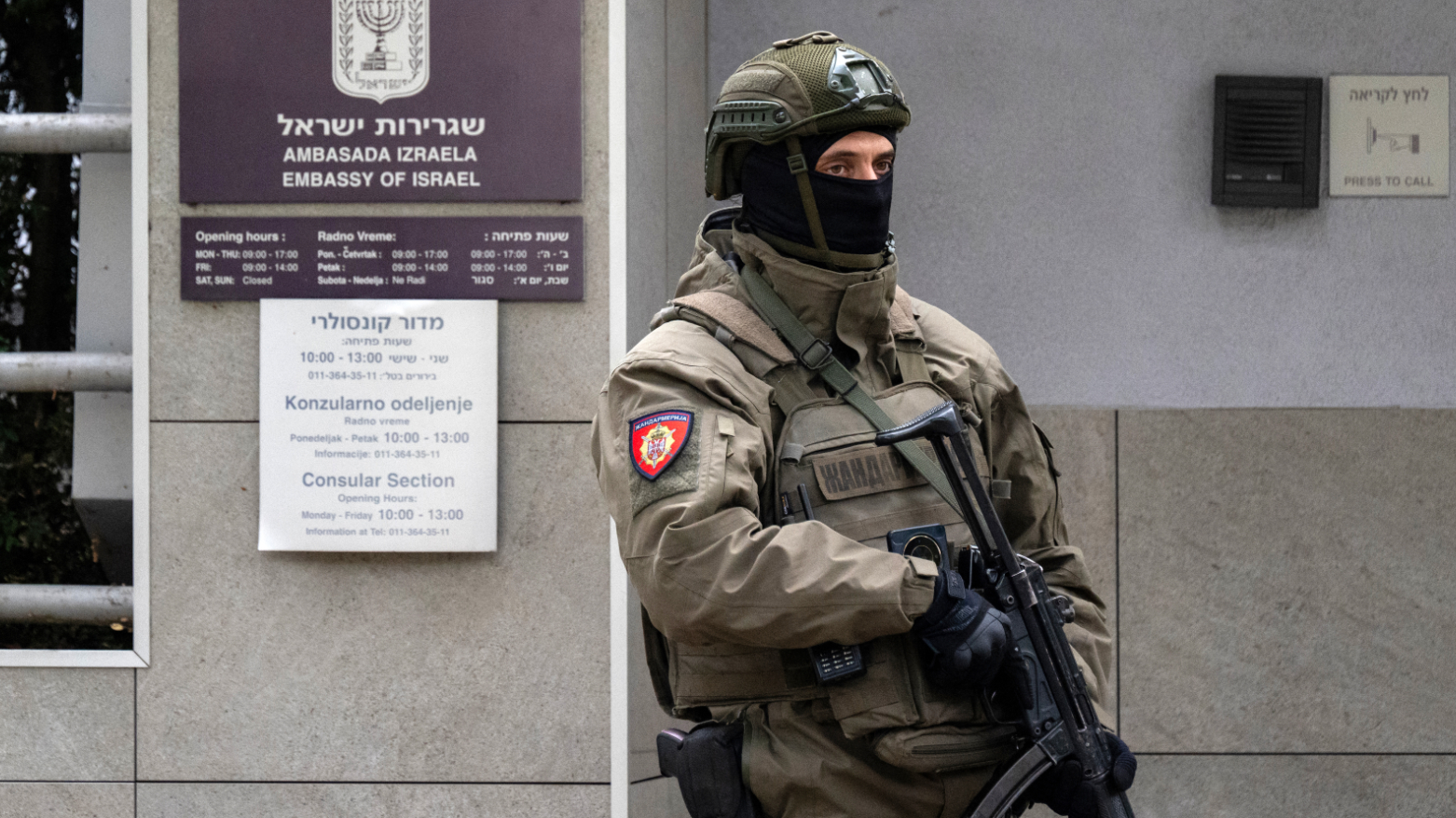
ERBIL (Kurdistan24) — Serbian police killed a knife-wielding attacker outside the Israeli Embassy in Belgrade early Wednesday after he assaulted a police officer guarding the mission, prompting authorities to raise the country's terrorism threat level to its highest setting.
Outgoing Interior Minister Ivica Dacic described the incident as a “terrorist attack,” saying the assailant was a minor whose identity had not yet been established. The attacker reportedly shouted “Allahu Akbar” while striking the officer with two knives shortly after midnight.
The police officer shot and killed the attacker in self-defence but sustained a minor wound to the face, according to Serbia's Interior Ministry.
Dacic said security services had been monitoring the suspect, who was believed to be from the western Serbian city of Sabac and was known to authorities as a supporter of the Islamic State (ISIS) group. He added that the suspect's Instagram profile featured a black flag and the group's emblem.
Following the incident, Serbia raised its terrorism alert to the highest level, known as a red alert. Dacic said the measure would bring tighter security checks and an increased police presence at sensitive locations, including critical infrastructure and places where large crowds gather.
The attack is under investigation, and authorities have yet to establish the suspect's full identity or publicly disclose further details about his motives.
Previous attack on the same embassy
The incident renewed concerns over the security of Israel's diplomatic missions, particularly in Belgrade, where the embassy was targeted in June 2024.
In that attack, a man armed with a crossbow seriously wounded a Serbian police officer guarding the embassy before being shot dead. Serbian authorities identified the attacker as a 25-year-old man from a village near Belgrade who had converted to Islam and subsequently embraced extremist views.
The two incidents, involving different weapons but targeting security personnel outside the same diplomatic mission, have placed renewed attention on the protection of Israeli diplomatic facilities in Serbia.
Western Policy Shifts Deepen Divisions Over Israel
The attack also comes amid growing tensions between Israel and several Western European countries over the war in Gaza and the future of Palestinian statehood.
France and the United Kingdom formally recognized the State of Palestine in September 2025, while both governments, alongside other European partners, have increased pressure on Israel over settlement expansion and policies they say undermine the two-state solution.
In September 2026, France and the UK joined a broader group of countries considering or pursuing restrictions on trade with Israeli settlements. Germany, while maintaining its longstanding commitment to Israel’s security and declining to recognize Palestinian statehood before a negotiated settlement, has also criticized Israeli settlement plans and called for a viable two-state solution.
While Western European governments have increasingly voiced criticism of Israel’s military operations and backed Palestinian statehood, US President Donald Trump has continued to provide strong political support for Israel.
The growing divide reflects a broader shift in Western attitudes toward the Israeli-Palestinian conflict, as European leaders face mounting public pressure to reassess their policies and Washington maintains its longstanding alliance with Israel.
A history of attacks on Israeli diplomatic missions
Attacks against Israeli embassies and diplomatic personnel have occurred in several countries over the past decades, ranging from deadly bombings to attempted attacks on diplomats and embassy vehicles.
One of the deadliest incidents took place on March 17, 1992, when a car bomb exploded outside the Israeli Embassy in Buenos Aires, Argentina, killing 29 people and injuring more than 200.
The blast destroyed much of the embassy building and damaged nearby structures. The attack remains a landmark case in the history of international terrorism targeting Israeli diplomatic facilities.
Argentina's government commemorated the victims on the attack's 34th anniversary in March 2026.
Two years later, on July 18, 1994, a bombing destroyed the Argentine Israelite Mutual Association (AMIA), a Jewish community centre in Buenos Aires, killing 85 people and injuring more than 300.
Although the building was not an Israeli embassy, the attack formed part of the wider history of deadly violence against Israeli and Jewish targets in Argentina.
AP reported that Argentine prosecutors attributed the planning of the bombing to former Iranian officials allegedly operating through Hezbollah; Iran has denied involvement.
In February 2012, Israeli diplomatic personnel were targeted in separate incidents in New Delhi, India, and Tbilisi, Georgia. In New Delhi, a bomb attached to a vehicle carrying the wife of an Israeli diplomatic official exploded, injuring her and several other people.
In Tbilisi, a suspected explosive device attached to a vehicle associated with the Israeli Embassy was discovered and defused before it detonated. The incidents prompted international condemnation and heightened security concerns around Israeli diplomatic missions. The US State Department condemned both incidents.
These cases illustrate the range of threats faced by Israeli diplomatic facilities and personnel, from large-scale bombings to targeted assaults and attempted attacks on vehicles. They also demonstrate why host countries often reinforce security around diplomatic missions following incidents involving suspected extremist violence.
Security implications for Serbia
Wednesday's attack comes as Serbian authorities confront a renewed security challenge at a diplomatic site that has already experienced a serious assault.
The decision to raise the national terrorism alert to its highest level signals that the authorities are treating the incident as a broader security concern rather than an isolated attack on an individual police officer.
The investigation will need to establish the attacker's identity, affiliations and precise motives, as well as whether he acted alone or had links to a wider extremist network.
For now, the incident underscores the continuing vulnerability of diplomatic missions to targeted violence and the importance of intelligence monitoring, protective security and international cooperation in preventing further attacks.