Iraq's FM Discusses PKK, ISIS Detainees and Militia Disarmament
Iraqi Foreign Minister Fuad Hussein reports progress on armed group disarmament talks and details Iraq's security challenges, $60 billion losses and US pressure.
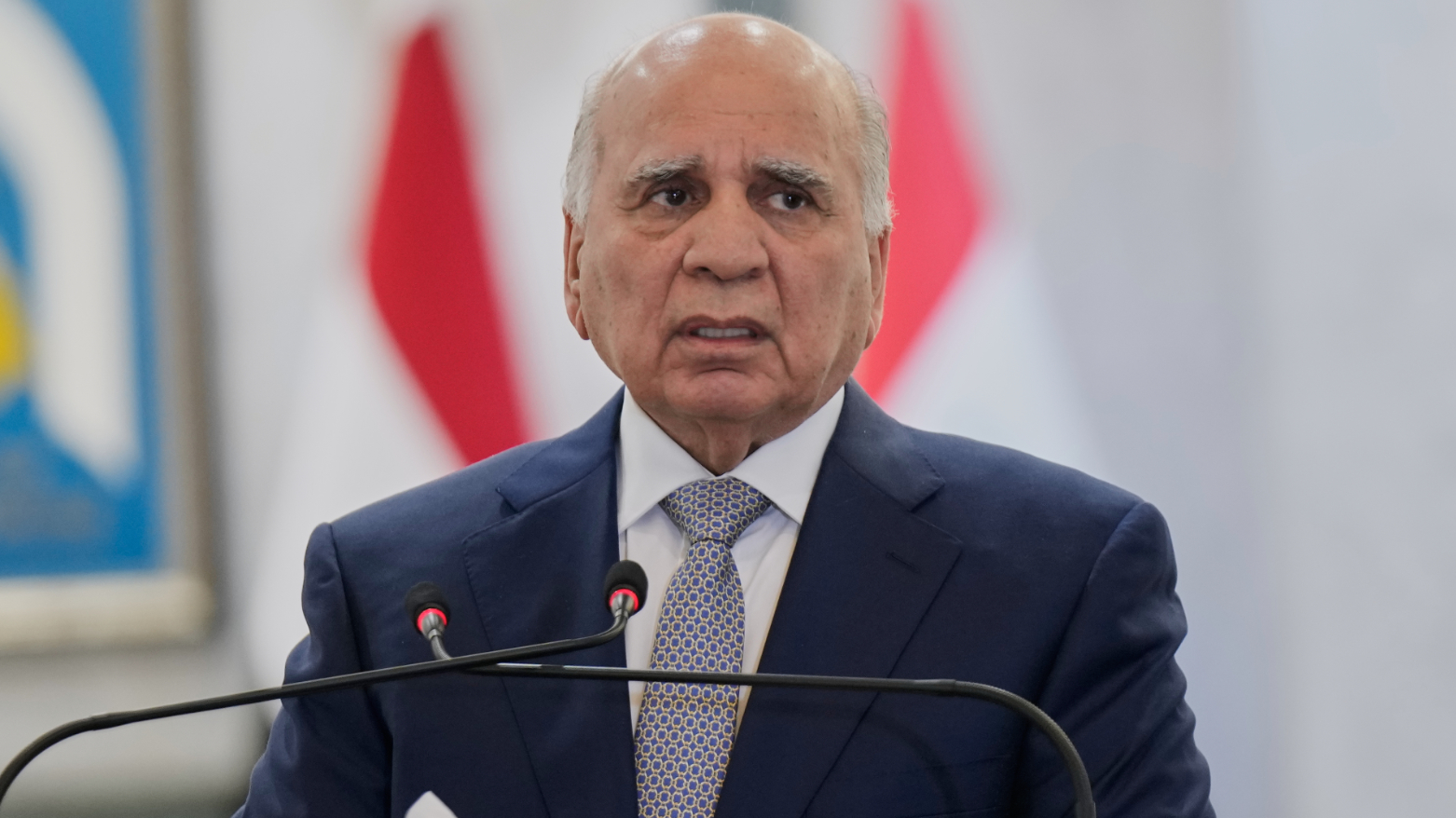
ERBIL (Kurdistan24) - Iraq has made significant progress in negotiations to bring weapons held by armed factions under state authority, Foreign Minister Fuad Hussein said, describing understandings with four groups while talks continue with two others amid mounting regional security and economic pressures.
In an interview with Al Jazeera discussed on Monday, Nov. 9, 2026, Hussein said Prime Minister Ali al-Zaidi was pursuing dialogue rather than confrontation to persuade armed organizations to surrender their weapons, enter the political process and integrate into state security institutions.
The minister identified Asaib Ahl al-Haq and Kataib Sayyid al-Shuhada among four factions with which the government had reached positive understandings.
Negotiations remain ongoing with Kataib Hezbollah and the Nujaba Movement, he said.
Hussein did not announce that the four factions had completed disarmament, nor did he provide an implementation timetable. His remarks concerned progress in discussions aimed at placing weapons under government control, rather than a completed transfer of arms.
Integration into institutions such as the Popular Mobilization Forces was among the outcomes under discussion, he said, alongside participation in political life.
The terms of any future arrangements, including how they would be implemented, were not specified.
State Authority and Cross-Border Security
The foreign minister presented the negotiations as part of a broader policy of strengthening the state's authority while preventing Iraq from becoming a launchpad for attacks on its neighbors.
He reiterated Baghdad's constitutional rejection of using Iraqi territory to strike neighboring countries and said investigations were continuing into attacks against Saudi Arabia originating from border areas.
He also dismissed allegations that armed groups were assembling to move toward Kuwait, calling the reports baseless.
These efforts, Hussein argued, require political dialogue with armed factions and coordination with surrounding countries.
Bringing weapons under state control remains a central objective, but the government is seeking an agreement that avoids renewed internal fighting.
The foreign minister also addressed security along the Syrian frontier, denying reports of an Iraqi military buildup directed at Damascus. He said additional border measures were intended to restrict the movement of ISIS militants and drug-smuggling networks, not to threaten Syria.
Hussein described Baghdad's relations with Damascus as good and based on shared interests. He said officials from both countries were jointly reviewing questions involving detained militants.
According to the minister, Iraqi authorities hold approximately 168 to 180 Syrian convicts affiliated with al-Qaeda and ISIS.
Iraq has also received around 6,000 ISIS detainees transferred from facilities in Hasakah and nearby areas, with Syrians accounting for roughly half of that larger group.
Türkiye, Water and the PKK
Relations with Türkiye featured prominently in Hussein's account of Iraq's efforts to manage security and resources through cooperation.
He said a visit by Prime Minister al-Zaidi to Türkiye had produced an understanding linking projects intended to address Iraq's water shortages with continued oil exports through the Iraq-Türkiye pipeline.
Under the arrangement Hussein described, Turkish companies or government bodies would undertake water-management projects inside Iraq as oil shipments continued through the pipeline.
He said daily flows had increased gradually from around 20,000 to 30,000 barrels to approximately 260,000 barrels.
On the Kurdistan Workers' Party (PKK), Hussein characterized the issue as fundamentally an internal Turkish matter.
He said Baghdad supported Ankara's political initiative and negotiations and hoped discussions involving a possible amnesty would lead militants to lay down their weapons and withdraw from Iraqi territory.
He did not describe a completed agreement on a withdrawal or disarmament, instead expressing hope that the political process could produce those outcomes.
Economic Losses and Alternative Oil Routes
The foreign minister said regional warfare had inflicted losses of approximately $60 billion on Iraq, chiefly through disruptions to oil exports and maritime activity.
Hussein attributed the losses to restrictions affecting the Strait of Hormuz and the reluctance of shipping and insurance companies to use Basra's ports during the first four months of the conflict.
He said exports, normally around 3.3 million to 3.4 million barrels per day, had at times fallen to zero before alternative arrangements were introduced.
According to Hussein, Iraq subsequently resumed shipments through a maritime passage near Oman following understandings with Washington and Tehran, while the northern pipeline through Türkiye provided another export option.
He said the experience had accelerated plans to diversify the routes available for Iraqi oil. Baghdad has begun negotiations over potential pipeline connections through Jordan and Syria, reducing its dependence on a single southern maritime outlet.
The government is also seeking to reduce reliance on imported gas through electricity-grid connections with Gulf countries via Kuwait and with Jordan and Türkiye, Hussein said.
He presented these projects as part of longer-term efforts to improve economic resilience rather than measures already sufficient to offset every disruption.
Washington's Demands Over Iran Trade
Hussein also described pressure from the United States to restrict Iraq's economic ties with neighboring Iran.
He said the US Treasury had formally requested closure of all Iraq-Iran border crossings except two, including one in the Kurdistan Region.
Baghdad was continuing discussions with Washington because implementing such a broad restriction would be difficult and could damage Iraq's economy, he explained.
The minister valued annual bilateral trade with Iran at between $15 billion and $18 billion, including about $4 billion in gas purchases.
Those figures, he suggested, showed why the proposed border restrictions could have substantial consequences for commerce and energy supplies.
He did not announce that Iraq had accepted the American request or begun closing all the crossings identified in the proposal.
The issue places Baghdad between an important trading relationship with Tehran and Washington's efforts to intensify economic restrictions. Hussein framed the continuing discussions as an attempt to protect Iraqi interests while responding to pressure from the United States.
Investment, Governance and Diplomacy
On domestic economic policy, Hussein contrasted the pace of investment in Baghdad with that of the Kurdistan Region.
He attributed slower investment in the federal capital to the public sector's dominant role and centralized legislation dating from the Revolutionary Command Council period.
Such laws, he argued, sit uneasily with constitutional principles encouraging private enterprise. He also said efforts to recover funds lost through corruption were continuing and that recovered money was being transferred to a fund overseen by the Finance Ministry.
Hussein linked Iraq's international position to its ability to maintain working relationships with competing regional powers. He pointed to the Baghdad Conference and five rounds of Saudi-Iranian talks hosted by Iraq as examples of diplomacy intended to bring opposing sides together.
He also highlighted Iraq's presidency of the Organization of Islamic Cooperation as an avenue for regional engagement. In his assessment, Baghdad could play a greater role in maintaining stability if military operations across the region subsided.
Taken together, the minister's remarks portrayed a government trying to reduce the influence of armed factions, safeguard its borders and limit exposure to regional conflicts without cutting ties with important neighbors.
The clearest near-term test remains the weapons negotiations: Hussein reported understandings with four factions, but talks with others continue, and the practical steps needed to place their weapons under state control have yet to be detailed.