DEM Party Urges New Party Leader to Join Türkiye's Peace Process
Aysegul Dogan, spokesperson for the DEM Party, made the remarks during a press conference at the party's headquarters, where she addressed recent political developments, the peace process, judicial decisions targeting Kurdish politicians, and the situation of sick prisoners.
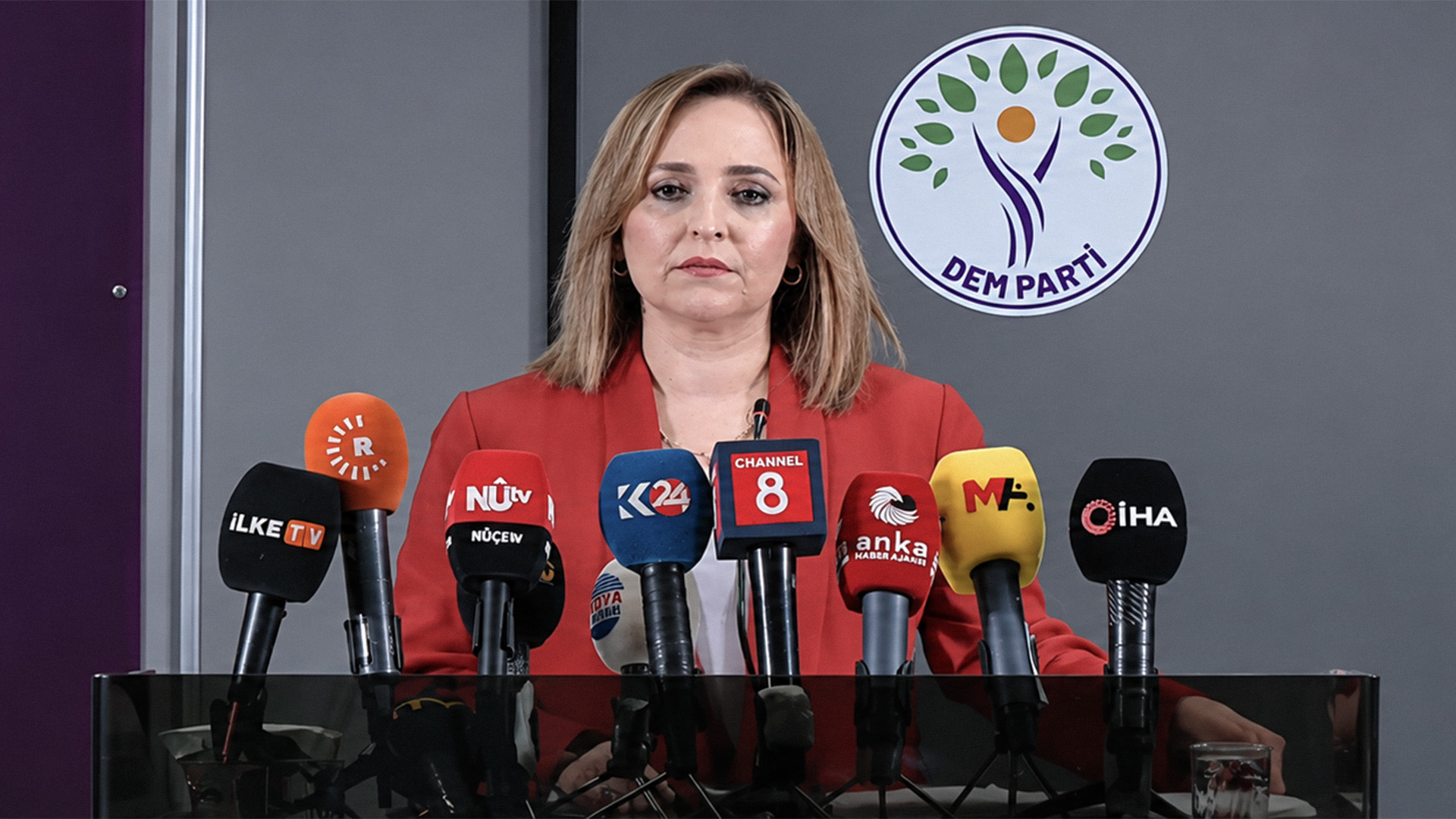
ERBIL (Kurdistan24) – The Peoples' Equality and Democracy Party (DEM Party) on Thursday urged New Party (Yeni Parti) leader Ozgur Ozel to reconsider his decision not to participate in a parliamentary commission monitoring Türkiye's peace process, stressing that all political parties should be represented in efforts to resolve the country's decades-long Kurdish conflict.
Aysegul Dogan, spokesperson for the DEM Party, made the remarks during a press conference at the party's headquarters, where she addressed recent political developments, the peace process, judicial decisions targeting Kurdish politicians, and the situation of sick prisoners.
Dogan said efforts to end the 50-year conflict must continue, emphasizing that the success of the peace and democratic society process depends on concrete steps toward democratization and confidence-building measures.
Responding to Ozel's decision not to appoint a representative to the parliamentary monitoring commission, Dogan warned that distancing political parties from the process could undermine public confidence and weaken efforts to achieve peace.
"For our party, there is no dilemma between peace and democracy. They complement each other and cannot be separated," she said, adding that turning democratic demands into a source of suspicion would weaken society's commitment to peace.
The proposed commission is expected to be established following parliament's approval of a framework law by 467 votes. Dogan noted that 54 lawmakers had voted against the legislation.
She also recalled that last year, when a parliamentary delegation visited Imrali Island, the Republican People's Party (CHP) did not appoint a representative to join the delegation.
Dogan said Ozel's latest decision not to participate in the monitoring commission risked creating the impression that his party did not want to be associated with the peace process.
She urged Ozel and his New Party to reconsider their position, stressing that the main opposition should be represented at the table from the outset.
"Otherwise, this will be interpreted as a lack of political engagement and an absence of proposals for resolving the Kurdish issue and advancing democracy," she added.
Dogan also criticized the lack of a clear timetable for establishing the monitoring commission, although preparations were reportedly nearing completion. She welcomed Turkish Parliament Speaker Numan Kurtulmus's position that neither the government nor the opposition should exploit the process for political gain.
Dogan stressed that Abdullah Ocalan should participate in the delegation in his capacity as its coordinator, describing him as a key figure in coordinating peace and democratization efforts.
The DEM Party spokesperson also condemned recent arrests and judicial decisions, including an appeals court ruling upholding a 19-year-and-six-month prison sentence against Hakkari (Colemerg) Co-Mayor Sıddık Akış and the continued appointment of government trustees to municipalities governed by her party.
Dogan strongly criticized the raid on Belki Publishing House in Diyarbakir, the arrest of lawyers affiliated with the Contemporary Lawyers Association in Izmir, and restrictions on access to media outlets.
"On the one hand, peace and democratization are being discussed, while on the other, the Kurdish people's deepest wound — their language being taken away — is being inflicted. If pressure on the Kurdish language does not end, how can the peace and democratic society process move forward?" she asked.
Dogan also raised concerns about the critical health conditions of sick prisoners, highlighting an ongoing sit-in by prisoners' relatives, human rights advocates, and lawmakers outside the Justice Ministry.
She referred to the death of sick prisoner Tuncer Saglam, saying that despite applications seeking his release and the postponement of his sentence, the public prosecutor had failed to respond.
"Choosing not to save a person's life when it is possible to do so is a political decision," she said.
Dogan also cited the cases of Evin Zapsu, who has stage-four cancer and is held at Kayseri Bünyan Prison, and Newroz Bozkurt, who suffers from chronic blood cancer and is held at Sincan Prison.
She stressed that the state bears direct responsibility for prisoners' lives and must guarantee their right to life and access to healthcare, adding that requests for their release must not be delayed.